
The Printmaker Who Attacks the Plate: The Hardware-Store Approach to Editions of Jim Dine
Jim Dine doesn’t so much make a print as assault one. He grinds plates with power tools. He scrapes and rubs paper raw to raise new textures. He layers etching over woodcut over hand-coloring, then rubs turpentine into the whole mess and starts again. For an artist who grew up surrounded by his father’s hardware store inventory — hammers, C-clamps, saws — that physical, tool-driven aggression toward the printmaking surface isn’t a stylistic flourish. It’s the same relationship to material he’s had since childhood, just redirected at a copper plate instead of a workbench.
From Happenings to a Thousand Prints
Dine arrived in New York in 1959 in the thick of a genuinely radical downtown art scene, and spent the early part of his career associated with performance-based Happenings before his work evolved through the 1960s toward a sustained focus on painting, drawing, and printmaking. What followed was one of the most prolific print careers of the postwar era: Dine has made more than 1,000 etchings, lithographs, and woodcuts over the course of his career, with some accounts putting the number closer to 900 distinct prints — an output so vast that a museum has literally hosted an exhibition titled “Jim Dine: A Life in Print” built entirely around surveying it. He made his first prints in 1960 at the Pratt Graphic Art Center, and Tatyana Grosman herself invited him among the earliest group of artists to work at her legendary printshop, Universal Limited Art Editions — meaning Dine was embedded in the modern American fine-print revival practically from its opening chapter.
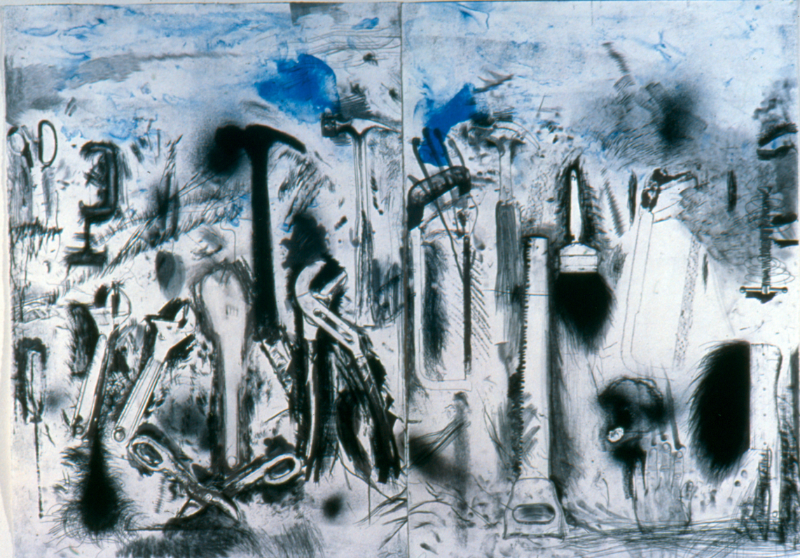
The Sky in Madison, WI (2004)
Jim Dine
Tandem Press
An Education Built to Break the Rules
Part of what made Dine such a restless printmaker traces back to how he actually learned the medium. Under printmaking teacher Donald Roberts, Dine experimented across lithography, etching, intaglio, dry paint, and woodcut all at once — never settling into a single technical specialty the way many printmakers do early in their training. That broad, simultaneous exposure meant Dine never internalized the idea that a print had to commit to one process from start to finish. Combining techniques wasn’t a later, sophisticated development in his career. It was baked in from the beginning.
Combining Everything, on Purpose
Where most printmakers pick one medium per work — etching, lithography, or woodcut — Dine does the opposite: he mixes one with another, and keeps adding more of his own invention on top. A single recent print, as one dealer catalog describes, might combine hand coloring and drawing on top of woodcut, etching, and power-tool drypoint, worked across multiple sheets of heavyweight paper hinged together — a genuinely hybrid object that no single printmaking term adequately describes.
That hybridizing habit shows up across his catalog again and again. One eight-part work exists as a series of woodcut monoprints on dyed Japanese paper; another combines etching, spit-bite aquatint, mechanical abrasion drypoint, and polishing across five sheets stretching over eight feet wide; a diptych pairs woodcut, drypoint, and monotype with hand coloring on one side against a different paper entirely on the other. Dine isn’t choosing a technique to suit an image. He’s stacking techniques until the image arrives at something none of them could produce alone.
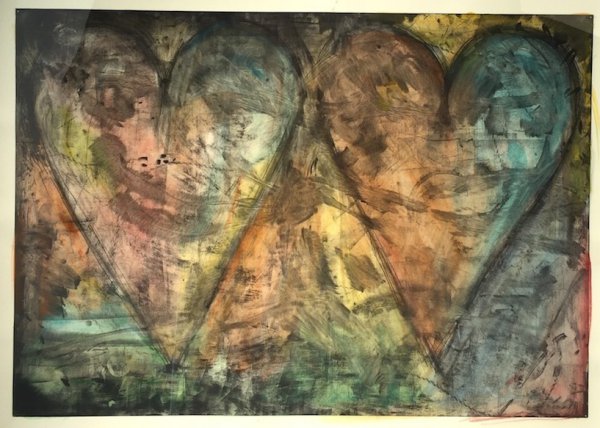
Watercolored By Jim (2015)
Jim Dine
Gregg Shienbaum Fine Art
Power Tools, Scraped Plates, and Turpentine Rags
The physical violence of Dine’s process is well documented by curators who’ve studied his working method up close. His experimental approach to the medium involves combining various techniques while frequently using power tools to grind the plate, scraping and rubbing the paper to raise new textures, and, in the words of one museum’s own description, essentially “attacking” the work through a series of spontaneous actions. That’s not metaphorical. Dine has described the actual sequence of steps behind some of his prints in almost recipe-like detail: hand-coloring over a black-and-white woodcut, printing the block a second time over the color he’s just painted on, then taking a rag soaked in turpentine and rubbing it across the whole print, before finally laying an etching over the top of everything.
Read that sequence closely and it becomes clear Dine treats the technically “finished” print state as merely a checkpoint, not an endpoint. Each additional layer of destruction — the turpentine rag, the power sander, the mechanical abrasion drypoint — is a deliberate reintroduction of chance and damage into an already-completed image, precisely because a too-controlled surface stops interesting him.
Inventing a Technique Over a Glass of Wine
Some of Dine’s most idiosyncratic contributions to printmaking’s technical vocabulary emerged from conversation rather than solitary studio experimentation. His cardboard intaglio technique — which produces a soft effect closer to a charcoal drawing than a typical etched line — came directly out of a discussion with Austrian printmaker Kurt Zein in a heurigen, a wine-bar in a vineyard outside Vienna. Dine asked Zein, over the season’s new wine, whether they couldn’t make an etching that looked like a charcoal drawing; months later, Zein worked out the solution. That anecdote captures something essential about how Dine approaches technical innovation in printmaking generally — not as solitary formal research, but as a genuinely collaborative, almost social process of posing a problem to someone with the right expertise and letting the answer emerge from the relationship.
The Crommelynck Partnership: “He Taught Me Everything I Know”
No collaborator shaped Dine’s technical range more than master printmaker Aldo Crommelynck, who worked with him for years and produced more than 100 prints together, including the ambitious Nancy Outside in July series of twenty-five aquatints and etchings made between 1977 and 1981. Dine’s own assessment of the relationship leaves little room for false modesty about how much he owed the printer: “He taught me everything I know about etching.” Their partnership was close enough that Dine later donated a nearly complete set of the Nancy Outside in July prints to the Bibliothèque nationale de France, and after Crommelynck’s death, a small press published Dine’s own reminiscences of their collaboration alongside a signed portrait etching made in his memory.
That kind of tribute is rare in the printmaking world, and it underscores how central technical partnership was to Dine’s practice. His power-tool aggression toward the plate needed, paradoxically, a master craftsman’s patience and precision standing right alongside him to actually pull it off.
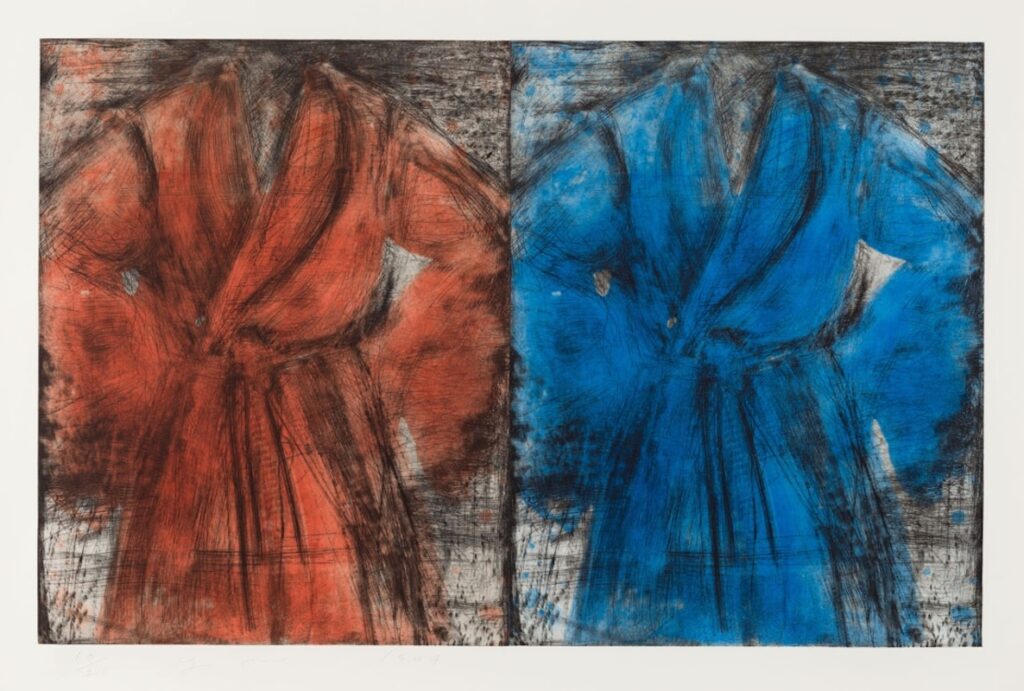
Red And Blue Robe (1999)
Jim Dine
Michael Lisi/Contemporary Art
The Same Objects, Endlessly Reworked
Underneath all that technical variety sits a tight, deeply personal set of recurring subjects — tools, hearts, bathrobes, skulls, the Venus de Milo — charged with private meaning and explored in serial variation across media, sometimes over decades. His use of hearts in particular runs through his whole body of work as a deeply personal, multifaceted motif, while the recurring bathrobe image — most famously realized as a large-scale woodcut — traces back to an advertisement Dine spotted decades earlier and never stopped returning to.
That serial habit maps directly onto his technical restlessness. A single subject like a heart or a bathrobe becomes an occasion to try yet another combination of woodcut, etching, and hand-finishing, so the recurring image functions almost like a control variable in an ongoing experiment — the same way Thiebaud or Diebenkorn used a constant subject to isolate what a shift in medium actually changed. For Dine, though, the changes stack rather than isolate: each pass adds another layer of process onto the same beloved object, until a bathrobe or a heart carries the visible residue of a dozen different technical decisions at once.
His Influence: Printmaking as Contact Sport
Dine’s real contribution to the medium’s later reputation is a simple but consequential idea: that a print didn’t have to protect its own surface. Where classical printmaking prized a clean, controlled pull from a well-prepared plate, Dine treated the plate and the paper as materials to be fought with — sanded, soaked, scraped, and recombined until the image bore visible evidence of the struggle. That combative, maximalist attitude toward technique helped widen what later printmakers felt licensed to attempt, encouraging a generation of artists to treat “mixed technique” not as a compromise but as a legitimate, even preferable, way of working.
His decades-long, prolific relationship with master printers like Crommelynck also modeled something important about the craft side of contemporary printmaking: that an artist’s most experimental, boundary-breaking ideas often still depend on a technician’s deep expertise to actually survive contact with the plate. Dine’s nearly one thousand prints stand as proof that raw physical aggression and refined craftsmanship aren’t opposites in printmaking — they’re collaborators.
The Takeaway
Jim Dine never treated the print studio as a place to behave. He brought a hardware store’s worth of tools, a habit of destroying and rebuilding the same surface repeatedly, and a genuine appetite for technical collaboration to a medium that, in less restless hands, might have stayed comparatively tidy. Nearly a thousand prints later, the throughline is unmistakable: for Dine, a finished print was never really finished — just paused, waiting for the next power tool, the next rag of turpentine, the next layer.