
The Backwards Kingdom: What Printmaking Teaches Every Artist Who Dares to Slow Down
There’s a peculiar humility built into the printmaking process that no other medium quite demands. A painter can chase a mistake around the canvas forever, layering over doubt until it disappears. A printmaker has to commit – carve, etch, ink, pull – and then live with what the plate gives back. This built-in distance between intention and result is exactly why printmaking has quietly shaped how some of history’s sharpest artistic minds thought about their own work. Here’s what the medium has been whispering to artists for over 500 years.
You Are Always Working in Reverse (And That’s the Point)
Every printmaker learns this the hard way: what you carve is not what you get. Text runs backwards. Compositions flip. A hand raised on the right becomes a hand raised on the left the moment it hits paper. Albrecht Dürer, arguably the medium’s first true virtuoso, built an entire visual language around this constraint in the late 1400s and early 1500s, mentally mirroring his workshop drawings before they ever touched a woodblock.
The lesson embedded here isn’t really about mirror image – it’s about learning to see your own work from outside itself. Printmaking forces artists to develop a kind of double vision, holding both the intended image and its inverse simultaneously in the mind. Painters who take up printmaking often report this skill bleeding back into their canvases: an improved instinct for stepping back, flipping a composition mentally, checking if it still holds up from an unfamiliar angle. The medium trains you to distrust your first, most comfortable point of view.
Ed Ruscha’s printmaking practice is almost a case study in this kind of self-scrutiny. Ruscha came to prints already obsessed with words as objects – flat, graphic, oddly detached from their own meaning – and the medium’s demand for precision only sharpened that obsession. Working with master printers on lithographs and screenprints throughout the 1960s and beyond, he treated typography the way a printmaker treats a plate: as something to be flipped, tested, and re-tested until the gap between what a word says and what it looks like became the actual subject of the piece. Prints gave Ruscha a laboratory for testing whether an image could survive translation, reversal, and repetition and still land with the same deadpan punch.
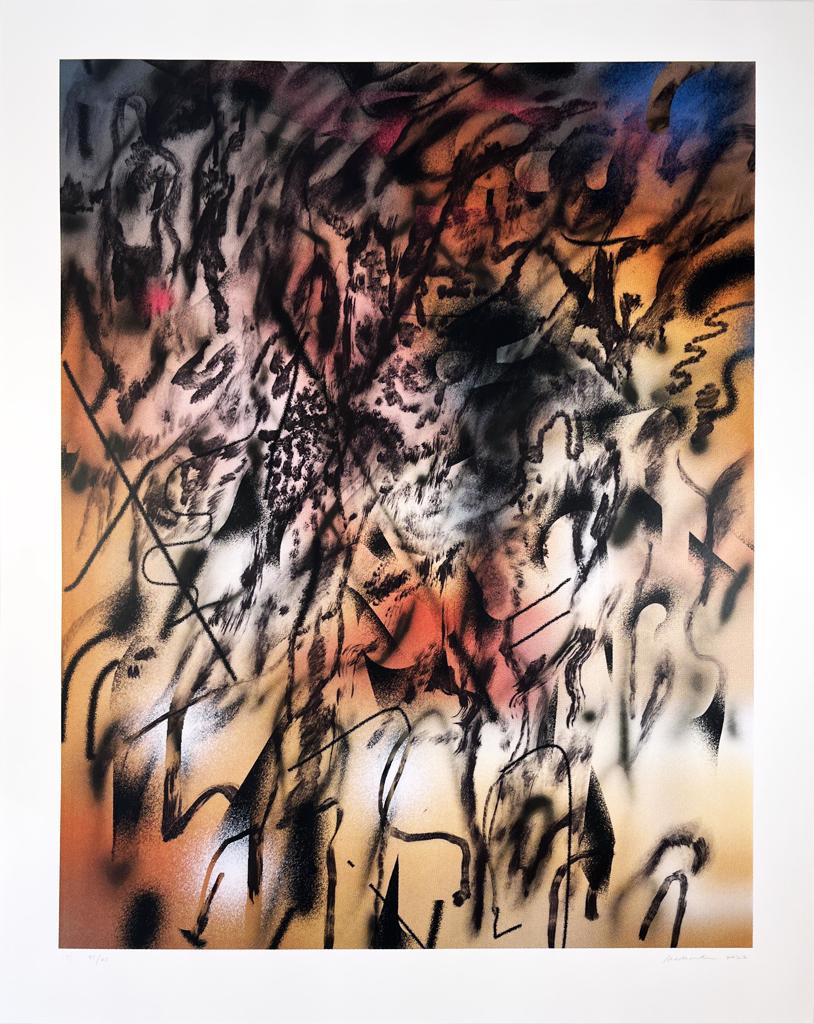
Corner of Lake and Minnehaha (2022)
Julie Mehretu
Hamilton-Selway Fine Art
The Plate Remembers Everything You Did to It
Unlike a canvas, which can absorb infinite revision, an etching plate or woodblock keeps a record. Every scratch, every over-bitten line in the acid bath, every slip of the burin stays there, printing again and again unless physically removed. Rembrandt understood this better than anyone – he reworked his copper plates obsessively across states, and because collectors saved impressions from each stage, we can watch him think in real time, correcting, deepening, sometimes ruining and rescuing a single image across a decade.
This is printmaking’s brutal gift: it makes your process visible and permanent in a way brushwork rarely does. It teaches artists that every mark is a decision with consequences, and that “fixing” something later doesn’t erase what came before – it just adds another layer of history on top. There’s a discipline that grows out of this. You start making marks like they matter, because on a plate, they genuinely do.
Julie Mehretu’s work with Crown Point Press pushes this idea into wildly dense territory. Her paintings are famous for their layered, storm-system accumulation of marks – architectural fragments, gestural swoops, faint grids buried under more grids. Translating that sensibility into etching means confronting the plate’s memory directly: aquatint tones, drypoint scratches, and multiple states of biting all have to be sequenced with real foresight, because each layer changes what the next layer can do. Mehretro’s prints reveal something her paintings sometimes obscure – the actual order of operations behind the density, the way accumulation is not chaos but a carefully staged argument built one irreversible layer at a time.
Multiplicity Is Not the Enemy of Meaning
For centuries, “original” and “unique” were treated as synonyms in the art world, which made prints – deliberately repeatable by design – something of an aesthetic outlaw. But printmakers discovered early that repetition doesn’t dilute meaning; it can concentrate it. Käthe Kollwitz’s woodcuts and lithographs of grief and war gained power precisely because they could circulate widely, reaching working-class audiences a single unique painting never could. The multiple wasn’t a lesser cousin of the original – it was the point.
Andy Warhol later blew this idea wide open, using screenprinting’s mechanical repetition to interrogate fame, consumption, and the flattening effect of mass media itself. What printmaking teaches here is a genuinely radical idea for artists steeped in the myth of the singular masterpiece: that meaning can live in variation and accumulation, not just in uniqueness. Ten imperfect impressions of the same image can say something a single perfect one cannot.
Ruscha belongs in this conversation too, but from a different angle. His print editions of gas stations, parking lots, and Hollywood signage treated the vernacular American landscape as something worth mass-producing precisely because it was already mass-produced in the culture – motels, logos, roadside grammar. By making multiples of these subjects, Ruscha collapsed the distance between “fine art” and the printed ephemera it was depicting, letting the medium’s built-in repeatability comment on a culture already saturated with repeated imagery.
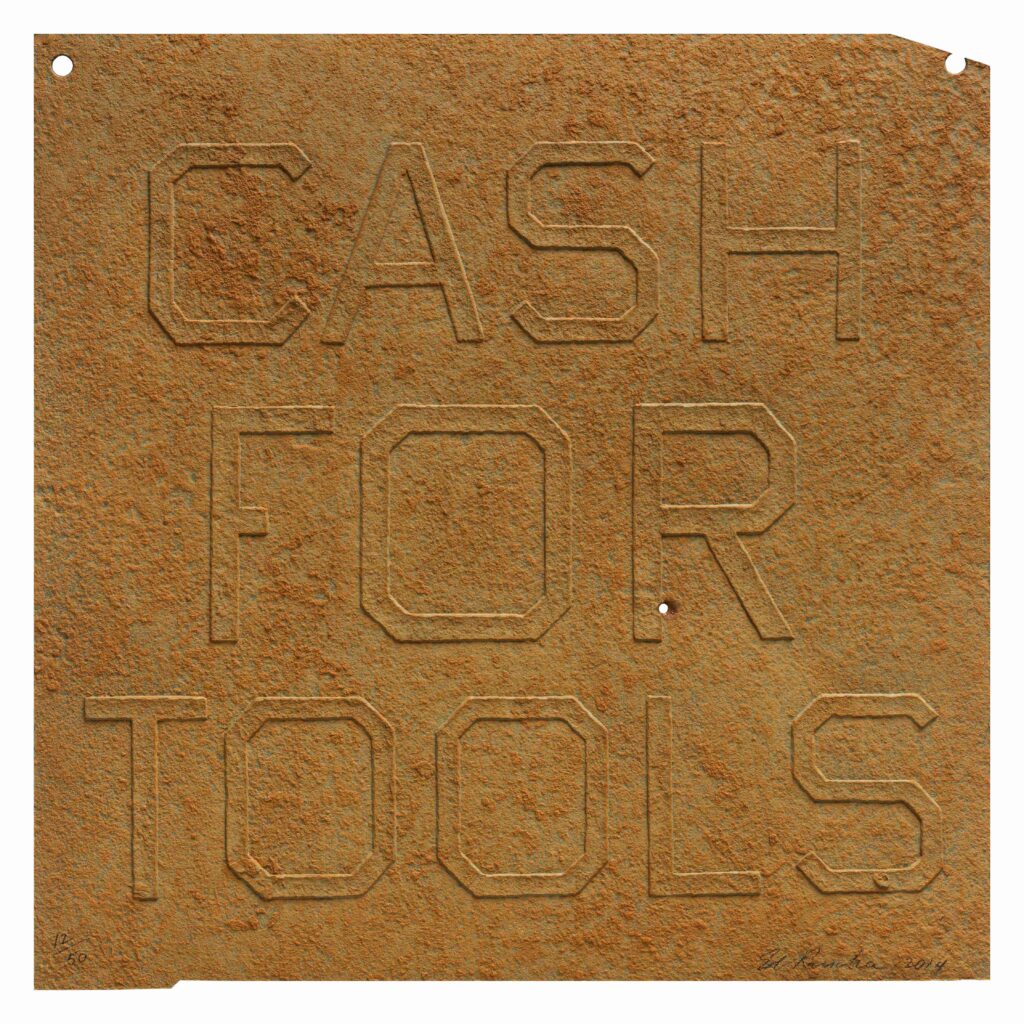
Rusty Signs: Cash for Tools 1 (2014)
Ed Ruscha
Mixografia
Constraints Are Where the Interesting Decisions Live
A woodcut only really wants to give you bold, high-contrast shapes. An etching favors linear, atmospheric delicacy. A lithograph responds to the greasy intimacy of a crayon dragged across stone. Each printmaking technique arrives with a built-in personality, and it pushes back against whatever the artist wants to force onto it. Katsushika Hokusai’s ukiyo-e woodblock prints, including the Great Wave, weren’t fighting the medium’s flatness and limited palette – they were built entirely around those limits, turning restriction into a signature visual rhythm.
This is printmaking’s quiet argument against the romantic idea that total freedom produces the best art. Limitation forces invention. Artists who move between printmaking techniques often describe a heightened sensitivity to material voice in general – a sense that every medium, including paint or clay, has its own resistances worth listening to rather than overriding.
Anish Kapoor’s relationship to printmaking makes this especially vivid, because his primary practice – vast, voidlike sculptures in stone, pigment, and mirrored steel – depends so heavily on physical depth and reflected light, exactly the qualities a flat sheet of paper cannot offer. Working in etching and aquatint has forced Kapoor to translate his signature sense of bottomless space into something achieved purely through tonal gradation and the pooling of ink, without any of sculpture’s actual dimensionality to lean on. The constraint doesn’t defeat the idea of the void; it re-poses the question of how to suggest infinite depth using only the printmaker’s oldest trick – controlling how dark a dark can get, and how it fades.
Failure Is Data, Not Disaster
Because the printmaking process has so many discrete, semi-irreversible stages – carving, biting the plate in acid, inking, registering paper, pulling the print – there are countless places for something to go wrong, and it usually does. Printmakers develop an unusually pragmatic relationship with failure as a result. A botched plate isn’t necessarily dead; it’s information. Many artists, Rembrandt included, deliberately reworked “failed” states into something stranger and better, treating error as raw material rather than a dead end.
This iterative, state-by-state mentality – proof, evaluate, adjust, proof again – is essentially the scientific method wearing an artist’s smock. It’s a mindset that rewards detachment from any single attempt and rewards process over precious outcome, a lesson many artists say permanently recalibrated how they handle mistakes across every medium they touch. Mehretu’s editions are known to go through numerous proof states before she’s satisfied, each one a working document of what the density needed to become legible rather than merely chaotic – proof that even highly controlled, maximalist work depends on a willingness to fail in public, one impression at a time.
The Hand and the Machine Have Always Been Negotiating
From the wooden press to the etching acid bath to the photographic screens Warhol adopted for silkscreening, printmaking has always sat at the friction point between manual craft and mechanical or chemical process. It was arguably the first major art form to force artists to reckon seriously with the question: where does authorship live when a machine, a chemical reaction, or a technician’s hand is doing part of the work?
That question has never felt more relevant than it does right now, as artists confront new tools reshaping how images get made. Printmaking’s centuries-long history of artists collaborating with – rather than being replaced by – process and technology offers a useful, hard-won precedent: the tool doesn’t dilute the vision, as long as the artist stays the one asking the questions.
Printmaking has never been the flashiest discipline in art history’s hall of fame. It doesn’t have painting’s immediacy or sculpture’s physical presence. But it may be the medium that has taught artists the most about how to think – about reversal, permanence, repetition, constraint, failure, and collaboration with process itself. Whether it’s Ruscha testing how far a word can be flattened before it breaks, Kapoor chasing the void through nothing but ink density, or Mehretu building storms of mark-making one irreversible layer at a time, the lesson holds steady across five centuries: every plate pulled through a press carries a small lesson about patience and consequence that ripples outward into everything else an artist makes.