
The Japanese Got It Right: What Ukiyo-e Can Teach the Western Art World About Respecting Prints
A Tale of Two Hierarchies
Walk into almost any major Western museum and the architecture of value reveals itself before you read a single label. Paintings hang in soaring, sky-lit galleries. Sculptures command the center of the room. Prints – if you can find them at all – wait in low-lit side rooms, viewed by appointment, handled with white gloves as if their fragility were the only thing that mattered about them.
Now walk into a museum’s Japanese art wing. Hokusai’s Great Wave doesn’t apologize for being a woodblock print. It doesn’t sit in a basement. It sits at the center of the cultural imagination — reproduced on phone cases, tattooed on forearms, hanging in the Met with the same reverence given to a Vermeer.
Something happened in the West that never happened in Japan. Prints became “lesser.” In Japan, they simply never were.
When a Print Was the Point, Not the Compromise
To understand why ukiyo-e never carried the stigma that haunts Western printmaking, you have to understand what it was built to do. The term ukiyo-e translates roughly to “pictures of the floating world” – a phrase that captures the genre’s obsession with the fleeting pleasures of Edo-period urban life: actors, courtesans, landscapes, seasons, gossip, beauty.
This was popular art, made for a popular audience, and that was never treated as a flaw. A single ukiyo-e print might cost about the same as a bowl of noodles. It was meant to be bought by merchants, collected by travelers, traded among friends, and yes – eventually used as packing material, which is famously how so many ended up in Europe in the first place.
The point is this: the intended audience shaped the cultural status of the medium. Ukiyo-e was never trying to be a painting’s poor cousin. It was its own art form, judged on its own terms, excellent at the thing it set out to do.
Western printmaking, by contrast, has spent centuries being measured against painting and found wanting – a comparison nobody asked the prints to win, and one they were never designed to enter.
The Atelier System: Division of Labor, Not Division of Worth
Here’s where the comparison gets genuinely instructive for collectors today. A traditional ukiyo-e print wasn’t the work of a single hand. It was a collaboration between an artist (eshi) who created the design, a carver (horishi) who translated it into woodblocks, a printer (surishi) who applied ink and pressure, and a publisher (hanmoto) who financed and distributed the whole operation.
In the West, this kind of division of labor is often cited as the very reason prints get demoted – “it’s not really by the artist’s hand,” the thinking goes, “so it’s not really art.” In Japan, the same division of labor was simply understood as how the medium worked. Nobody thought Hiroshige’s landscapes were diminished because a carver’s blade gave them their final lines. The collaboration was the craft.
This is the lesson Western collectors still haven’t fully absorbed: a print’s value was never supposed to rest on the myth of the solitary genius touching every inch of the surface. It rests on vision, mastery of process, and the integrity of the final image – exactly the standards we already apply to architecture, filmmaking, and fashion without anyone calling those lesser arts.
See it for yourself: Woodland Meadows (1917) by Gustave Baumann, available through Annex Galleries, is a direct descendant of this lineage. Baumann was one of the Western artists who studied the colour woodblock tradition closely, and the result is the kind of dense, glowing, layered green stillness that only comes from genuine carving-and-printing mastery – proof that the technique travelled west far more successfully than the respect for it did.
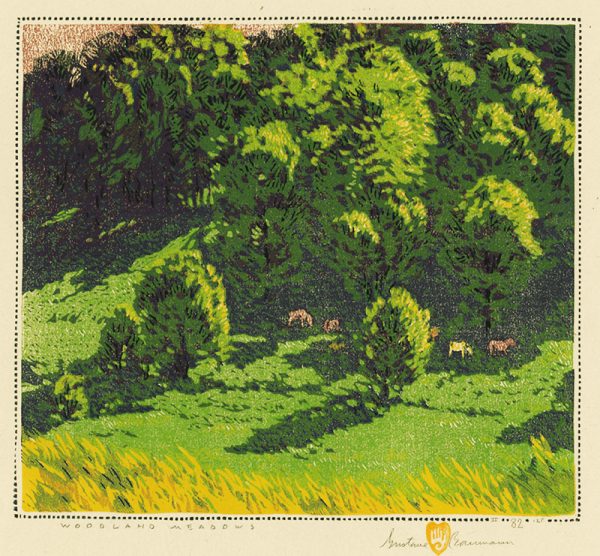
Woodland Meadows, 1917, Gustave Baumann, Annex Galleries
Editions Without Apology
Western art history has spent two centuries quietly insisting that uniqueness equals value – that a one-of-a-kind object is inherently more serious than a multiple. Ukiyo-e never absorbed that anxiety. A popular print might be issued in editions of several thousand, struck and re-struck as woodblocks wore down and were occasionally recarved, sold for a price most households could afford.
And critically – nobody pretended otherwise. There was no fiction of preciousness layered on top of a fundamentally reproducible medium. The honesty of the form was part of its appeal. Multiplicity wasn’t a compromise to be hidden; it was the entire mechanism by which great design reached great numbers of people.
Compare that to the often-tortured language Western print markets still use – “limited edition,” “artist’s proof,” “destroyed plate” — phrases that exist largely to manufacture scarcity and borrow legitimacy from the unique-object model. Ukiyo-e suggests an alternative: prints don’t need to imitate painting’s scarcity logic to be taken seriously. They can simply be brilliant on their own terms.
See it for yourself: Mickey Mouse (FS II.265) by Andy Warhol, available through Revolver Gallery, is the closest thing the West has to its own ukiyo-e moment. Warhol ran his studio like a workshop, not a shrine to the solitary hand, and he never pretended his screenprints were anything other than multiples. He simply trusted that the image – and the process behind it – could carry the weight of “serious art” without needing to borrow painting’s scarcity myths.
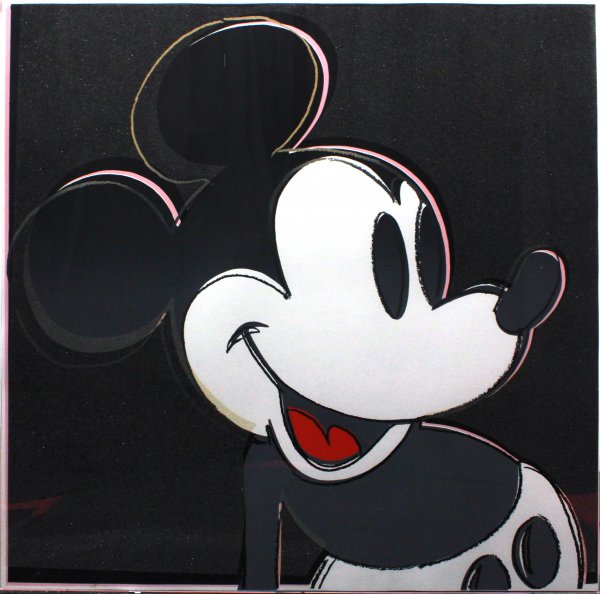
Mickey Mouse (FS II. 265), 1981, Andy Warhol, Revolver Gallery
The Irony That Should Embarrass Western Art History
Here’s the twist that makes this whole conversation almost uncomfortable: Western art already learned to love ukiyo-e – passionately, transformatively – without ever extending that same respect to its own printmaking tradition.
When Japanese prints flooded into Europe in the mid-1800s, they didn’t just charm collectors. They rewired the visual language of Western painting itself. Manet, Degas, Monet, and Van Gogh studied ukiyo-e’s flattened perspective, cropped compositions, and bold outlines with genuine devotion – a movement art historians call Japonisme. Van Gogh didn’t just admire these prints; he copied them directly, hung them on his studio walls, and credited them with reshaping how he saw colour and line.
So the West fell in love with a print tradition, absorbed its innovations into the “serious” medium of painting – and then continued treating its own printmakers, working in etching, lithography, and engraving, as second-tier artists. The hierarchy survived even the evidence that should have dismantled it.
What This Means for Collectors Today
This isn’t just art history trivia – it’s a roadmap for anyone building a collection in 2026.
Judge the medium on its own terms. A great lithograph doesn’t need to resemble a painting to be taken seriously. Ask what the process makes possible – the texture of a woodcut, the tonal range of a mezzotint, the flatness of a screenprint – rather than what it’s missing compared to oil on canvas.
Stop fetishising the solitary hand. Some of history’s most significant prints were collaborative by design. Picasso worked closely with master printers. Warhol ran an actual factory. The collaboration is the craft, not a discount on authorship.
Recognize that accessibility was always a feature, not a bug. Ukiyo-e proves that art made to be affordable and widely owned can still be canon-defining, museum-worthy, and historically pivotal. A lower price point doesn’t ask you to lower your expectations.
Remember who actually shaped modern art. The next time someone implies prints are a lesser category, point them toward a wall of Impressionist paintings — and remind them what was pinned to the studio walls that inspired them.
The Floating World Was Never Beneath Anyone
Ukiyo-e didn’t need three centuries and a market correction to earn respect. It commanded the cultural conversation the moment it existed, because nobody had told it to feel small. The West built an entire hierarchy that asked prints to apologise for not being paintings – and then imported a print tradition that never got the memo, fell head over heels for it, and somehow still didn’t think to ask why.
Maybe it’s time we did.