There is a moment that every serious collector knows. You are standing in front of a print – perhaps in a gallery, perhaps on a screen at half past ten on a Sunday morning – and something shifts. It is not the feeling of wanting to own something. It is the feeling of recognising something. Of understanding, on a level that bypasses logic entirely, that this work needs to exist in the world, and that you are the person who can help it do so. That moment is not commerce. It is something far older, and far more significant. It is the beginning of an act of cultural stewardship that most people never think to name, because they are too busy calling it shopping.
It is not shopping. And the distinction matters enormously – not just philosophically, but practically, for the artists whose careers depend on it.
Sound 9, 1997, Yoshishige Furukawa
The Artist Cannot Survive on Admiration Alone
We have built a culture that professes to love art whilst doing very little to sustain the people who make it. We follow artists on Instagram. We attend private views and drink the warm wine and nod appreciatively. We share images of work we find beautiful and move on. But admiration, however sincere, does not pay a studio rent. It does not fund the next body of work. It does not give an artist the financial ground beneath their feet that allows them to take risks, to fail productively, to push into territory that no one has yet mapped.
Editions exist, in large part, to solve this problem. When an artist works with a master printer to produce a limited edition, they are not diluting their practice — they are extending it. They are creating a mechanism by which their work can reach beyond the gallery system and into the hands of people who genuinely want to live with it. When you buy that print, you close the loop. You become the economic infrastructure that makes the next work possible.
Every Collection Is an Act of Cultural Opinion
To collect is to take a position. It is to say, in the most concrete terms available: this matters. This artist, this moment, this particular way of seeing the world deserves to be preserved and remembered. Museums perform this function on behalf of institutions and nations, but private collectors have always been the more nimble, more prescient force in the shaping of art history. They move faster than curators. They respond to what is alive in the present tense rather than what has already been ratified by consensus and committee.
The prints on your walls are not decorative choices in the way that a sofa or a rug is a decorative choice. They are a record of your cultural judgement – a visible argument, made in the language of objects, about what you believe has value. Taken together over a lifetime, a collection becomes something extraordinary: a self-portrait, a manifesto, and a gift to whoever comes after you. It reflects not just your taste, but your attentiveness – your willingness to pay close enough attention to the world to notice who is doing something genuinely new within it.
Prints Are Where the Canon Gets Written
It is worth pausing to remember that many of the artists now considered canonical were, at one point, available as editions at prices that seemed ambitious to the cautious and self-evident to the brave. David Hockney, Bridget Riley, Tracey Emin – these names now carry the full weight of art history and institutional validation. But there were collectors, decades ago, who bought their prints not because they knew with certainty what would happen, but because they trusted what they felt when they looked. That trust was itself a form of cultural contribution. By committing early, those collectors helped construct the reputations that the museums and the auction houses later confirmed.
This is not to reduce collecting to speculation, or to suggest that the point is to second-guess the market. The collector who buys with one eye permanently fixed on resale value almost always misses the point, and usually misses the best works too. The works that appreciate most meaningfully tend to be the ones that were acquired out of genuine connection, not calculation. But there is something worth acknowledging in the fact that supporting artists at the right moment – when their vision is fully formed but the world has not yet caught up with it – is one of the most consequential things a person can do within a living art ecosystem.
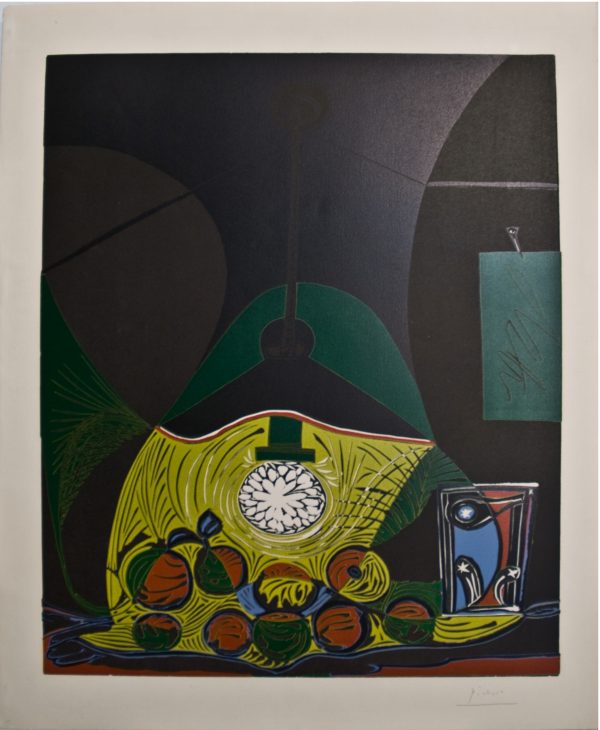
Nature morte à la suspension, 1962, Pablo Picasso
The Quiet Power of Living With Art
There is also something that no investment case, however compelling, can fully account for: the daily experience of living with a work you love. A great print is not a static thing. It changes with the light, with your mood, with the accumulation of years. You notice things in it on an ordinary Tuesday morning that you missed entirely when you first brought it home. It asks questions of you that you are only ready to answer later. This is not what objects do. It is what companions do.
The works we choose to live with shape us in ways we rarely articulate. They set a tone for a room and, by extension, for the thinking that happens within it. They signal, to everyone who enters, something true about who you are and what you find worthy of sustained attention. In that sense, collecting is less about acquisition and more about curation – of your home, yes, but also of your inner life.
What You Leave Behind
There is a long tradition, particularly in British collecting, of thinking about what one’s collection will do after one is gone. Bequests to galleries, gifts to public institutions, works passed down through families with the stories still attached — these are the gestures through which private passion becomes public culture. The print you buy today may, in thirty years, be the work that introduces your grandchild to an artist whose importance has by then become undeniable. Or it may be the gift that allows a regional museum to represent a movement it could not otherwise afford. Or it may simply remain on a wall, doing the quiet work that great art has always done: making whoever looks at it feel less alone.
None of this is shopping. Shopping is the acquisition of things that serve you. Collecting, at its best, is the act of serving something larger than yourself – the ongoing, precarious, irreplaceable project of keeping visual culture alive. The print is not the end of that story. It is where it begins.