
Bon à Tirer, The Secret Standard: Why the Rarest Thing in Art Is Not a Painting
A proof before the edition is more rare than most paintings — the “bon à tirer” (good to pull) is the artist’s own handpicked standard — one exists per series, ever.
Before the Edition, There Was the Moment of Yes
Somewhere in a flat file drawer in a museum storage room, wrapped in acid-free tissue and catalogued with the kind of reverence usually reserved for relics, there is a single sheet of paper. It looks, at first glance, like every other impression in the edition. Same ink. Same image. Same dimensions. But in the margin – usually bottom left, sometimes bottom right, occasionally in a hurried hand that suggests the artist was already moving on to the next thing — are three small words in French.
Bon à tirer.
Good to pull.
It is the artist’s own declaration that this impression – this exact one, among all the test pulls and false starts and almost-rights – is the standard against which every subsequent print in the edition must be measured. The printer keeps it on the press bench. Every pull that follows is held against it. When the edition is complete, the bon à tirer doesn’t go to a collector. It doesn’t get numbered and sold. It goes to the printer as a record, or into an archive, or – in some of the most significant cases in art history – into a museum collection as a work of extraordinary rarity.
There is one per edition. One. Ever.
Think about that against the mythology of painting. A Picasso painting is rare because Picasso made it once. A bon à tirer proof is rare because Picasso looked at every possible version of the image, chose the one that was exactly right, wrote three words on it, and then moved on. The painting is the destination. The bon à tirer is the standard by which everything else is judged.
Most People Have the Whole Story Backwards
Here is the assumption most people carry: paintings are the real art. Prints are reproductions. Drawings are sketches. The hierarchy feels settled, obvious, unquestionable.
It is also almost entirely wrong.
For most of Western art history – from Dürer’s workshop in the 1490s through to the explosion of lithography in the nineteenth century – the print wasn’t the reproduction of a painting. It was the publication of an idea. The painting might hang in a church or a palace, seen by hundreds of people over its lifetime. The print crossed borders, changed hands, was folded into pockets, read by candlelight, passed between scholars, tacked to walls, pressed into devotional books.
The painting stayed. The print moved.
When Raphael wanted Europe to know what he was capable of, he didn’t send paintings. He collaborated with the engraver Marcantonio Raimondi to produce prints after his compositions, and those prints made him famous from Rome to Antwerp to London – cities where his paintings would never travel. The prints weren’t lesser versions of the paintings. They were the mechanism by which the paintings mattered at all.
The bon à tirer exists because this publication of an idea had to be right. The standard had to be set. A thousand impressions might go out into the world, and every single one of them had to meet the mark that the artist had set with those three words.
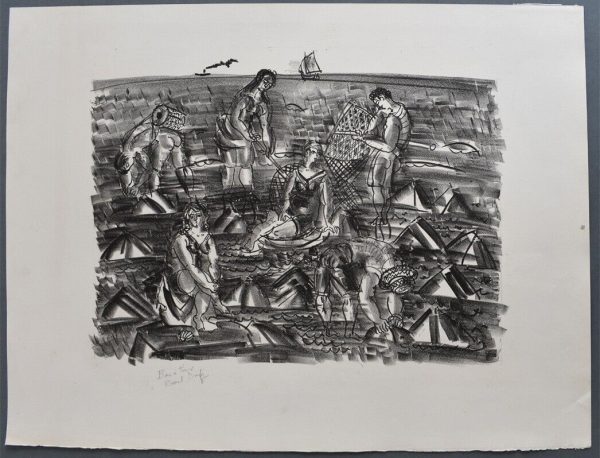
Pêcheurs de crevettes, (Bon à Tirer), Raoul Dufy, Sylvan Cole Gallery
The Print Was Meant to Be Touched
There is something almost heretical about touching a painting. You don’t touch the Mona Lisa. You don’t touch a Vermeer. The distance between viewer and painted surface is not accidental – it is structural, built into centuries of framing, hanging, guarding, and eventually alarming.
Prints were made for hands.
A devotional woodcut in the fifteenth century was pressed into the palm of a pilgrim as a souvenir of faith. A broadside print was handed across a market stall, folded in thirds, shoved into a coat. Rembrandt’s etchings – among the most studied and collected prints in the world – were handled by their first owners with the same easy familiarity that we bring to a letter. They were rolled, stacked, kept in portfolios that were passed around drawing rooms like books.
The intimacy was the point.
When an artist pulls a bon à tirer, they are holding it the same way. They are looking at it close, tilting it toward the light, running their eye across the ink. The standard being set is not a standard of display. It is a standard of presence – how the image looks and feels and reads in the hand of someone paying close attention. The bon à tirer is the most handled impression of all. It lives at the press, consulted again and again, held up as the thing every subsequent pull must become.
No painting has ever served that function.
Rembrandt Understood This Better Than Anyone
Rembrandt van Rijn produced more than three hundred etchings. He also produced somewhere between six hundred and nine hundred paintings – art historians are still sorting it out – and he cared intensely about both. But the way he worked in printmaking reveals something about his understanding of the medium that painters rarely reach.
He reworked his plates. Obsessively. The Three Crosses exists in four distinct states, each one darker, more dramatic, more theologically weighted than the last. Christ Healing the Sick – known as the Hundred Guilder Print because of the price it fetched in his own lifetime – was pulled in multiple states as Rembrandt refined the image across years of returning to the plate.
Each state produced its own working proofs. Each required its own moment of decision: is this it? Is this the one? The rarest impressions of Rembrandt’s prints are not the ones in the largest editions. They are the working proofs and early state impressions that show the image in the process of becoming itself – the pulled impressions that predate the bon à tirer, when the standard hadn’t yet been set because the image hadn’t yet been found.
Collectors who understand this will pay more for an early working proof of a Rembrandt etching than for a late-edition impression of one of his smaller paintings. They are not wrong to do so. What they are paying for is proximity to the moment of decision – the moment before the bon à tirer, when the artist was still working out what the image needed to be.
The Edition Number Is About Integrity, Not Scarcity
The contemporary art market has turned edition numbers into a mechanism of scarcity: lower numbers suggest higher value, smaller editions command higher prices. This is partly a marketing construct and only partly connected to the original logic of the edition.
The original logic was integrity.
When an artist sets an edition – declares that there will be, say, thirty impressions of this print – they are making a promise about consistency. Every one of those thirty impressions will be held against the bon à tirer. Every one will meet the standard. The edition is a guarantee of quality, not a creation of artificial rarity.
The artist who burns the plate after the edition is complete is making an even stronger declaration. They are saying: these impressions are not just limited in number. They are the only impressions that will ever exist, because I have destroyed the means of making more. The destruction of the plate is the most emphatic endorsement of the edition’s integrity – a statement that the bon à tirer standard has been met thirty times, and now the standard itself is retired.
In a world where digital reproduction has made the concept of “limited” feel slightly absurd, printmaking’s physical logic stands apart. The plate wears. The stone degrades. The screen breaks down. An edition has natural limits built into the material – the bon à tirer exists not just as a conceptual standard but as a record of what the image looked like when the plate was at its best.
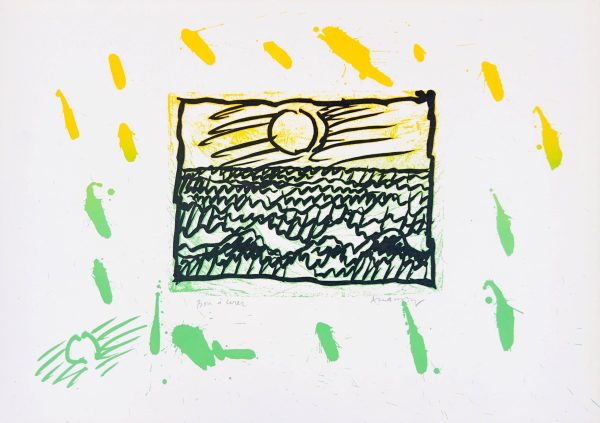
Lino-Litho, Planche VII (Bon à Tirer), Pierre Alechinsky, Epicentrum Art Gallery
Collectors Who Know, Buy Prints
The persistent myth that prints are lesser objects – “just reproductions,” “not original art,” “something you buy when you can’t afford the painting” – is a relatively recent invention, and it has very little to do with how artists and serious collectors have historically understood the medium.
Dürer considered his prints his most important work. Goya’s Los Caprichos and The Disasters of War are print series – they do not exist as paintings, because the print was the right form for what Goya needed to do: publish outrage, distribute horror, force the image into as many hands as possible. Toulouse-Lautrec’s posters are prints. Warhol’s most iconic images are prints. Hockney has spent significant portions of his career as a printmaker, and his print work is collected as seriously as his paintings.
What sophisticated collectors understand – and what the mythology of painting obscures — is that the choice of printmaking is always intentional. An artist who makes prints is not making a cheaper version of a painting. They are working in a medium with its own logic, its own history, its own forms of rarity. The bon à tirer proof is the clearest evidence of that intention: an artist who cares enough to set a standard, hold every impression against it, and release only the ones that pass.
One proof exists for each series. One standard was set. Everything that follows either meets it or doesn’t make it out of the studio.
That is not reproduction. That is exactitude.
What the Bon à Tirer Tells Us About Art
The bon à tirer is interesting as an art historical curiosity. It is more interesting as a way of understanding what artistic standards actually mean.
We talk a great deal about artistic vision – the painter’s eye, the sculptor’s hand, the composer’s ear. But vision without a standard is just preference. The bon à tirer is the moment when preference becomes standard, when the artist’s internal sense of rightness is externalised onto a single sheet of paper and held up as the measure of everything that follows.
It is, in this sense, one of the most honest documents in the history of art. Not a manifesto. Not an explanation. Just a print that the artist looked at and said: yes, this is right, everything else must be this.
One per edition. One per series. One per moment of absolute decision.
If you ever encounter one — in a museum study room, in an auction catalogue marked with those three French words – you are looking at something more specific than rarity. You are looking at the exact point where an artist stopped searching and started publishing.
That is worth understanding, and worth a great deal more than most people think.
The artists who have loved etching most have tended to be those for whom that accountability was not a constraint but a liberation – the discipline that allowed them to stop performing and simply say what they meant.