
How Much Is a Banksy Print Worth?
From £75 on a website nobody visited, to £18.6 million at Sotheby’s – and back to earth again. The full story of the most extraordinary price journey in contemporary art.
In the early 2000s, you could have bought a Banksy print for less than a decent dinner out. Most people didn’t. Those who did – even by accident, even just because they liked the image — went on to own one of the most remarkable investments in the history of the art market.
This is the story of how a print that cost £75 became worth a hundred thousand pounds. How a market born in Bristol back streets grew to turn over £35 million a year. How it peaked, crashed, and where it stands today – still very much alive, just considerably more sober.
Act One: £75 and No Waiting List (Early 2000s)
Banksy’s earliest prints were sold through Pictures on Walls, a London-based publisher he worked with from the early 2000s. The prices were deliberately, almost defiantly cheap. Unsigned prints went for £75. Signed editions – bearing his actual signature – cost £150. The idea was simple: art should be for everyone, not just people with private banking accounts.
And for a while, almost nobody bought them.
The buyers who did were largely fans of the Bristol street art scene, people who’d seen his stencils on walls and liked what they stood for. There was no investment thesis. There was no waiting list. There was just a website, a flat fee, and a rolled-up screenprint in a cardboard tube.
Girl with Balloon was released in this era – around 2004–2005 – at that same price: £75 unsigned, £150 signed. Today, a signed edition commands somewhere between £140,000 and £210,000. The unsigned version fetches £70,000–£100,000. The same print. The same paper. A completely different world.
The idea of the intentional mistake is older than printmaking itself – and it runs surprisingly deep through the craft. Whether it’s a spiritual belief, a technical philosophy, or a marketing masterstroke, artists and printmakers have been building imperfections into their work for centuries. Here’s why.
Act Two: The Slow Climb (2006–2015)
Banksy’s reputation began to grow in ways that couldn’t be ignored. The Exit Through the Gift Shop documentary arrived in 2010 – Oscar-nominated, widely seen, and brilliantly self-mythologising. His street interventions became international news events. His work appeared, uninvited, on the walls of the West Bank barrier. He hung fake pieces in major museums. He built Dismaland.
Each stunt fed the next. His prices climbed steadily but not yet dramatically. Between 2006 and 2015, unsigned prints were reaching £1,000–£5,000 at auction. Signed prints had moved into the £5,000–£25,000 range. Annual auction turnover across all Banksy print sales stood at around £1.2 million in 2015.
These were serious numbers – a genuine market had formed – but nothing to suggest what was coming.
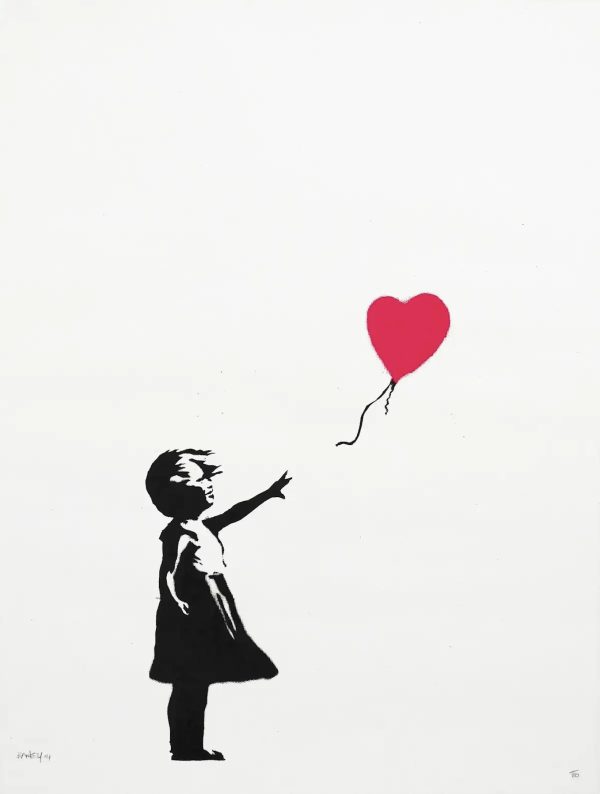
Girl With A Balloon (signed), 2004, Banksy
Act Three: The Stunt That Changed Everything (2018)
On 5 October 2018, at Sotheby’s London, a framed Girl with Balloon sold at auction for just over £1 million. Then, as the hammer fell, it fed itself through a hidden shredder built into the frame.
The room went silent. Then cameras came out. Within hours, it was the most talked-about moment in contemporary art in living memory.
Banksy had pre-installed the device years before, waiting for the right moment to pull it off. Whether he intended it to half-shred (and not fully destroy) the work is still debated. But the result was something nobody had anticipated: instead of destroying the value, the stunt created a new work – Love Is In The Bin – and amplified it.
When the original buyer returned that partially shredded canvas to auction in October 2021, it sold for £18.6 million. The most expensive Banksy ever sold. An artwork literally created live on the auction floor had become priceless.
It wasn’t just a stunt. It was the spark for a bonfire.
Act Four: The Fever Years (2019–2021)
What followed 2018 was the most extraordinary period of growth any print market had seen in decades. The shredding made Banksy globally famous in a new, broader way. Lockdown-era conditions amplified it further: people stuck at home, money saved on holidays and restaurants, an entirely new cohort of online bidders.
The numbers were staggering:
2020: Annual sales value grew by 262%. Average prices surged 183% in a single year.
2021: The market turned over £35.2 million — nearly 30 times the 2015 figure.
2021: Game Changer, his painting of a nurse as a superhero created during COVID-19, raised £16.8 million for the NHS at Christie’s — bidding opened at £1.6 million and didn’t stop for 15 minutes.
2021: Girl with Balloon — Colour AP (Gold) achieved £900,000 at Sotheby’s.
2021: Over 996 lots appeared at auction — up from 153 in 2015.
In 2020 and 2021, Banksy’s average sale price exceeded that of Andy Warhol. Prints that had sold for £50 in the early 2000s were trading for 1,000 times that figure. The price index peaked in May 2021, at more than three times its 2019 level.
It was a frenzy. And like all frenzies, it couldn’t last.
Act Five: The Correction (2022–2024)
Markets that climb at 262% a year don’t sustain that pace. By 2022, the correction had begun. Average prices fell. Unsold rates at auction — historically around 7–10% — climbed to 29–33% by 2023–2024. Trading volume contracted from 996 lots to 575.
By 2024, annual turnover had fallen to approximately £6 million — an 83% drop from the 2021 peak.
Brutal numbers, on paper. But context tells a different story.
That £6 million is still five times the 2015 figure. The collectors who bought in the early 2000s at £150 still hold assets worth tens or hundreds of thousands. The 2021 peak was anomalous — a perfect storm of celebrity, pandemic liquidity, and speculative momentum. The market didn’t fail; it overheated and then cooled.
What emerged from the correction was a more selective, more discerning market. Iconic imagery continued to perform. Lesser-known works stalled. Unsigned prints — cheaper, more liquid — attracted strong bidding even as the top tier softened. Girl with Balloon appeared at auction at least eleven times in 2024, selling successfully on nine occasions. The core demand never went away; the speculation did.
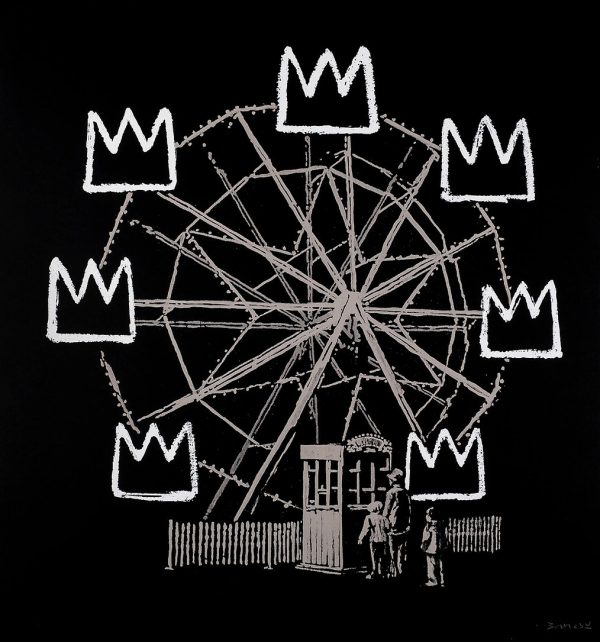
Banksquiat (Black), 2019, Banksy
Where the Market Stands Today (2025–2026)
The Banksy print market in 2026 is characterised by the word its specialists keep reaching for: stabilisation.
Pricing has normalised into more sustainable ranges. Signed editions of the most recognisable images – Flower Thrower, Girl with Balloon, Choose Your Weapon, Kate Moss – continue to command serious premiums, typically £60,000–£200,000 or more depending on the variant. Unsigned prints of well-known images trade actively at £15,000–£60,000. Lesser-known works, or prints without impeccable Pest Control authentication, can sit unsold for months.
A few reference points from recent sales:
Banksquiat averaged around £47,500 across seven auction sales in 2024.
Flower Thrower Triptych sold at Phillips London in January 2025 for £120,650.
Unsigned prints continue to be the most active segment, reflecting demand for accessible authenticated works.
Interestingly, a major Reuters investigation into Banksy’s identity – published in March 2026 and disputed by his representatives – has added fresh public attention to a market already showing signs of renewed activity. Whether that translates to sustained price growth remains to be seen.
The Long View
Wherever the market goes next, the trajectory of Banksy prints is one of the most remarkable in the history of collected objects. A £75 print that becomes worth £100,000 is not a footnote. It is a fundamental story about how cultural relevance, scarcity, and timing create value from almost nothing.
The early buyers were not shrewd investors. They just liked what the work said. The market’s extraordinary growth – and its subsequent correction – happened to them, around them, and sometimes despite them.
The lesson, if there is one, is the same as it has always been in art collecting: understand what you’re buying, authenticate it rigorously, and don’t mistake a mania for a floor. The 2021 peak was not the natural resting price of a Banksy print. Neither, probably, is today’s.
What those £75 prints from a forgotten website in 2003 tell us is that value – real, lasting value – tends to find art that earns it. Banksy earned it. The market just couldn’t agree on the price.
Prices referenced are based on public auction data and secondary market reporting up to early 2026. Always consult a specialist and verify Pest Control authentication before buying or selling.