
Intaglio Printing Pulling Ink From Below the Surface
There is a moment, standing in front of a Rembrandt etching in a museum, when you realise something is different about what you’re looking at. The lines are too alive. The shadows too warm. The thing seems to breathe in a way a photograph never could. You lean in closer and notice the ink itself sits proud of the paper, raised like a whisper you can almost hear. You are standing in front of an intaglio print, and it has been quietly ruining all other art for you without your permission.
Intaglio is one of the oldest and most extraordinary printmaking techniques in human history, and yet most people walk past examples of it every single day without knowing what they’re seeing. If you’ve ever held a banknote up to the light and felt the crisp, slightly raised text under your fingertip, you’ve touched intaglio printing. If you’ve ever been stopped cold by an old engraving in an antique shop and couldn’t quite explain why it felt so different from a poster or a photocopy, intaglio is your answer.
The Technique That Defies Common Sense
Every other form of printing works by putting ink onto a surface and pressing it against paper. Intaglio does the opposite, and that reversal is where everything interesting begins. The artist takes a metal plate, traditionally copper or zinc, and works directly into its surface. They might drag a sharp steel tool called a burin across the metal to carve clean, precise lines in a process known as engraving. They might coat the plate in a waxy ground, draw through it with a needle to expose the metal beneath, and then submerge the whole thing in acid, which bites into the exposed lines and eats them deeper into the plate in a process called etching. They might skip the acid entirely and work directly onto the bare metal with a sharp needle, dragging it across the surface to raise a ragged, feathery burr that holds ink in a uniquely soft and velvety way – that is drypoint, the most immediate and intimate of all intaglio techniques, a process so direct it is practically drawing. Or they might work with a mezzotint rocker, a toothed tool that roughens the entire surface of the plate into a burr capable of holding vast quantities of ink, building an image from rich, smoky darkness toward light. Each technique produces a different quality of line, a different emotional temperature, a different conversation between the artist’s hand and the resistant metal.
Aquatint deserves a moment of its own because it solves a problem the other techniques cannot. Engraving, etching, and drypoint all excel at line, but tone — the soft graduation of shadow across an open sky, the velvety darkness of a shadow without visible marks — requires something different. In aquatint, the artist dusts the plate with fine particles of rosin, then heats it so the resin melts and bonds to the metal in a fine, irregular grain. When the plate is placed in acid, the acid bites around each tiny rosin particle, creating a texture that holds ink as an even, granular tone rather than a line. By stopping out areas of the plate with varnish at different stages of the biting, the artist builds up a range of tones from pale grey to near black. Goya understood aquatint as few artists before or since have, using it to conjure the murk of night, the flat terror of an open field, the suffocating weight of darkness pressing against a single candle flame. When you see a print with that particular quality of atmospheric shadow that seems to absorb light rather than reflect it, you are almost certainly looking at aquatint.
Once the plate is worked, ink is pushed across its entire surface and then carefully wiped away. What remains is only the ink trapped inside the incised lines and textures, sitting below the surface of the plate, invisible until the moment of printing. A sheet of dampened paper is laid over the plate. Both are fed through a printing press under enormous pressure, sometimes several tonnes of it. The damp paper fibres are forced down into every groove, every scratch, every bitten line, and when the paper and plate are separated, the ink comes away with the paper, standing slightly above its surface in a ridge you can see and feel. The image has not been stamped onto the paper. It has been drawn out of the metal.
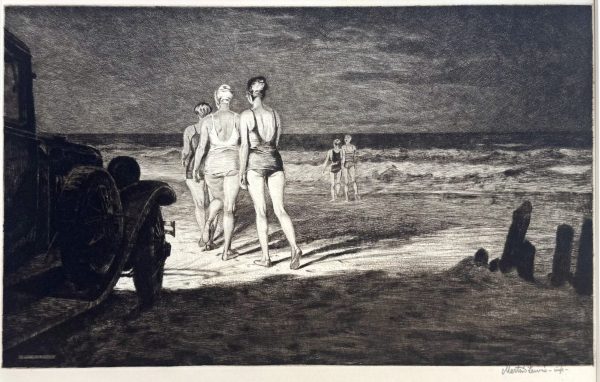
Down to the Sea at Night (1929), Drypint, Martin Lewis, Catherine Burns Fine Art
Why the Hand of the Artist Is Still in Every Print
One of the great misunderstandings about printmaking is that it is somehow less personal than a unique painting or drawing, that something is lost in the act of making multiples. With intaglio, the opposite is true. Every mark on the plate was made directly by the artist. The pressure of their hand, the speed of their stroke, the hesitation or confidence of their line, all of it is preserved in the metal and transferred faithfully to every print pulled from it. When you look at a Dürer engraving and marvel at the impossible fineness of the hatching, the way light seems to curl around a fold of cloth, you are seeing the result of a hand moving a tool across copper with extraordinary control and intention. No filter. No intermediary. Just the artist, the metal, and the mark.
This is also why intaglio prints age so beautifully. The ink, held in those grooves under pressure, bonds with the paper in a way that surface-printed inks rarely do. A well-made etching on good paper, stored reasonably well, can look as fresh after four hundred years as it did the day it was printed. There are etchings by Rembrandt pulling in prices that would embarrass most contemporary paintings, not because they are rare objects in the way a unique painting is, but because they are genuinely, physically extraordinary things. The market has simply noticed what your fingertip already knew.
From Rembrandt to Right Now
Intaglio has a lineage that runs through some of the most significant names in Western art. Albrecht Dürer used engraving to achieve a precision and symbolic density that left contemporaries speechless. Rembrandt van Rijn turned etching into a medium for capturing light, emotion, and the full spectrum of human experience with a freedom that painting couldn’t match. Francisco Goya used aquatint, a tonal intaglio process that creates rich, atmospheric grains of shadow, to produce his Disasters of War series, images so raw and unflinching they still shock today. William Hogarth used engraving to satirise Georgian society and reach an audience no painter could. These artists didn’t turn to intaglio because it was fashionable. They turned to it because it could do things nothing else could.
Contemporary artists continue to find intaglio indispensable for exactly the same reasons. There is a current generation of printmakers working in studios from East London to Brooklyn to Tokyo who are producing intaglio work that is as urgent and relevant as anything being made in any medium. They are combining centuries-old techniques with new imagery, new politics, new ways of seeing. They are making prints of extraordinary beauty and meaning, in editions that remain genuinely accessible compared to the prices commanded by unique works on canvas. The tradition has never really had a fallow period, because the technique itself refuses to become obsolete.
The Thing About Owning One
Here is something printmaking culture has always understood that the broader art market is sometimes slow to admit. An editioned print, signed and numbered by the artist, is not a lesser object than a unique work. It is a different object, with its own logic, its own value, its own way of meaning. Every print in an edition of twenty was made with equal care. The artist was present for each one. The plate that made your print made all the others, yes, but the plate also bears the artist’s marks as directly as any canvas. When you own an intaglio print, you own something the artist made with their hands. The fact that twenty people might own the same image does not dilute that. It distributes it, which is rather the whole point.
And the physical quality of a well-made intaglio print in your hands is simply unlike anything else you can hang on a wall. The slight platemark pressed into the paper, the rectangular ghost of the metal that held the image. The ink that you can feel if you dare to run a careful fingertip across the surface. The paper itself, often beautiful, sometimes handmade, chosen by the artist for the way it would take the ink. These are objects made to be close to, made to reward attention, made to live with rather than be glanced at. They look different in morning light than afternoon light. They reveal new details the longer you live with them. They are, in the very best sense, inexhaustible.
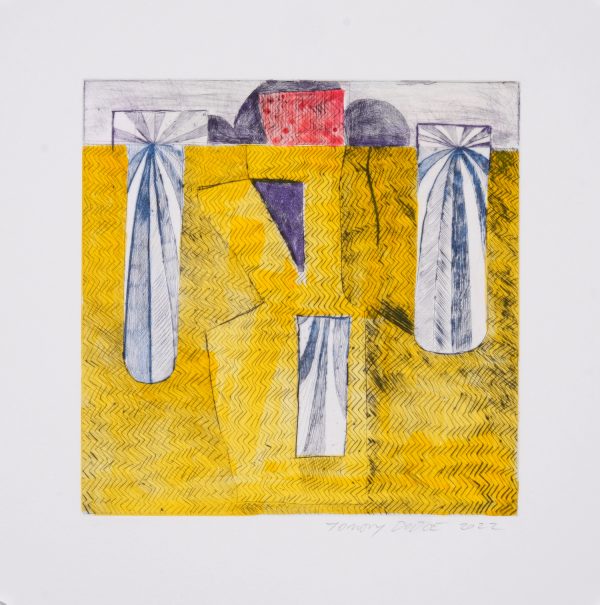
Untitled (2022), Etching & Drypoint, Tomory Dodge, Flying Horse Editions
Where to Start
If intaglio has caught your attention, the best first move is simply to go and look at some in person. Major museums almost always have significant print collections, and many of them rotate works from storage specifically to give prints the visibility they deserve. Stand close. Look at the edges of the plate mark. Notice whether the ink sits above the paper surface. Give yourself permission to spend twenty minutes with a single small etching. The experience is different from every other encounter with art, quieter, more intimate, more like being handed a letter than shown a monument.
When you are ready to buy, seek out printmakers who are working in the medium now. There are dedicated print fairs, online platforms that focus specifically on original prints, and studio open days where you can meet the artist, see the press, understand the process. Editions of contemporary intaglio work by serious artists can begin at prices that might surprise you, not because the work is cheap, but because printmakers have traditionally believed their work should reach people. You can own something genuinely extraordinary without extraordinary means.
Intaglio printing has survived five hundred years because it offers something irreplaceable: the direct trace of a hand working against resistant material, preserved in metal, transferred to paper under pressure, and sent out into the world to be touched and looked at and lived with. Every print is a small proof that beauty can be pulled up from below the surface of things. Once you know that, you start to see it everywhere.