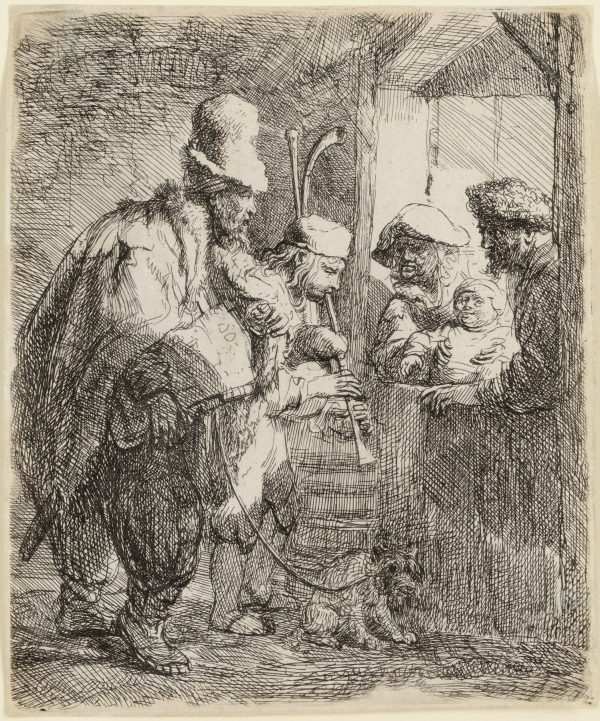
Hand someone an etching by Rembrandt van Rijn and tell them it exists in twenty known impressions, and watch the subtle recalibration happen in real time. The eyes soften slightly. The enthusiasm adjusts. It’s not the original, goes the unspoken calculation. It’s one of several. The fact that Rembrandt pulled that sheet through the press himself – that the scratches in the copper plate were made by his own hand, that he reworked and refined the image across multiple states with extraordinary intentionality – registers less than the simple, damning fact of its plurality.
This is the scarcity illusion at work. And it shapes how we think about value, creativity, and ownership far more than most of us realise.
The Strolling Musicians (1635), Harmensz van Rijn Rembrandt
The Hierarchy We Never Chose
Somewhere in our cultural wiring, a clear hierarchy took hold: unique objects sit at the top, multiples below. A painting outranks a print. A prototype outranks a production model. The one-off commands reverence; the edition attracts a discount. This hierarchy feels so natural that we rarely think to interrogate it – we simply apply it.
But it is not a law of aesthetics. It is a social convention, and a relatively recent one at that. For much of art history, the print was not a lesser form of expression but simply a different one. It had its own techniques, its own demands, its own traditions of excellence. The multiple was not a degraded original. It was an object in its own right.
The assumption that repetition diminishes worth crept in gradually, shaped by the rise of the art market, by the logic of auction houses, and by the particular prestige economy of collecting. Once rarity became the primary driver of price, and price became shorthand for value, the multiple was structurally disadvantaged – not because it was worse, but because there was more of it.
What the Print Actually Is
Let us be precise about something that is routinely misunderstood: a fine art print is not a reproduction. It is not a poster. It is not a photograph of a painting run through a commercial printer and trimmed to size. A lithograph, an etching, a screenprint, a woodblock – each is a distinct medium with its own material logic, its own aesthetic possibilities, its own history of mastery.
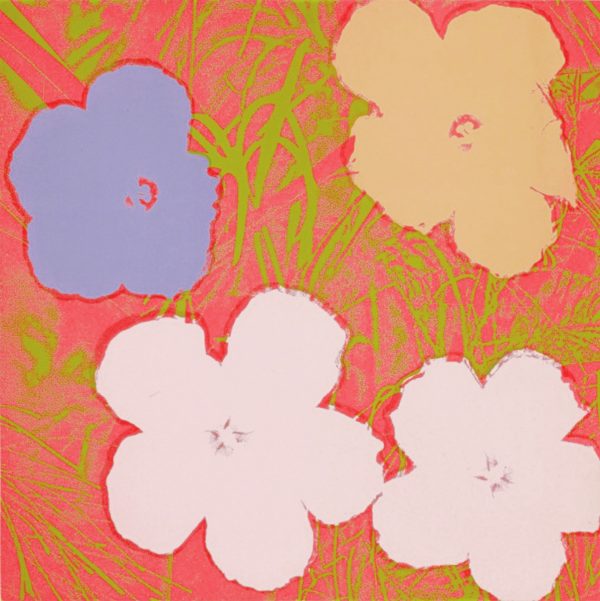
Toulouse-Lautrec did not make lithographs because he couldn’t find a canvas. He made them because the medium gave him something painting couldn’t – a particular flatness, a boldness of line, a relationship between image and paper that suited exactly what he was trying to do. Warhol’s screenprints were not his paintings simplified for mass consumption. They were a direct artistic statement about reproduction, celebrity, and the nature of the image itself. The multiple was the message.
To treat these works as inferior because they exist in editions is to fundamentally misread what the artist was doing.
The Trophy Problem
Much of the prejudice against multiples has nothing to do with aesthetics and everything to do with status. The unique object offers something an edition cannot: the certainty of possession. To own the one thing is to own what no one else can have. It is a trophy, and trophies derive their meaning from exclusivity.
This is a perfectly understandable human impulse. But it is worth being honest that it is a social impulse, not an artistic one. When a collector pays a significant premium for a unique work over an edition they consider equally beautiful, they are not making a purely aesthetic judgment. They are paying for the right to say: mine alone.
There is nothing wrong with that. But it should not be mistaken for a reliable guide to quality.
Flowers (FS II.69) (1970), Andy Warhol
The Democratic Ambition We Abandoned
Printmaking has, from its earliest days, carried a democratic intention. The whole point of the multiple – what made it radical in the fifteenth century and what makes it quietly radical still – is that it resists the concentration of meaningful work in the hands of the very few. The Dürer print in a merchant’s home showed the same image, expressed the same craft, embodied the same artistic intelligence as the impression in a royal collection. The number did not degrade the object. It distributed it.
That is not a bug. That is one of the most generous things art has ever done.
The Question Worth Asking
When we reflexively place the unique object above the multiple, we are often not responding to the work at all. We are responding to our own ideas about ownership, status, and what it means to have something others cannot.
The print on the wall may be every bit as considered, as skilled, as moving as the painting in the vault. The edition number at the bottom of the sheet is not a measure of artistic worth. It is simply a count.
And a count tells you very little about what something is actually worth.