
Camille Pissarro: How Restless Beginnings Forged a Printmaking Revolution
A Boy Between Two Worlds
Before he was the “father of Impressionism,” before the Salon rejections and the friendships with Cézanne, Monet, and Degas, Camille Pissarro was a Sephardic Jewish boy from a tiny Caribbean island who belonged nowhere completely. Born in 1830 in Charlotte Amalie on St. Thomas, he grew up the son of a French-Jewish merchant father and a Dominican-born mother, in a Danish colony, attending a school where Black, mixed-race, and white children sat side by side, an extraordinary rarity in the racially stratified Caribbean of the era.
This early experience of being perpetually slightly outside the dominant culture, too Jewish for French Catholic society, too colonial for Parisian sophistication, too radical eventually for the art establishment he sought entry into, would echo throughout his life. It’s tempting, and not unreasonable, to see in this restless positioning the seed of an artist who would later gravitate toward printmaking: a medium itself considered marginal, reproducible, and somehow less “serious” than painting in nineteenth-century hierarchies of art. Painting was for masters. Prints, in the popular imagination, were for everyone else. Pissarro, who never quite fit anywhere, found something honest in a medium that didn’t pretend to aristocratic exclusivity.
It’s worth pausing on just how unusual his childhood schooling was. In a century when racial hierarchy was law and custom across nearly every colonial territory, the multiracial classroom Pissarro sat in planted something that never fully left him: a baseline comfort with mixing, blending, and refusing rigid categories. Later in life, his prints would do something similar with technique itself, freely combining etching, drypoint, aquatint, and even monotype-like effects within a single plate, refusing to stay neatly within one medium’s “proper” boundaries.
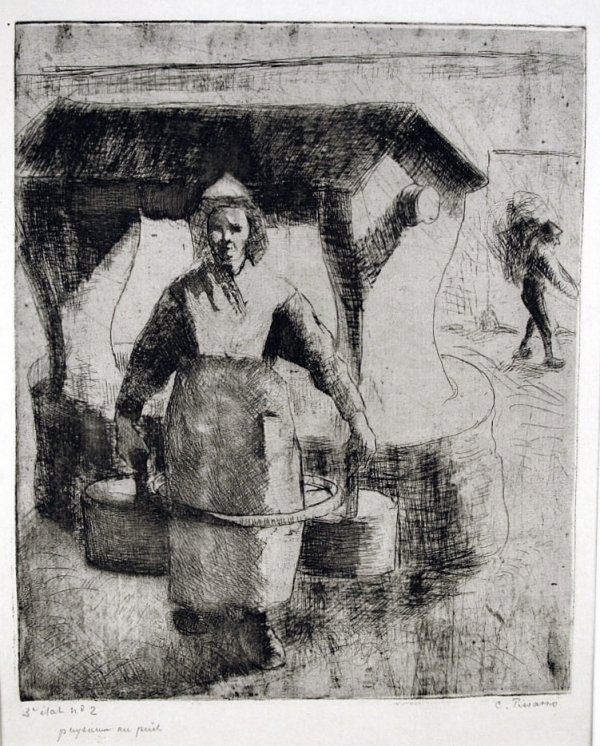
Paysanne Au Puits (peasant Woman At The Well), 1891, Camille Pissarro, Harris Schrank Fine Prints
The Tropics in His Fingertips
St. Thomas gave young Camille something no Parisian academy could teach: an intimacy with raw, vivid light and atmospheric humidity that saturated color and softened edges. The Caribbean sun doesn’t fall the way northern European light does. It’s heavier, more insistent, and it creates a peculiar density in shadow and tone, a kind of visual thickness entirely unlike the crisp, cool clarity of the Île-de-France.
When Pissarro later took up etching and lithography in earnest during the 1870s and beyond, his prints reveal an obsessive interest in atmosphere over outline, in tonal gradation rather than crisp delineation. Compare his market scenes and rural landscapes in print to the sharper, more linear etchings of contemporaries like Manet, whose lines snap with confident, almost theatrical decisiveness. Pissarro’s plates seem to breathe with humidity instead, built up through countless delicate strokes of aquatint and drypoint that mimic the way light diffuses through tropical air, dissolving hard edges into something softer, more felt than seen.
This is most visible in his treatment of skies and distances. Where a more academically trained printmaker might render a horizon with a single decisive line, Pissarro frequently let it dissolve into a haze of crosshatching and tonal wash, as though the plate itself were sweating. He was, in some sense, still chasing the optical truth of his childhood island in the cold north, translating a tropical memory into the gray vocabulary of French ink and acid.
Caracas, Commerce, and the Education of an Eye for Labor
After a brief, unhappy stint being groomed for the family business, including a formative period working in Caracas, Venezuela, with the Danish artist Fritz Melbye, Pissarro spent his early adulthood not in an academy but among ledgers, markets, and the working rhythms of colonial commerce. This mercantile background, often glossed over in romantic artist biographies that prefer their geniuses born fully formed with a brush in hand, may explain something crucial about Pissarro’s print subject matter: his enduring, almost anthropological fascination with peasants, market women, laborers, and the unglamorous textures of agricultural and commercial life.
Unlike painters born into Parisian bourgeois comfort, who often approached rural labor as a charming subject to be observed from a respectful, slightly sentimental distance, Pissarro had watched goods move, watched people work, watched the unglamorous machinery of daily survival up close, sometimes as a participant rather than a spectator. His etchings and lithographs returned again and again to scenes of harvest, market day, washerwomen, and rural toil, not as picturesque set pieces but as records of labor’s dignity and its weight.
Look closely at his print series depicting peasant women, bent over fields, balancing baskets, herding geese, and you find none of the soft prettiness that made rural subjects palatable to bourgeois Salon audiences. The figures are solid, weighted, often slightly awkward in their poses, captured mid-motion rather than arranged for effect. Printmaking, with its associations with reproducibility, accessibility, and the democratic distribution of images, suited this sensibility perfectly. A print could circulate among ordinary people, hang in a modest home, travel beyond the gilded frames of collectors. A print could go where a precious oil painting could not, and Pissarro, the merchant’s son who never lost his comfort with commerce and circulation, seemed to understand this instinctively.

The Self-Taught Radical and His Suspicion of Polish
Pissarro arrived in Paris in 1855, ostensibly to formalize his training, and dutifully visited the Universal Exposition where he encountered the landscapes of Camille Corot, an artist whose mentorship he later sought and whose influence shaped his early naturalism. But his actual academic training remained inconsistent throughout his life, supplemented by private study, copying at the Louvre, and informal exchanges with other artists rather than the rigorous, hierarchical discipline of the official Ecole des Beaux-Arts.
This patchwork education may have left him less reverent toward the polished perfection that academic printmaking traditions demanded. Where many trained engravers pursued immaculate, almost mechanical precision, treating each plate as a problem with one correct, final solution, Pissarro’s prints embrace visible process as a virtue rather than a flaw. He reworked plates obsessively, sometimes producing fifteen or more documented states of a single image, each one a record of doubt, revision, and searching, printed and reprinted as his thinking evolved.
This isn’t carelessness. It’s the visible mind of an artist who never fully trusted inherited rules because he’d never been fully inducted into them in the first place. The roughness, the visible erasures, the experimental combinations of technique within a single plate, these are the fingerprints of someone working things out in real time, unashamed to let the viewer see the seams. In an era that prized the appearance of effortless mastery, Pissarro’s prints dared to look like work.
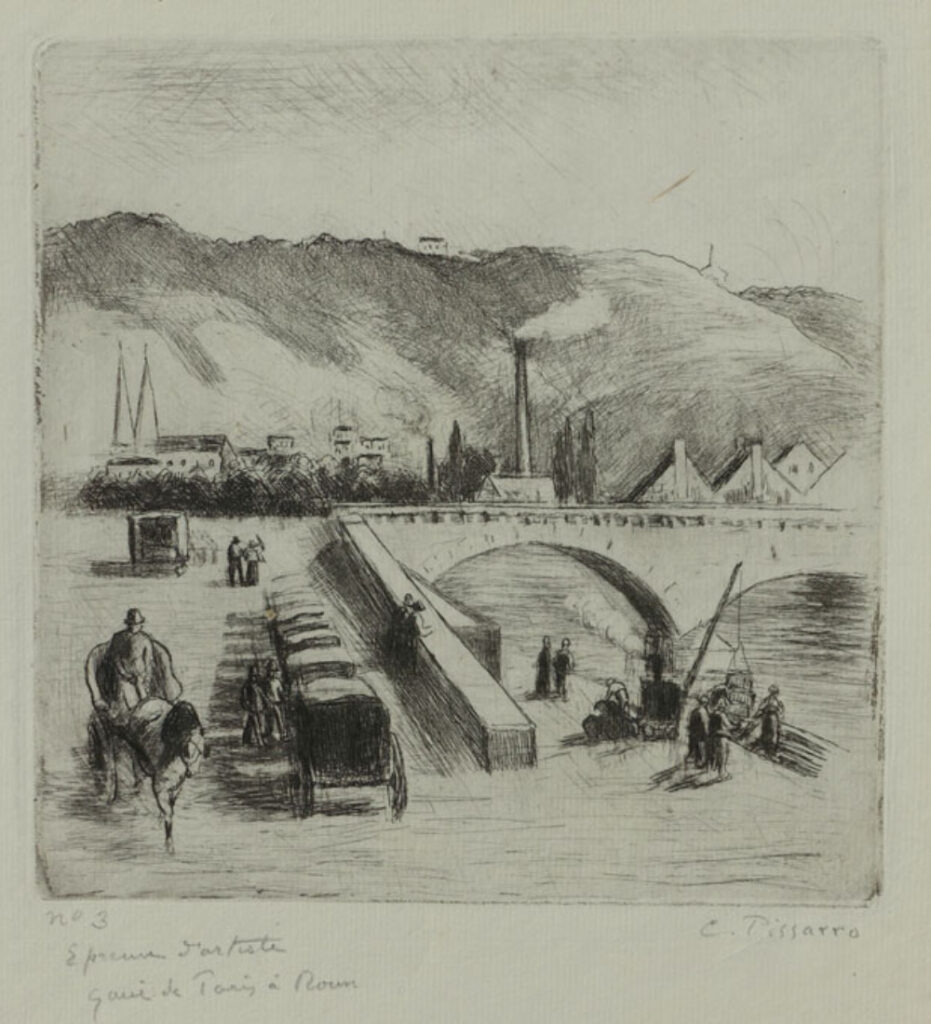
Quai de Paris à Rouen, 1896, Camille Pissarro, Jan Johnson Old Master Modern Prints
Exile, Instability, and the Pull Toward Intimate Mediums
Pissarro’s adult life was marked by repeated upheaval that went well beyond ordinary artistic struggle. The Franco-Prussian War forced him to flee to London in 1870, during which Prussian soldiers occupying his Louveciennes home destroyed or used as floor mats the majority of his earlier paintings, a catastrophic loss of nearly two decades of accumulated work. This trauma of impermanence, of seeing a life’s visual output literally trampled into the mud of an occupied house, may have made the print’s nature as a multiple, an image that exists in many physical copies rather than one precious, irreplaceable original, newly and urgently appealing.
A painting could be destroyed in a single afternoon by indifferent soldiers who saw only canvas and stretcher bars. An edition of prints, scattered across portfolios, sold to collectors, traded among artist friends, offered a strange kind of insurance against history’s cruelty and chance. Pissarro’s later, prolific embrace of etching and lithography in the 1870s through 1890s, often in close collaboration and friendly technical rivalry with Degas, who pushed him toward increasingly experimental monotype effects, can be read as the choice of an artist who had learned, brutally and personally, not to put all his visual eggs in one fragile basket.
There is also something poignant in the way Pissarro, financially precarious for most of his career and supporting a large family on uncertain income, found in printmaking a medium that was simply cheaper to produce and easier to sell in multiples. Survival and aesthetic philosophy were never entirely separate concerns for him.
Conclusion: The Island Never Left Him
Camille Pissarro’s printmaking, with its tonal subtlety, its devotion to labor and land, its comfort with process and imperfection, and its embrace of the democratic multiple, cannot be fully separated from the boy who grew up between cultures on a small Caribbean island, watched commerce up close, and arrived in Paris an outsider with nothing to lose and no orthodoxy to protect. His prints don’t just depict the French countryside; they carry, beneath their inked surface, the humid light, the mercantile attentiveness, and the restless displacement of where he began. To look at a Pissarro etching is, in a sense, to look at St. Thomas refracted through decades of European wandering, never quite arriving, always still searching for solid ground.