
James McNeill Whistler: The Prints That Poverty Built
Broke, Brilliant & Armed with a Needle
Picture this. It’s 1879. One of the most famous artists in London has just won a court case against the most powerful art critic of his generation – and somehow ended up completely broke because of it. The bailiffs are at the door of his dream home. They’re taking the furniture, the peacock-blue china, the velvet curtains. Everything. And this man, who once threw legendary Sunday brunches and wore yellow gloves to his own bankruptcy hearing just to make a point, is left with almost nothing.
That man was James Abbott McNeill Whistler. And what he did next produced some of the greatest prints in the history of art.
You might not know his name. You almost certainly know his most famous painting – the one everyone calls “Whistler’s Mother,” that severe grey portrait of an old woman sitting very still. It’s been on posters, mugs, and internet memes for decades. But that painting, iconic as it is, barely scratches the surface of what Whistler actually was: a ferociously talented, catastrophically self-destructive, genuinely revolutionary artist who happened to be his own worst enemy.
Whistler – The Man Who Won a Lawsuit and Lost Everything
Here’s the backstory. In the late 1870s, Whistler painted a dark, hazy night scene over the Thames and charged two hundred guineas for it. John Ruskin – the most influential art critic alive, the kind of man whose opinion could make or break careers – publicly called it a swindle. He wrote that Whistler was charging that much money for “flinging a pot of paint in the public’s face.”
Whistler, being Whistler, sued him.
He won. The jury found in his favour. And the damages awarded to him were one farthing – literally the smallest coin in existence. Whistler had to cover his own legal costs. He went bankrupt within months.
Most people, at this point, would retreat. Whistler, instead, accepted a commission from a London gallery for twelve prints of Venice, packed his bags, and left for Italy with his girlfriend, a printing press, and a set of copper plates. He had very little money, a damaged reputation, and absolutely nothing to lose.
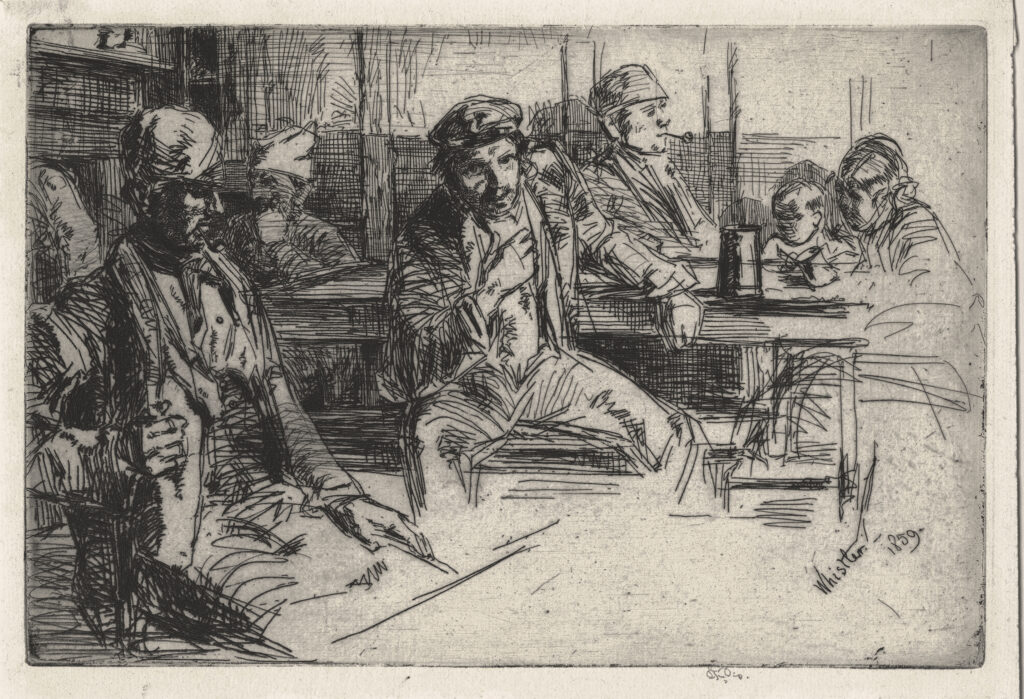
Longshoremen (Longshore Men) (1859), by James Abbott McNeill Whistler, Annex Galleries
Why Venice, and Why It Mattered
Here’s the thing about Venice that nobody puts on the tourist brochures: it’s a city that has been slowly, magnificently falling apart for about five hundred years. The grand palaces are crumbling. The plaster peels to reveal older plaster beneath. The water laps at the doorsteps of buildings that have been sinking since the Middle Ages. It is one of the most beautiful places on earth precisely because of its decay, not in spite of it.
For a man whose own reputation was quietly rotting away back in London, it was the perfect place to be.
Whistler didn’t do what every other visiting artist did – painting the Grand Canal, the gondolas, the famous landmarks. He couldn’t afford the gondoliers, for one thing. So instead he walked. He wandered into the back alleys and the forgotten courtyards, the working-class neighbourhoods, the doorways where old women sat mending nets. He drew the Venice nobody was painting.
And he did it with almost nothing on the page.

Less Is Impossibly Hard
This is where his poverty actually changed what he made. Before the bankruptcy, Whistler’s prints – though already technically brilliant – were sometimes busy. Lots of lines, lots of detail, lots of look-at-what-I-can-do. In Venice, with no studio, limited supplies, and no wealthy audience to impress, he stripped everything back.
He’d spend an hour looking at a doorway. Then he’d etch it in minutes – just a shadow here, a hinge there, a crack in the stone. He’d leave most of the copper plate completely bare, so the white of the paper showed through like light itself. Then he’d wipe each plate by hand before printing, leaving a thin film of ink that gave every image a soft, smoky atmosphere.
Here’s the quietly extraordinary part: because he adjusted that ink film differently every single time, no two prints from the same plate are exactly alike. He wasn’t just making copies. He was making each one individually, by hand, in the moment. Every print was, technically, a unique object.
It sounds simple. It is, in fact, one of the hardest things to do in printmaking. Restraint always is. Knowing what to leave out – trusting that the gap, the silence, the empty space does more work than another line would – that takes a specific kind of confidence. The kind you can apparently only find at the bottom.
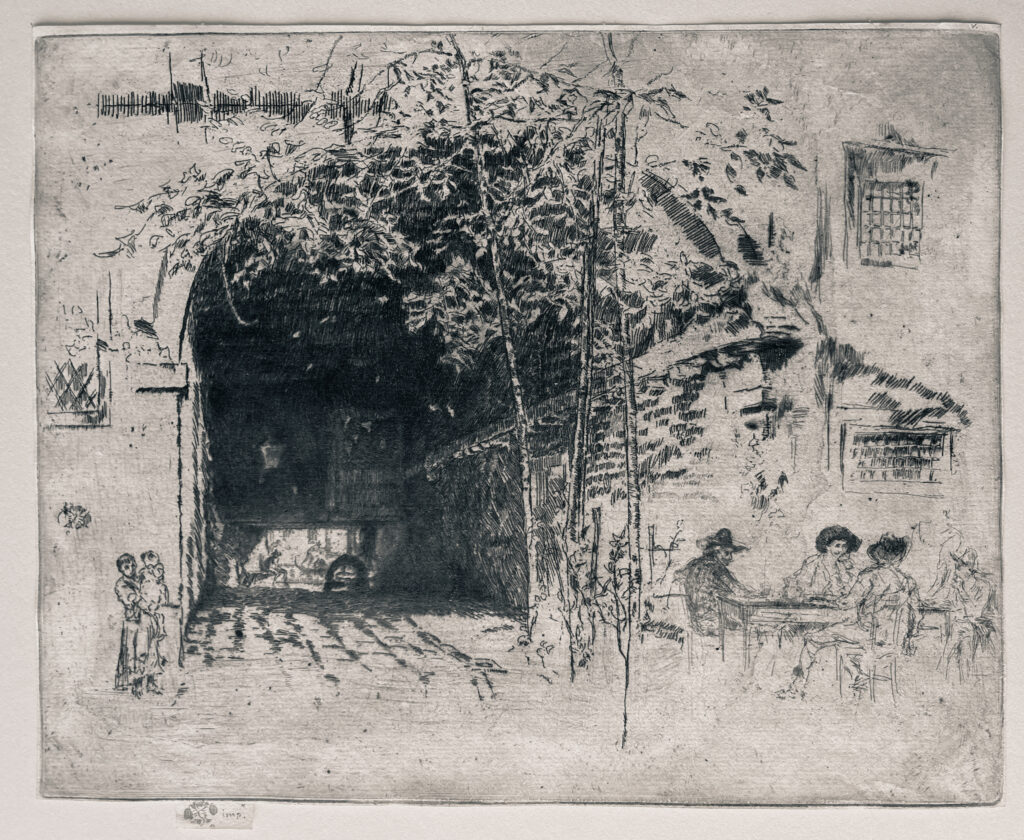
The Traghetto, No. 2 (1879), James Abbott McNeill Whistler, Harris Schrank Fine Prints
Prints Pay the Rent. Paintings Break Your Heart.
So why didn’t he just go back to painting once things improved? He could. He did, sometimes. But there were very good reasons – practical and personal – why printmaking stayed central to his life long after the bankruptcy crisis had passed.
The first reason is embarrassingly straightforward: prints sold. A painting is one object. You make it, you sell it once, and then it’s gone – either into someone’s drawing room or, if nobody buys it, back against your studio wall gathering dust. A print is different. One copper plate could yield dozens of impressions, each one sellable. For an artist who had been financially destroyed and was rebuilding from nothing, that mattered enormously. Whistler was acutely aware of the economics. He numbered his editions, signed each print in pencil with his distinctive butterfly monogram, and understood that scarcity and quality together created value. He was, among other things, a very canny operator when he chose to be.
But the money is only half the story. The deeper reason Whistler kept returning to the copper plate is that printmaking did something painting couldn’t – at least not for him, not in the same way. It forced a particular kind of decision-making. You can’t easily undo a line scratched into copper. You can’t paint over a mistake the way you can on canvas. Every mark is a commitment. And Whistler, whose best work is characterised by an almost frightening economy of line, thrived under that pressure. The constraint wasn’t a limitation. It was the whole point.
There was also something he loved about the intimacy of prints – the fact that they could end up in ordinary hands, not just in the grand houses of collectors. He cared, sometimes irritatingly so, about how his prints were framed and displayed. He wrote instructions. He argued with gallery owners about mat colours. He wanted the works seen correctly, and prints, being smaller and more affordable than paintings, had a better chance of actually being lived with, looked at daily, understood over time.
Coming Home to a Fight He’d Already Won
When Whistler came back to London after fourteen months and showed the Venice prints, the critics didn’t quite know what to make of them. Too spare. Too quiet. Looked almost unfinished. A few people grumbled.
But the artists understood immediately. And slowly, then all at once, so did everyone else. Within a few years he was widely considered the greatest living printmaker in Europe. The French adored him. Young artists made pilgrimages to meet him. The man who had been publicly humiliated, financially destroyed, and essentially laughed out of London had produced, in his broke and scattered state, work that would still be studied and admired a hundred and fifty years later.
The bankruptcy didn’t ruin Whistler. It focused him. It took away every distraction – the parties, the arguments, the expensive decorating projects – and left him alone with a needle, a copper plate, and something genuine to say.
And once he discovered what that needle could do in his hands – how it could catch a whole city in a few spare lines, how it could make something that was both repeatable and unrepeatable, both his and the world’s – he never really put it down.
It turns out that losing everything is, occasionally, exactly what a certain kind of genius needs.