
John Baldessari Did Not Make Prints. He Made Arguments.
John Baldessari treated the print medium like a courtroom, not a studio – and everything he put on paper was evidence.
“I Will Not Make Any More Boring Art” Wasn’t a Joke. It Was a Diagnosis.
By the early conceptual era, printmaking had calcified into a prestige game. Limited editions. Archival inks. The cult of the artist’s hand – the belief that what made a print valuable was the evidence of skilled, careful mark-making by someone who had studied the old masters and could prove it. The print had become a luxury object dressed up in democratic clothing, priced for scarcity, handled with hushed reverence, celebrated above all for craft.
Baldessari looked at all of that reverence and asked the most dangerous question an artist can ask: Why? Not rhetorically. Not as provocation for its own sake. But with the genuine curiosity of a man who had grown up in Southern California rather than New York, taught high school before teaching art school, and arrived at conceptualism not through theory but through the slow, practical realization that what he was making was boring – and that boring was the one thing art had no right to be.
His answer was to strip the print of its preciousness and reload it with language. Text wasn’t decoration in his work – it was the work. In his photo-text combinations of the late 1960s and 1970s, words and images didn’t illustrate each other. They interrogated each other, sometimes with surgical precision, sometimes with the dry wit of a man who had read too much Wittgenstein and watched too much television and understood that the gap between those two activities was both enormous and enormously productive.
The print had always had a relationship with text – engravings accompanied manuscripts, woodcuts illustrated religious narratives, lithography built the poster tradition. But text and image had always coexisted in a relationship of service: one explained the other. Baldessari abolished that hierarchy entirely. In his hands, they were combatants. Each made the other stranger, more resistant, more alive.
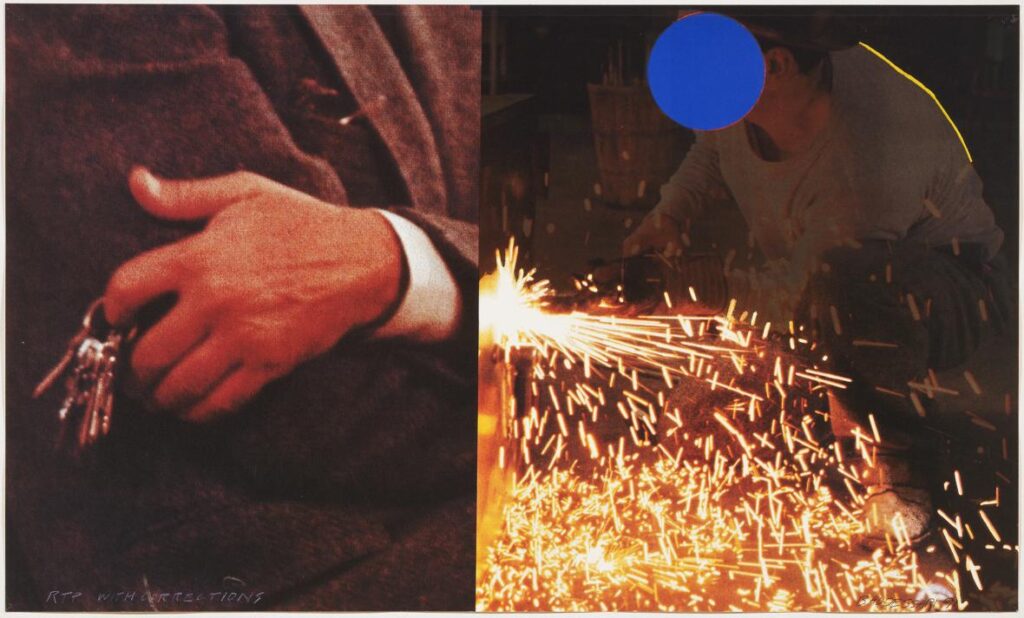
Keys (with Intrusion) , 1994, John Baldessari, Gemini G.E.L. at Joni Moisant Weyl
The Dot Over the Face Was Not a Signature. It Was a Philosophical Position.
Few moves in late twentieth-century art are as instantly recognisable as Baldessari’s coloured dots placed over the faces of figures cropped from found photographs. But calling it a signature misses the point so completely it nearly inverts it.
The dots were a refusal. We are wired for faces – neuroscience has spent decades confirming what portraitists knew intuitively for centuries. The face is the gravitational center of any image that contains one. We go there first, build our entire interpretation of a scene around what we read there: emotion, status, gaze, the implied relationship to everything else in the frame.
By covering the face with a flat circle of cadmium red or cobalt blue, Baldessari didn’t just hide a face. He short-circuited the entire interpretive machinery of figurative representation. The print was no longer about who was depicted or what was happening. It was about the act of depicting itself – what we demand from images, what we assume we’re entitled to, and what happens when those demands are cheerfully, systematically denied.
The colour matters too. He didn’t reach for neutral tones. He used colours borrowed from the vocabulary of abstract painting and dropped them with perfect incongruity into the grammar of documentary photography – a collision between two of the twentieth century’s dominant visual languages, happening in a space the size of a coin. In a medium where portraiture runs from Dürer to Rembrandt to Warhol, this was not a small gesture. It was a grenade rolled quietly across five centuries of tradition.
He Stole His Images. That Was Entirely the Point.
Baldessari pioneered appropriation before it had a critical vocabulary – before Sherrie Levine rephotographed Walker Evans, before Richard Prince re-shot Marlboro ads, before the Pictures Generation gave theorists a syllabus. His prints drew from the visual landfill of mass culture: film stills from B-movies and westerns, news photography, instructional diagrams, advertising imagery. The kind of photographs that exist in millions in archive drawers, made by no one in particular and owned by everyone in general.
Where other artists built a visual vocabulary from scratch and defended it as a matter of artistic identity, Baldessari sourced the world’s. This wasn’t laziness – it was a rigorous conceptual position with specific aesthetic consequences. By using pre-existing images, he removed virtuosic mark-making from the conversation entirely. You could not stand in front of one of his prints and admire the draftsmanship. There was no draftsmanship to admire, and that was precisely the point – not because he was incapable of it, but because admiring draftsmanship was exactly the reflex he was trying to interrupt.
The print became a showcase not of the artist’s ability to render, but of the artist’s ability to think – to select, juxtapose, crop, and combine in ways that produced meaning no single source image could contain. You couldn’t receive a Baldessari print passively. It wouldn’t let you.

His Prints Were Funny. That Made Them More Serious Than Almost Everything Else on the Wall.
Humour is art criticism’s most persistent blind spot. We don’t know what to do with work that makes us genuinely laugh, so we either explain the joke until it stops being funny or treat the comedy as incidental to the real, serious meaning beneath. With Baldessari, neither escape route works.
The deadpan sequencing of images that refuse to cohere into narrative. The captions that confuse rather than clarify. The cropped film still from which the central action has been removed, leaving only bystanders. A gesture in the image directing the eye toward a space the print refuses to show. The viewer looks where they’re told to look and finds nothing – and that absence is exactly where the meaning lives.
The humour isn’t decorative. It’s load-bearing. It’s the mechanism by which Baldessari keeps the viewer off balance, which is the mechanism by which the viewer actually looks – really looks – which is the mechanism by which meaning, provisional and hard-won, begins to form. The joke keeps pulling the rug. Each time it does, you reorient. And in reorienting, you see something you wouldn’t otherwise have seen. That is, quietly, the whole of what art is supposed to do.
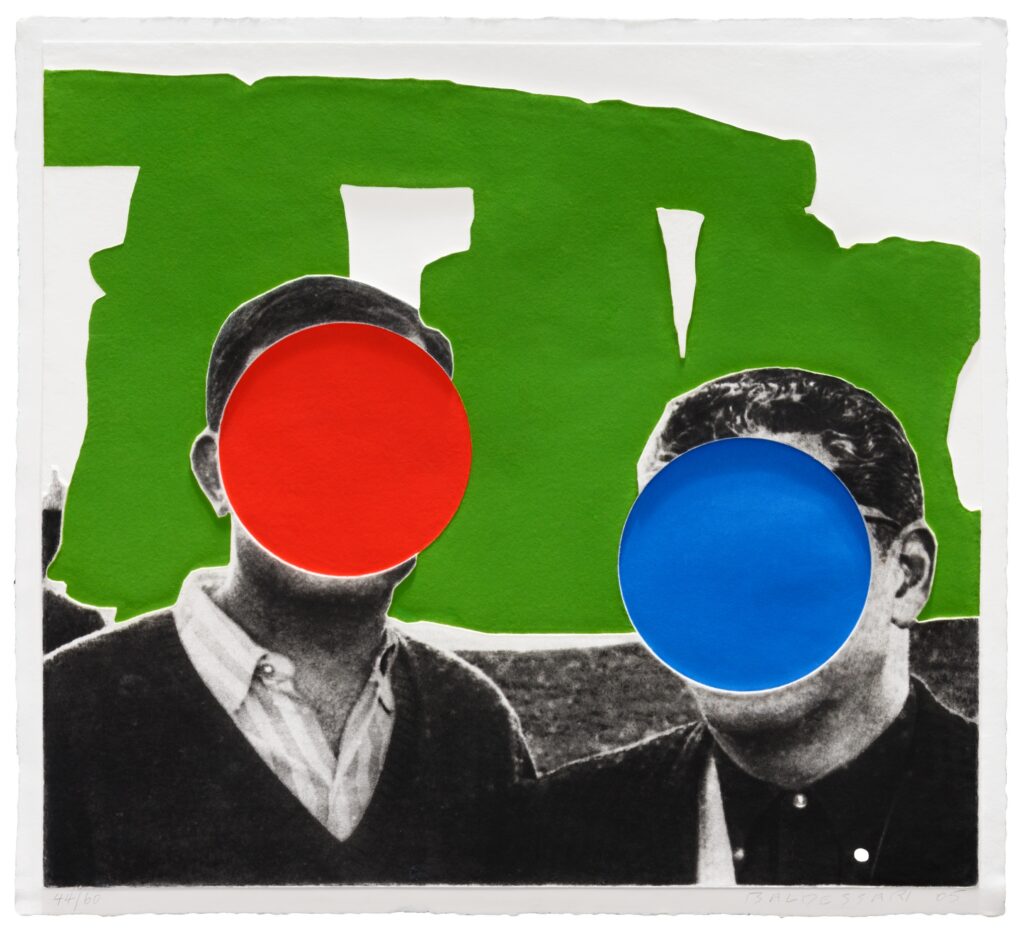
Stonehenge (With Two Persons) Green, 2005, John Baldessari, Mixografia
The Legacy Is Invisible Because It’s Everywhere
The casual integration of image and language in contemporary art. Found photography as primary material rather than reference. The willingness to let a print withhold as readily as it reveals. The understanding that humor and rigor are not opposites, that the viewer’s disorientation is not a failure of communication but its most sophisticated form. All of it traces back to a former high school teacher from National City, California, who decided that the way prints had always been made was not the only way – and that figuring out the other ways was worth a life’s work.
None of it would have landed the way it did without the workshops. At Gemini G.E.L. in Los Angeles, where Baldessari returned across decades, the collaboration was genuinely generative – he arrived not with finished images to be transferred faithfully onto paper, but with conceptual problems, and the workshop met them as creative partners rather than technical service providers. That openness carried into his work with Mixografía in Mexico City, where Luis and Lea Remba’s proprietary process of pressing handmade paper into deep relief matrices produced prints that were, technically, multiples, and in every other sense, sculptures – objects with topography, shadow, physical weight. For an artist who had spent decades interrogating the flat image, the process was irresistible: a very good question posed in three dimensions.
He didn’t revolutionise printmaking by mastering its techniques. He revolutionised it by asking whether the techniques were the point – and discovering, with patience and wit and the quiet confidence of a man who had nothing to prove, that they were not. The point was thought. The point was the space between an image and what you expected it to do – a space that turned out, in his hands, to be infinite.
The print, for Baldessari, was never a destination. It was a question. The fact that it never resolved is not a limitation. It is the whole achievement.
The Legacy Is Invisible Because It’s Everywhere
The casual integration of image and language in contemporary art. Found photography as primary material rather than reference. The willingness to let a print withhold as readily as it reveals. The understanding that humour and rigour are not opposites, that the viewer’s disorientation is not a failure of communication but its most sophisticated form. All of it traces back to a former high school teacher from National City, California, who decided that the way prints had always been made was not the only way – and that figuring out the other ways was worth a life’s work.
He didn’t revolutionise printmaking by mastering its techniques and pushing them to new extremes. He revolutionised it by asking whether the techniques were the point, and discovering, with patience and wit and the quiet confidence of a man who had nothing to prove, that they were not. The point was thought. The point was language. The point was the space between an image and what you expected it to do – a space that turned out, in his hands, to be infinite.
The print, for Baldessari, was never a destination. It was a question. The fact that it never resolved – that each work opened onto more uncertainty rather than less – is not a limitation of the practice. It is the whole achievement.