Bourgeois Didn’t Make Art to Be Admired. She Made It to Survive.
There is a particular kind of artist who doesn’t create to communicate with an audience but to stay sane. Louise Bourgeois was that artist. She said so herself: “Art is a guarantee of sanity.” Not a metaphor, not an affectation — a genuine, urgent claim made by a woman who had been in psychoanalysis for over three decades and who returned, every single day, to the materials of her studio as other people return to prayer. What is less widely understood is that among all her media – the towering bronze spiders, the uncanny latex forms, the room-sized installations – it was printmaking that offered her the most intimate and persistent relationship with her own psychology. The print, for Bourgeois, was not a secondary form. It was a confessional booth.
Why Print? The Medium That Mirrors an Obsessive Mind
To understand why printmaking suited Bourgeois so completely, you have to understand something about repetition and its relationship to trauma. Psychoanalysts have long observed that the mind caught in trauma does not file the experience away and move on. It returns to it. Circles it. Replays it in dreams, in compulsive behaviours, in the unconscious choices we make again and again without knowing why. Bourgeois knew this about herself. She was acutely self-aware in the manner of someone who has spent a very long time in therapy and has learned to watch her own patterns with something approaching clinical detachment – though the heat behind the work suggested the detachment was never complete.
Printmaking is, structurally, a medium of repetition. You carve or etch or draw a matrix, and from that matrix you pull multiple impressions. Each one is the same and not the same – the ink sits differently, the pressure varies, the paper absorbs in its own way. For a different artist this might be merely a technical fact. For Bourgeois it was a psychological truth made material. The act of returning to the same image, pulling it again and again, adjusting it, reworking the plate, producing a new state – this was not unlike returning to the same memory and finding something new in it each time. She understood intuitively that the print’s logic was the logic of trauma: you cannot produce it just once and be done.
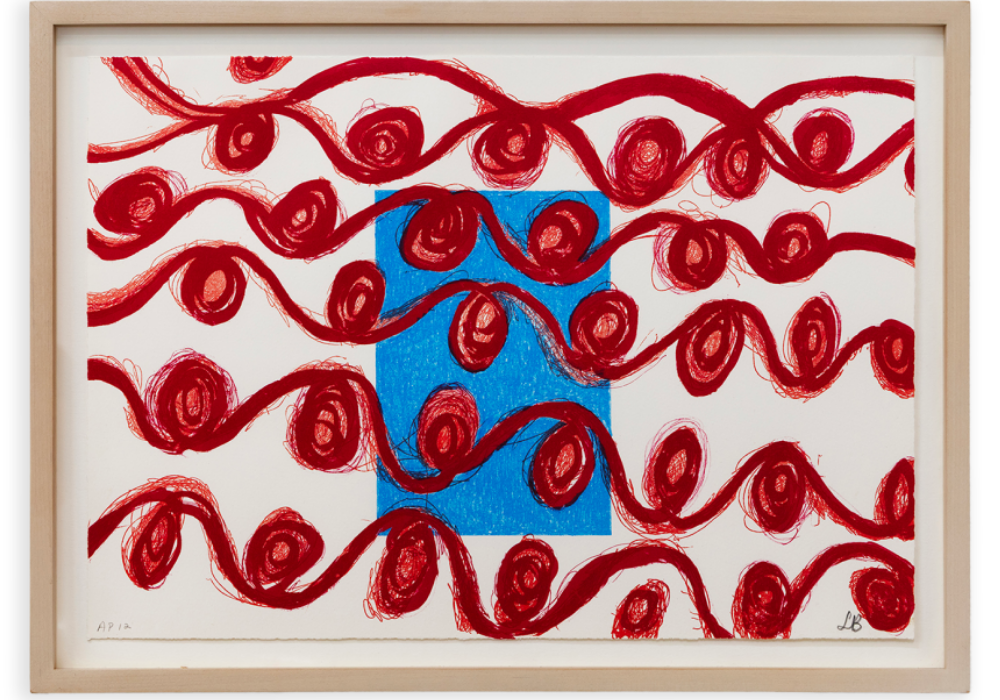
The Telephone Call From The Slammer, 1999, Louise Bourgeois
Bourgeois Etchings: Where the Needle Met the Wound
Bourgeois came to printmaking seriously in the 1980s and 1990s, relatively late in a career that had already spanned decades of sculpture. Her etchings from this period are among the most raw and revelatory works she ever made. Working with master printers – most significantly the workshop of Robert Blackburn in New York, and later with Harlan & Weaver – she produced images that looked nothing like the decorative or illustrative traditions of fine art printmaking. They were scratchy, urgent, anatomical, erotic, and strange.
The series “He Disappeared into Complete Silence” – which she had originally produced as a book in 1947 – set the tone for what would follow: text and image in uncomfortable proximity, neither one quite explaining the other, both circling a feeling that couldn’t be named. In later etchings she returned obsessively to figures that were half human and half something else – bodies that merged with furniture, with architecture, with one another. Spirals appeared constantly, that ancient symbol of both anxiety and growth, of the inward pull and the outward release. There were needles, thread, hands, legs, torsos without heads. There were eyes that seemed to be watching from inside the composition, turning the viewer into the watched rather than the watcher.
What made these etchings so powerful as a collector proposition – and so psychologically significant – was the quality of line. Etching is made by drawing into wax with a needle and then bathing the plate in acid. The acid bites where the needle has exposed the metal. It is, quite literally, a process of wounding a surface to leave a mark. Bourgeois grasped this and exploited it without sentimentality. Her lines were not refined or decorative. They were insistent, repetitive, occasionally violent. They looked like the work of someone who needed to get something out.
The Spider in Ink: Reading the Symbolic Grammar
Collectors who want to build a coherent body of work around Bourgeois prints need to understand her symbolic language, because it is consistent enough to be read like a grammar. The spider, so dominant in her sculpture, appears in her prints too — most memorably in a series of drypoint and etching works from the late 1990s and early 2000s that accompanied the enormous sculptural Maman editions. These spider prints are not merely souvenirs of the sculptures. They are independent meditations on the same imagery, and in the flatness of the print medium the spider takes on a different quality – more vulnerable, more nakedly drawn, less monumental and more intimate.
The spiral, which appears throughout her print work, is equally loaded. It represents for Bourgeois the structure of obsessive thought – the way a memory or a fear doesn’t travel in a straight line but winds inward toward a centre that may or may not be reachable. Collectors who trace the spiral motif across her output will find it migrating across decades and media, shifting in scale and mood but never disappearing entirely. It is one of the most reliable signatures of her psychology made visible.
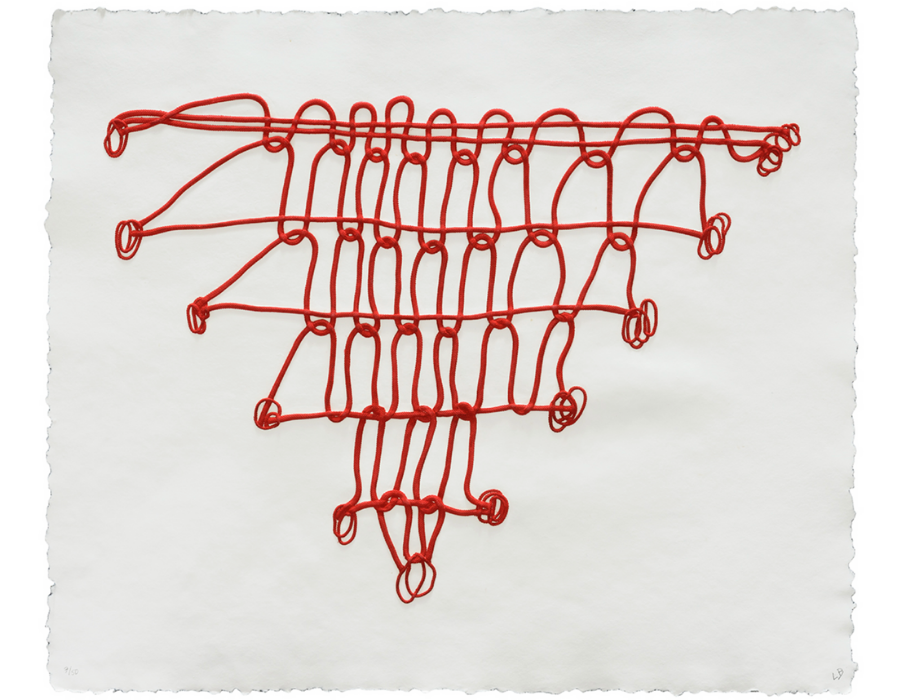
The needle and thread, which appear with particular force in her late fabric works, also show up in prints – sometimes rendered as fragile linear forms, sometimes as something approaching a weapon. Bourgeois’s mother was a tapestry restorer, patient and precise, and the needle was bound up for the artist with both the maternal and the surgical, the healing and the piercing. When you find this motif in a print, you are looking at one of her most compressed symbols: love and loss and the body and the act of repair, all threaded onto a single fine point.
Among the most unusual and sought-after of Bourgeois’s works on paper are her fabric prints – works made by printing onto textile rather than conventional paper, or incorporating fabric elements into the print surface. These pieces blur the boundary between printmaking and her late textile works, in which she cut up her own and her late husband Robert Goldwater’s clothes and stitched them into hanging sculptures and wall works.
The fabric prints occupy a particular emotional register. There is something about the textile ground – soft, yielding, domestic – that changes the encounter with the imagery. Where an etching on white laid paper feels clinical and precise, a print on cloth feels bodily. You are aware that you are looking at something that could have been worn, that carries the ghost of the body within it. For Bourgeois, whose art was always deeply concerned with the body as a site of memory and feeling, this was not incidental. The choice of material was always a choice of meaning.
These works are among the rarest in her print output and command significant premiums when they appear at auction. They also present particular challenges for collectors around conservation – fabric requires different storage and display conditions than paper, and the inks used can be more vulnerable to light damage. Any serious collector pursuing this area of her work should take specialist conservation advice before purchase.
Living With Difficult Art
There is a final question that serious collectors of Bourgeois prints must ask themselves, and it is one that goes beyond the market. Her work is not decorative. It does not resolve into prettiness or comfort when you live with it day to day. The imagery is insistent, sometimes disturbing, always psychologically charged. A spider etching above a mantelpiece is a different proposition from a landscape or a still life. It watches you. It asks something of you.
But this is also precisely the argument for collecting her. The best art does not merely ornament a space; it extends and complicates how you inhabit that space, how you think, what you notice about yourself. Bourgeois spent ninety-eight years turning her interior life into objects and images, and the best of those images carry that interior life inside them like a charge. To collect her prints is not merely to acquire financial value – though that value has proven remarkably durable – but to bring something genuinely alive into your home. Something that will not let you simply glance and move on. Something that will ask, again and again, that you pay attention.
That, in the end, is what the confessional print does. It insists on being heard.