The Man Who Could Paint a Masterpiece Before Breakfast – And Why His Prints Took Years
He once finished a painting in a single afternoon. He spent seven years on a series of etchings. Both were masterpieces. So what does that tell us about the genius of Pablo Picasso?
“I Do Not Seek, I Find”
Picasso didn’t believe in waiting for inspiration. He was inspiration – a restless, ferocious creative engine who reportedly sketched before he could speak in full sentences. By the time he died in 1973, he had produced an estimated 20,000 works across painting, sculpture, ceramics, drawing, and printmaking.
But here’s what most people don’t know: the speed at which he worked — and the wildly different pace demanded by different mediums – tells us everything about how his mind operated.
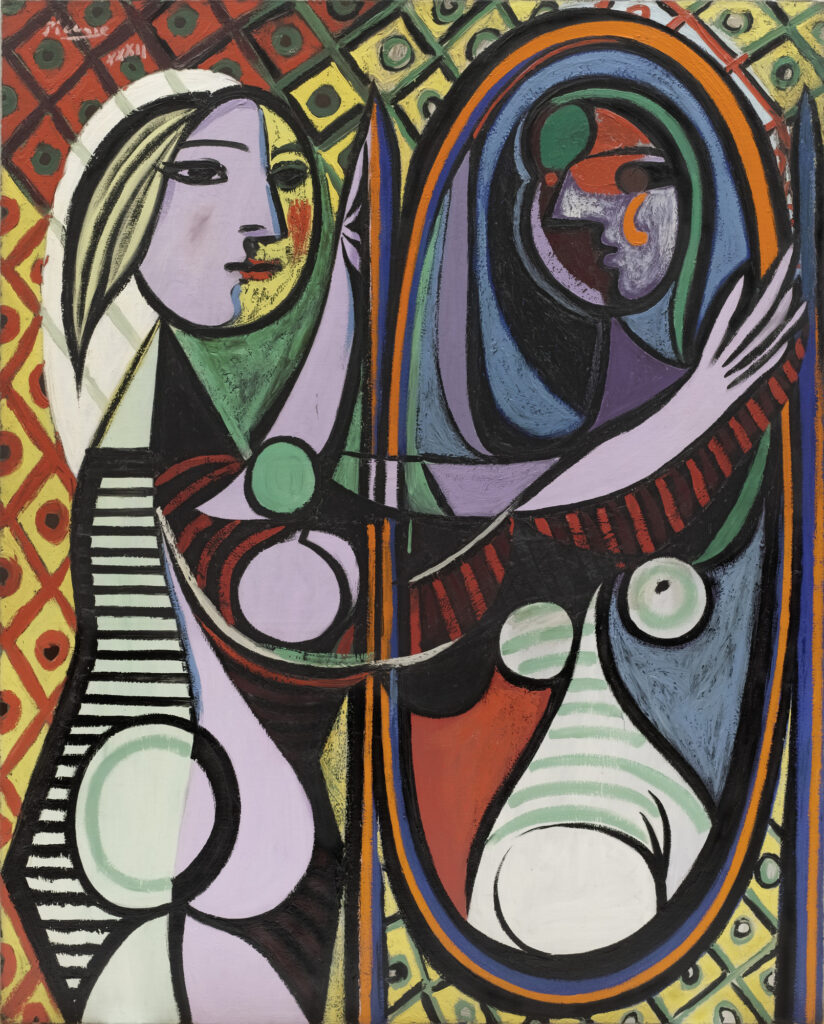
Girl Before a Mirror, 1932, Pablo OPicasso
A Painting in an Afternoon: The Lightning Years
Some of Picasso’s most beloved paintings were completed in a single sitting.
“Girl Before a Mirror” (1932) took approximately four to five hours. Marie-Thérèse Walter, his young muse, sat for him and the image poured out of him fully formed – vibrant, psychologically loaded, compositionally perfect. The paint barely had time to dry before the work was done.
“Weeping Woman” (1937) was completed within days, born from the same volcanic emotional state that produced Guernica. When Picasso was moved, really moved, the gap between feeling and finished canvas was almost nothing.
This was not recklessness. It was trust – an absolute, hard-won confidence in his own visual intelligence. The paintings looked spontaneous because, for Picasso, they were spontaneous. He said it himself: “I do not seek, I find.”
Guernica: When Even Picasso Had to Work
The one great exception to Picasso’s speed was his most famous painting.
Guernica (1937) – that enormous, anguished response to the Nazi bombing of a Basque town – took 35 concentrated days to complete. We know this with unusual precision because photographer and lover Dora Maar documented each stage of the canvas, creating a rare visual record of Picasso in the act of working.
Thirty-five days. For a painting that changed the course of political art forever. By most artists’ standards, that’s still breathtaking speed. For Picasso, it was practically a sabbatical.
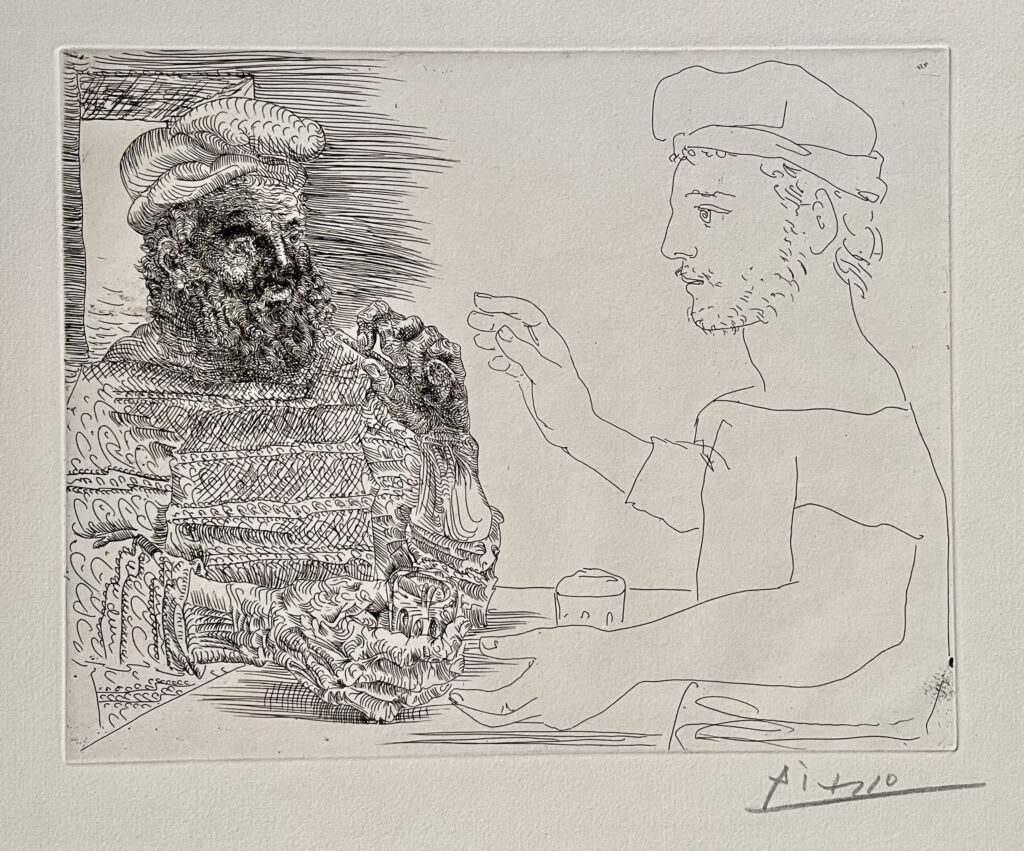
Deux Buveurs Catalans (from La Suite Vollard), 1934, Pablo Picasso
Enter the Print: Where Even Genius Has to Wait
And then there is printmaking – the discipline that brought Picasso to his knees in the best possible way.
Unlike oil paint, which could be pushed around a canvas in real time and corrected in the next brushstroke, printmaking demanded that Picasso submit to process. The acid bath doesn’t care how inspired you are. The lithographic stone dries on its own schedule. And once a linocut block is carved away, it cannot be un-carved.
This was a completely different relationship between the artist and the work – and Picasso was obsessed by it.
The Vollard Suite: Seven Years in the Making
Between 1930 and 1937, Picasso produced 100 etching plates for art dealer Ambroise Vollard. Known collectively as the Vollard Suite, these works rank among the most significant prints of the 20th century. Seven years. For 100 plates.
Each plate required coating in wax, meticulous scratching of the image, immersion in acid to bite the lines into metal, test proofs pulled to check the result, reworking, re-biting, and finally printing in a limited edition. Picasso returned to plates over and again, revising, deepening, refining. The suite became a meditation on themes of the artist and model, myth, eroticism, and the act of creation itself — fitting subject matter for a process that was itself so deliberate and slow.
Compare this to “Girl Before a Mirror,” completed in an afternoon the very same year. Two masterpieces. Two entirely different relationships with time.
The Bull: Watching a Mind Dismantle Itself
Perhaps the most extraordinary document of Picasso’s printmaking process is the Bull lithograph series of 1945–46, produced at Fernand Mourlot’s legendary Paris workshop.
Over the course of roughly two months, Picasso created 11 progressive states of a single image of a bull. He began with a detailed, almost academic representation – muscular, realistic, naturalistic. Then, state by state, he stripped it back. Simplified. Reduced. Abstracted. Until, in the final state, the bull is rendered in just a handful of spare, electric lines.
It is not just a series of prints. It is a visible record of how Picasso thought — how he moved from the observed world to the essential truth beneath it. And it took two months of returning to the stone, proofing, revising, returning again.
The Reductive Linocut: No Safety Net
In his late period – his seventies and eighties – Picasso pioneered a printmaking technique so demanding it was practically an act of controlled destruction.
The reductive linocut method, developed in the late 1950s, involved carving and printing from a single block in multiple passes. Each colour was carved away and printed before the next was cut. This meant the block was permanently altered with each stage. There was no going back. No correction. No second chance.
Works like “Bacchanal with Bull” (1959) required five or six colour passes, weeks of work, and an absolutely precise vision held in the mind from first cut to last. One misjudgement and the entire edition – every print in it — was ruined.
For a man who could dash off a masterpiece before breakfast, this was the ultimate creative discipline. And he loved it.
Speed as Style, Patience as Craft
What emerges from comparing Picasso’s paintings to his prints is not a contradiction but a portrait of an artist who understood his own process with exceptional clarity.
Painting gave him freedom – the direct, immediate translation of emotion onto surface. It suited his volcanic creative personality, his belief that inspiration was something to be seized, not cultivated.
Printmaking gave him constraint – and constraint, paradoxically, gave him new freedom. The resistance of the medium forced unexpected solutions. The gap between intention and result – the acid bath, the drying stone, the irreversible cut – created space for discovery that the instant responsiveness of oil paint never could.
One afternoon for “Girl Before a Mirror.” Seven years for the Vollard Suite. And both, unmistakably, the work of the same restless, magnificent mind.
Picasso produced over 2,000 prints in his lifetime – roughly one tenth of his total output. The prints are less famous than the paintings, but for anyone who wants to understand how he truly worked, they are essential. They show not the lightning strike, but the long, patient storm that made it possible.