
Sol LeWitt and the Print: Why He Changed Everything
The Man Behind the System: Who Was Sol LeWitt?
Sol LeWitt was born in Hartford, Connecticut, in 1928, the son of Jewish immigrants from Russia. His father died when he was six, and he was raised by his mother, who recognised his early talent and enrolled him in Saturday art classes at the Wadsworth Atheneum – one of America’s oldest public art museums, and the kind of institution that leaves a permanent mark on a young mind. He went on to study fine art at Syracuse University, graduating in 1949, and then spent two years in the US Army during the Korean War before arriving in New York City in the early 1950s with the intention of making art.
The New York he found was in the full roar of Abstract Expressionism – de Kooning, Pollock, Kline – and LeWitt absorbed it and then, with characteristic deliberateness, set about thinking past it. He worked odd jobs to support himself, including a period as a receptionist at the Museum of Modern Art, where he encountered the work of Cézanne, the Russian Constructivists, and the Bauhaus systematically for the first time. These encounters lodged themselves and waited. When his own artistic voice emerged, in the early 1960s, it came out already formed: cool, logical, insistently conceptual, and profoundly at odds with everything the art world around him was doing.
His two landmark essays – Paragraphs on Conceptual Art (1967) and Sentences on Conceptual Art (1969) – remain among the most important theoretical texts in postwar art history. They articulated, with a clarity and confidence unusual in artist writing, the central argument that would define his entire career: that in conceptual art, the idea itself is the work, and its execution – however it is carried out, by whomever – is secondary. This was not modesty. It was a philosophical position, held with complete conviction, and everything he made for the remaining forty years of his life was a demonstration of its truth.
He died in New York in 2007, at the age of seventy-eight, still producing work, still generating instructions, still trusted by a generation of artists who had grown up in the shadow of his ideas. His Wall Drawings continue to be realised in institutions worldwide, following his instructions, executed by trained teams. The work goes on without him. He would have considered that exactly the point.
LeWitt Didn’t Make Art. He Wrote Instructions for It.
Most printmakers of the 1960s and 70s were obsessed with the hand — the proof of presence, the mark that said I was here. Sol LeWitt looked at that tradition and quietly dismantled it. Where his contemporaries agonised over technique, texture, and the intimacy of the artist’s touch, LeWitt did something almost perverse: he removed himself from the equation entirely. His prints weren’t born from gestures. They were born from sentences. A typical LeWitt instruction might read: Lines, not long, not straight, crossing and touching, drawn at random, using four colours. That’s it. That’s the artwork. Someone else — a printer, an assistant, eventually a wall painter – would carry it out. The idea was the art. Everything else was just delivery.
This was radical in ways that are easy to underestimate today. In the world of printmaking, the artist’s hand was considered sacred. Etching, lithography, screenprinting – all of these were bound to the idea that creativity lived in the physical act of making. LeWitt blew that up with a conceptual grenade, and the ripples are still being felt.
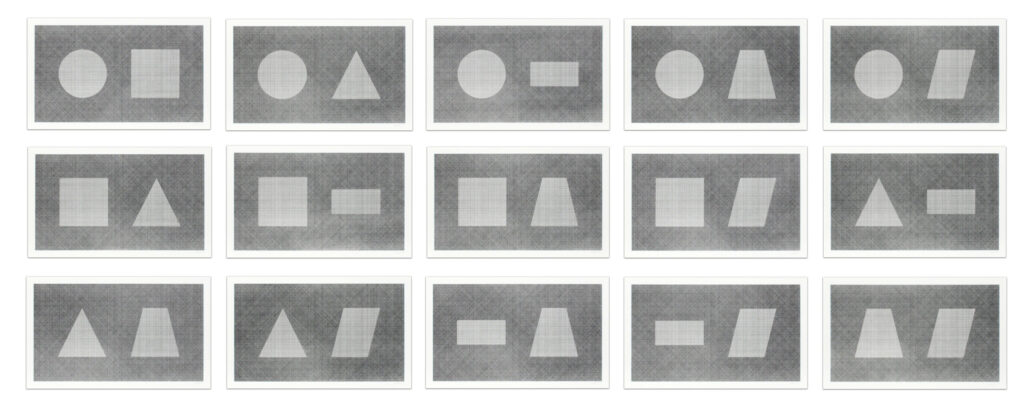
Six Geometric Figures & All Their Combinations (in pairs), 1980, Sol Lewitt
Why Sol LeWitt’s Prints Are More Beautiful Than They Should Be
Here’s the thing about LeWitt’s prints that surprises people when they actually stand in front of one: they’re beautiful. Not in a cold, clinical way – in a genuinely moving way. His series of prints based on grids, straight lines, and primary colours shouldn’t produce feeling. They’re mathematical. They’re systems. And yet there’s something almost meditative about a LeWitt print, a kind of visual hum that gets louder the longer you look.
His contemporaries in Minimalism – Donald Judd, Frank Stella in his early phase, Robert Morris – were also working with geometry and repetition. But their work often felt sealed off, finished, authoritative. LeWitt’s prints felt like they were breathing. Because his system could generate infinite variations, each print carried within it the ghost of all the others that might have existed. You were looking at one outcome of a rule, not the definitive statement of an ego. That distinction matters enormously. It shifted the viewer’s relationship from passive reception to active contemplation.

The Series Was the Point
One of LeWitt’s most important contributions to printmaking was his absolute commitment to the series. He didn’t make single, precious objects. He made sequences, progressions, permutations. His Squares with a Different Line Direction in Each Half Square works through every possible combination with the patience of a mathematician and the instinct of a poet. You see the logic unfold across the prints like a visual argument being made one step at a time.
This was genuinely unusual. Most of his contemporaries – even the great printmakers of the era like Jasper Johns or Robert Rauschenberg – used the print as a means of extending a singular vision, making multiples of a singular image. LeWitt used the print as the natural home of systematic thought. The medium and the method were perfectly matched. Print, after all, is inherently about repetition and variation. He understood that better than almost anyone.
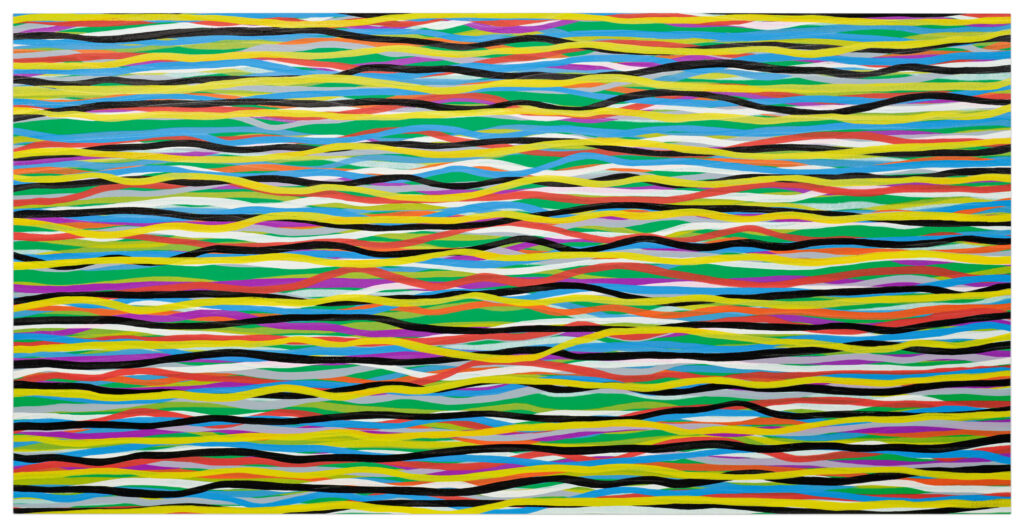
Horizontal Wavy Brushstrokes in Color, 2006, Sol Lewitt
Colour as Structure, Not Decoration
LeWitt’s use of colour in his prints is another place where he parted ways with his era. Colour in much 1970s printmaking was expressive – it carried emotion, atmosphere, personality. Think of the hot pinks and acid yellows of pop art prints, or the moody, painterly washes in the work of artists working in the expressionist tradition. Colour was feeling made visible.
For LeWitt, colour was structure. In his Colour Bands prints or the later woodblocks, colour functions the way grammar functions in a sentence – it organises, it separates, it creates relationships. He used it according to rules. Red, yellow, blue, and sometimes a fourth. Applied in flat, even washes. No blending, no atmosphere, no hierarchy of importance. The result is prints that feel strangely democratic — no single element is more significant than another – and yet intensely ordered. It’s a difficult balance to pull off, and he pulled it off constantly.
Sol LeWitt’s Legacy: How His Prints Changed Everything After Him
What makes LeWitt’s prints genuinely strange is how influential they became without ever quite being imitated. You can’t really copy a LeWitt print, because what you’d be copying is a set of instructions, and if you follow those instructions honestly, you’d just be making another LeWitt. His ideas about systems, seriality, and the separation of concept from execution seeded decades of subsequent practice – in generative art, in digital design, in the whole field of algorithmic creativity that now feels so contemporary.
His contemporaries made extraordinary prints. But most of them were in conversation with the history of mark-making. LeWitt was in conversation with something else entirely – with mathematics, with language, with the idea that an artwork could exist before it was made, and that the making was almost beside the point. In the end, that’s what set him apart. Not what he printed, but what he believed about what printing could be.
Which Sol LeWitt Prints Should Collectors Look For?
LeWitt’s printed output is vast – he was extraordinarily prolific, and his systematic approach to art-making meant that editions multiplied naturally from his working methods. For collectors, this abundance is both an opportunity and a challenge. Understanding the different periods, techniques, and series is essential to navigating the market intelligently.
The Geometric Figure Prints (1970s–1980s)
LeWitt’s earliest and most recognised print series – the geometric figures, the line combinations, the squares and their permutations – are the works through which most collectors first encounter his printed output. Works like Six Geometric Figures & All Their Combinations (1980) exemplify the qualities that define this period: precise, system-generated imagery, limited palettes of primary colours, and a formal rigour that rewards sustained looking. These prints are widely available, produced in editions that range from modest to substantial, and they represent the most accessible entry point into LeWitt’s work. Their prices reflect their relative availability, but also their cultural importance – they are as close to canonical as contemporary prints get, and institutions continue to acquire them actively.
The Line Series and Colour Combinations (Late 1970s–1990s)
Running parallel to the geometric figure works, LeWitt produced an extensive body of prints exploring the permutational possibilities of line direction and colour combination. These works – often screenprints, sometimes etchings – document the application of his systematic method to progressively more complex rule sets. A print in this category might involve all possible combinations of four line directions in four colours across a grid of squares: the logic is transparent and verifiable, and yet the visual result is often unexpectedly rich. For collectors interested in the intellectual foundations of his practice, these works offer the clearest window into how his mind worked. They tend to be competitively priced relative to their art-historical significance.
The Wavy Line and Brushstroke Prints (1990s–2000s)
In the 1990s, LeWitt introduced a new formal element that surprised many who had come to think of him purely in terms of straight lines and hard geometry: the irregular, organic curve. Works like Horizontal Wavy Brushstrokes in Color (2006) demonstrate a late-career willingness to introduce apparent spontaneity into the system – though of course the curves are themselves subject to rules, their application as systematic as everything else he made. These works are visually warmer than the earlier geometric prints, and they have attracted a broader collector base as a result. They also tend to be more recent in production, meaning condition issues are less prevalent. For collectors who respond to the energy of his late work but find the earlier geometric prints too austere, this is the natural entry point.
The Wall Drawing Print Editions
A distinct category within LeWitt’s output: prints conceived explicitly in relation to his Wall Drawing practice, where the same instruction that generates a large-scale wall installation is distilled into a signed, editioned work on paper. These prints carry a conceptual charge that other editions sometimes lack – they exist in direct, visible relationship to one of the most significant bodies of work in contemporary art – and they are prized accordingly by collectors who understand their position within his practice.