Robert Rauschenberg worked across virtually every major printmaking technique available to him, and in several cases pushed those techniques into territory their originators would barely have recognised.
What distinguished his approach was not mastery in the conventional sense – the production of flawless, controlled impressions – but rather a systematic probing of what each process would do under unusual conditions.
He treated every technique as a set of physical and chemical facts to be tested, and his most significant technical contributions came precisely from those moments when he introduced something the process was not designed to accommodate.
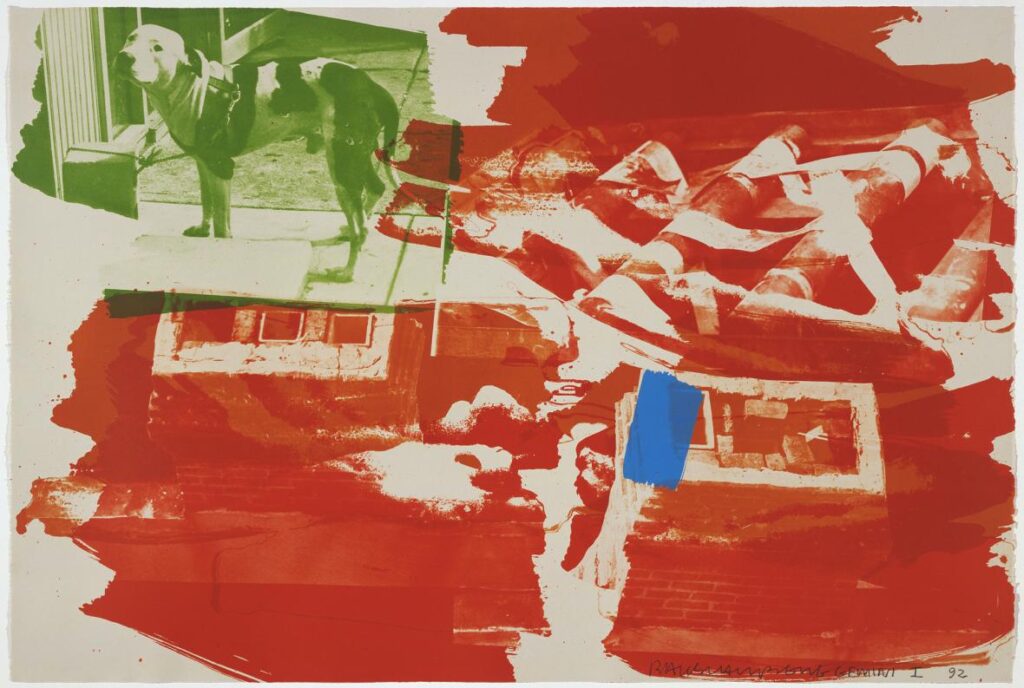
Rust Pursuit, Robert Rauschenberg, Gemini G.E.L. at Joni Moisant Weyl
Grease, Water, and Coca-Cola: The Lithographic Stone as Laboratory
Lithography was the medium in which he first worked seriously, and it suited him because its underlying logic is chemical rather than mechanical. The process depends on the antipathy between grease and water – a greasy mark on a limestone or aluminium surface will accept oil-based ink while the dampened surrounding area repels it.
Rauschenberg understood this chemistry intuitively and immediately began to exploit its edges. He drew on stones with unconventional substances, most famously Coca-Cola, to test how the sugar and acid content of the liquid would interact with the limestone surface. He combined hand-drawn marks with photographic imagery transferred photographically onto the stone, layering the two in ways that made it difficult to distinguish gestural from mechanical marks.
He also worked with multiple stones in a single print, building up complex surfaces through successive runs through the press, each pass adding a new layer of colour, texture, or imagery. The resulting prints had a density that was genuinely new to lithography – they looked less like prints in the traditional sense and more like surfaces that had accumulated history.
The Solvent Transfer: His Most Original Invention
His solvent-transfer technique, though developed outside the formal print workshop, was in many respects his most original technical invention and the one that most directly expressed his thinking about images and reproduction.
The process involved soaking a magazine or newspaper page in lighter fluid or another solvent, placing it face-down on a sheet of paper, and burnishing the back with a pencil or spoon. The pressure and the solvent together caused the printed ink to release from the magazine page and adhere partially to the receiving surface. The transferred image was always degraded – softer, grainier, slightly displaced – because the process introduced loss at every stage.
Rauschenberg embraced this degradation completely. The transferred image carried the ghost of its source while being visibly transformed by the physical act of transfer, and this quality of simultaneous recognition and estrangement was central to everything he wanted his imagery to do. When he later moved into photolithography and screen printing, he brought this same appetite for productive degradation with him.
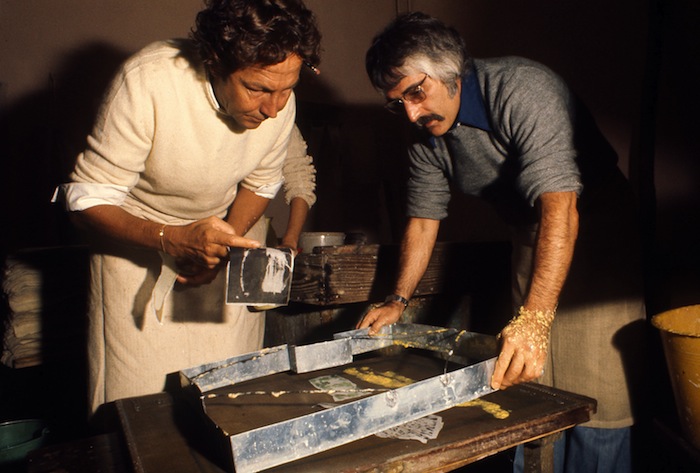
Kenneth Tyler positioning a galvanised metal mould on top of a paper mould with screen printed tissue, while
Robert Rauschenberg prepares to pour pulp into mould for Roan, from the ‘Pages and Fuses’ series.
Burn, Transfer, Layer, Repeat: Screenprinting Against Its Own Nature
At Gemini G.E.L. he developed his lithographic practice further in collaboration with master printer Kenneth Tyler, producing prints of enormous physical scale that required the workshop to build custom equipment. He worked with hand-made papers of unusual absorbency and texture, understanding that the surface receiving the ink was as active a participant in the final result as the matrix carrying it.
He experimented with ink viscosities, sometimes working with inks thinned to near-transparency so that successive layers remained visible through one another, building a kind of optical depth that was quite different from the flat surface of conventional printmaking.
The Acid’s Own Agenda: Etching and Aquatint
His work with etching and aquatint, though less central to his practice than lithography and screenprinting, showed the same pattern of technical investigation. He used acid biting not to produce clean, controlled lines but to create bitten surfaces of considerable textural complexity, sometimes allowing the acid to work longer than convention recommended in order to produce a roughness and irregularity that suited his aesthetic.
He combined etched passages with aquatint tones and photographic elements with the same layering logic he applied everywhere else.
The Mark the Process Left Behind
Throughout all of these techniques, the constant was his understanding that the physical process of making a print was itself a form of image-making, and that the marks left by chemistry, pressure, and material behaviour were as meaningful as anything he put there deliberately.
For Rauschenberg, something was always lost in transfer – and that loss was never a failure. It was the work.