He swore he only wanted to paint. So why did one of Britain’s most violently original artists spend his final three decades quietly building an empire of ink?
Francis Bacon hated the word “reproduction.” He built a career on the unrepeatable – on the accident of a loaded brush dragged across raw, unprimed canvas, on paint that did things he “could not make it do.” To Bacon, a painting was a live event, a controlled collision between chance and intention that could never happen the same way twice. So it’s a strange twist of art history that this same man, so allergic to anything mechanical or premeditated, spent from the 1960s until his death in 1992 collaborating with master printmakers on lithographs and etchings – building a body of prints, largely drawn from thirty-five of his own paintings, that today anchors an entire secondary market of its own.
It’s a genuine puzzle. Bacon wasn’t a printmaker by training or temperament. He never attended art school, never apprenticed in a print studio, and famously worked alone, door locked, in the chaos of his Reece Mews studio in South Kensington. So what pulled him toward a medium built on multiples, technicians, and process – the very opposite of everything he claimed to believe in?
An artist who never trusted his own hand to repeat itself
Understanding why Bacon turned to prints means understanding what he thought painting actually was. He described it to the critic David Sylvester as fundamentally a matter of accident – he wanted an ordered image that had nonetheless come about by chance. He worked with oversized brushes precisely because they wouldn’t fully obey him, producing effects he couldn’t have engineered on purpose. That philosophy makes prints a genuine contradiction: etching and lithography are inherently more controlled, more repeatable, more collaborative than anything happening at Reece Mews.
And yet the contradiction is exactly what makes the prints interesting. Rather than treating them as mechanical copies, Bacon and the master printers he worked with treated each print as a fresh act of translation – an attempt to smuggle the violence of his paintings into an entirely different physical process. According to the print specialists who study his editions, his prints retained the raw power and immediacy of his canvases, translating his distorted figures through lithography and etching rather than simply duplicating them. The etching plate, bitten with acid and packed with ink, became its own kind of unpredictable surface – the technique let him build deep lines and stark tonal contrasts that preserved the drama and psychological weight of the original paintings.
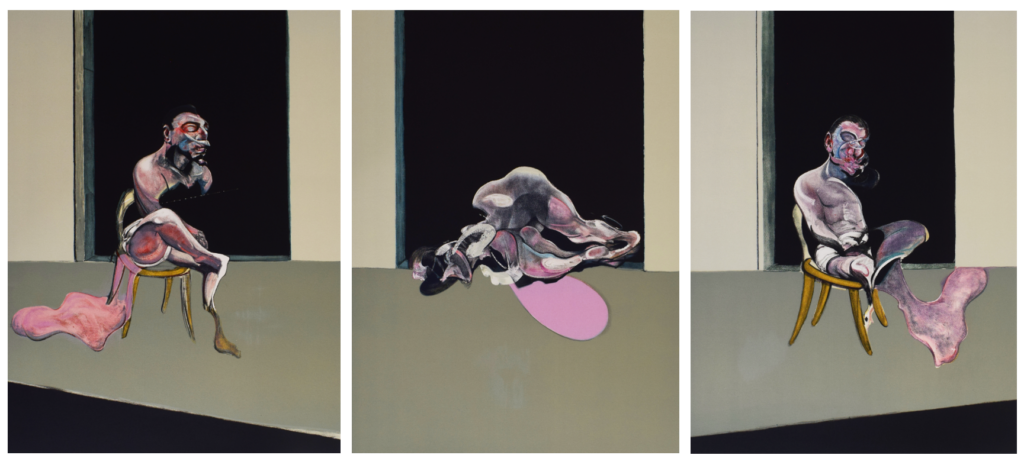
Triptych August 1972, Francis Bacon, Gilden’s Art Gallery
A market problem masquerading as an artistic one
There’s a blunter explanation too, and it has nothing to do with aesthetics: scarcity. Bacon painted in the region of 590 surviving canvases across a nearly six-decade career, and he destroyed a staggering number more – by some accounts entire studios’ worth of work he judged unworthy. Add to that his habit of returning obsessively to the same handful of subjects — screaming popes, wrestling lovers, tormented self-portraits – and you get an oeuvre that was rare almost by design. Original Bacon paintings were, and remain, essentially unreachable for all but the world’s wealthiest collectors and institutions; his 1969 triptych of Lucian Freud sold in 2013 for $142.4 million, one of the highest prices ever paid for a single artwork at that time.
Prints solved a problem that pure genius couldn’t: they let a much wider public actually own something touched by Bacon’s hand. Beginning in the 1960s, he began working with print studios specifically to reinterpret his most iconic paintings in editioned form – a decision that turned singular, unrepeatable canvases into limited runs that collectors of far more modest means could realistically pursue.
The control freak in the print studio
What separates Bacon’s prints from a cynical cash grab is how obsessively involved he stayed in making them. Bacon was, by every account, exacting to the point of tyranny about his paintings – and that same instinct followed him into the print workshop. Reports on his process describe him personally overseeing production, sometimes going so far as to hand-finish individual prints himself. This wasn’t an artist licensing his name to a factory; it was an artist treating the print run itself as an extension of the studio, worth the same relentless scrutiny he gave a canvas.
That obsessiveness shows in the results. Look at a piece like Study for a Portrait of John Edwards – it demonstrates his meticulous to preserving the darkness and distortion running through his paintings, so that the emotional weight carries through from canvas to print rather than getting flattened by the process. The prints weren’t meant to be a lesser echo. They were meant to survive contact with a totally different physical medium and still scream.
Photography, memory, and a mind built for translation
There’s a deeper reason the leap into printmaking wasn’t as foreign to Bacon as it might first appear: his paintings were never really “originals” in the naive sense to begin with. Bacon worked largely from photographs rather than live models, drawing on a sprawling, disorganized personal archive that included crime-scene photography, medical textbooks, and torn magazine pages – many of them stained, crumpled, or otherwise physically altered. His entire creative method was already an act of transformation – taking flat, mechanically reproduced images and reworking them into something charged and alive on canvas. Making prints, in that light, was simply running the same instinct in reverse: taking a living painting and translating it back into a flat, reproducible form, with the same intensity of attention he’d once given the source photographs.
His studio biographer put it sharply: Bacon insisted the printed material he collected was fuel, never the finished thought – he wanted, in his own words, to “trap this living fact alive,” not simply hunt for cuttings. Prints let him test whether that “living fact” could actually survive the crossing into a mechanical medium – and, painting after painting, it largely did.
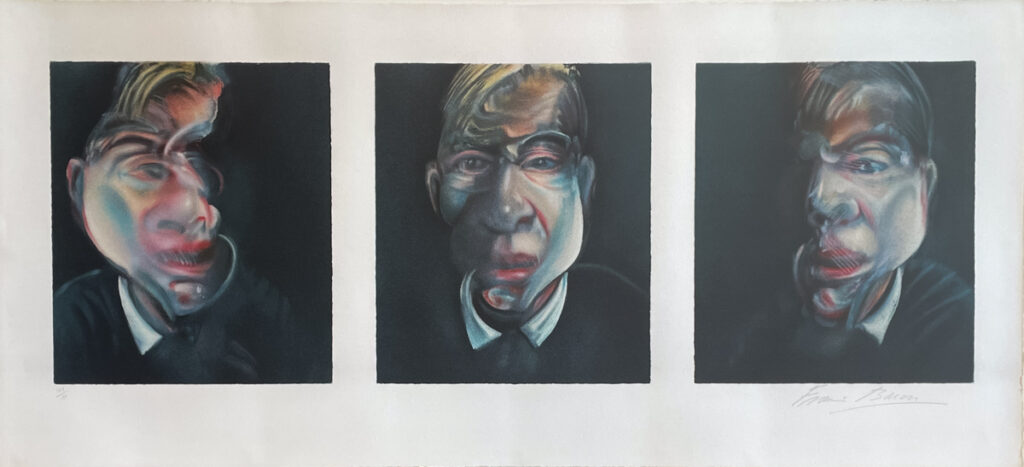
Three Studies for a Self Portrait, 1981, Francis Bacon, Jim Kempner Fine Art
The printers who earned his trust
Bacon didn’t hand his images to just anyone. In the 1970s he began working with master printers such as Georges Visat, and his editions were produced through a small circle of respected Parisian workshops rather than mass-market print houses – the same milieu that had once served Picasso, Matisse, and Chagall. Interestingly, he barely touched the most storied lithography atelier of them all: at the famous Mourlot workshop, whose founder Fernand Mourlot had built the twentieth century’s great lithographic partnerships, Bacon produced only a handful of prints, a footnote often described by print historians as a missed opportunity rather than a rejection of the workshop’s skill. It suggests that Bacon’s choice of collaborators was less about prestige and more about finding a printer whose sensibility matched the specific violence he was trying to preserve on paper.
The market has since ratified his instincts. His prints are now cataloged with the same rigor as his paintings, tracked through dedicated reference works and auction indices, and specific editions have set records in their own right – a portfolio of four lithographs, Miroir de la Tauromachie, sold for over £106,000 at Sotheby’s in 2015, a striking sum for works that began life as “mere” multiples.
A legacy measured in scarcity, not volume
What’s striking, given everything, is how small Bacon’s printed output actually stayed. Across three decades of intermittent collaboration with master printers, he produced only around forty editions total – a modest number for an artist this famous, and a figure that tells you the prints were never meant to flood the market. He wasn’t chasing volume. He was choosing, painting by painting, which images deserved a second life outside the original canvas.
That restraint is arguably the real answer to why Bacon made prints at all. Not because he’d softened his suspicion of the mechanical, and not purely for money – but because printmaking gave him a second language for the same obsession that drove every canvas: finding out whether raw, unbearable feeling could survive a process designed, on paper, to tame it.