To understand Munch’s obsession with printmaking, you must first understand the relentless parade of loss that shaped him. By the time he was twenty-five, Munch had watched his mother die of tuberculosis, then his beloved sister Sophie, then navigated a father crumbling under religious mania. “Disease, insanity, and death were the black angels that kept watch over my cradle,” he wrote – and he wasn’t being poetic. He was being precise.
When Munch arrived in Paris and Berlin in the 1890s and encountered the emerging world of printmaking – etching, lithography, woodcut – something clicked that went beyond mere technique. Here was a medium that didn’t just record an image. It suffered to produce one. The gouging of wood, the acid biting into copper, the stone dragged across paper: these were acts of physical violence that mirrored his interior life perfectly.
“I do not paint what I see, but what I saw.” – Edvard Munch
Munch Was Broke – and He Was Brilliant About It
Let’s be honest about something that art history often elides: Munch was frequently destitute. The bohemian circles of Christiania and Berlin offered intellectual stimulation but not a reliable income. Paintings were expensive to produce and hard to sell. Prints were neither.
A single woodblock or lithographic stone could yield dozens – sometimes hundreds – of impressions, each one saleable. Munch was sharp enough to recognise this arithmetic. But here is where his genius diverges from mere commerce: rather than treating the print as a cheap reproduction of a painting, he treated it as an entirely different kind of truth about the same subject.
He would return to the same image – The Sick Child, The Kiss, Madonna – in oil, then in etching, then in lithography, then in woodcut, each version stripped of something, gaining something else. The print was not a copy. It was a new confession.
Løsrivelse II / Separation II (1896), Edvard Munch
The Woodcut Was Made for a Man Who Thought in Scars
Of all the print techniques Munch explored, the woodcut became his most visceral and personal. Unlike the refinement of etching, woodcut demanded brutality. You took a knife or gouge and you removed what you didn’t want. The wood resisted. It splintered along the grain in directions you hadn’t planned. And Munch – in an act of radical honesty – let it.
He embraced the grain of the plank as a collaborator, not a flaw. In prints like Anxiety (1896) and The Kiss (1897), the wood’s natural lines run through the figures like veins, or like the invisible current of dread that connects one human to another. No other medium could have produced this effect. Oil paint is too forgiving. The woodcut has a memory – every cut is permanent, every error incorporated.
Edvard Munch Wasn’t Repeating Himself. He Was Trying to Get It Right.
One of the most remarkable and misunderstood aspects of Munch’s printmaking practice is the compulsive repetition. The Sick Child alone exists in at least six painted versions and multiple print variants. Why? Munch himself offered an answer: “I keep working on the same motifs … I want to see more clearly what I actually felt.”
This is not the behaviour of a man recycling successful images for profit. This is the behaviour of a trauma survivor circling the wound – not to reopen it, but to finally understand its shape. Each new medium forced a new confrontation. The lithograph could not lie in the same way as oil paint. The woodcut stripped away the nuance that oil permitted, leaving only the essential anguish or the essential tenderness. And so Munch kept returning, kept stripping down, kept asking the same question of the same image until the medium itself gave him a different answer.
“My whole life has been spent walking by the side of a bottomless chasm, jumping from stone to stone.” – Edvard Munch
He Wanted His Nightmares to Hang in Ordinary Homes
There is something quietly radical in Munch’s commitment to printmaking that goes beyond psychology and economics. Prints were affordable. They could be owned by people who could not dream of acquiring a painting. And Munch – for all his self-mythologising – cared deeply about this.
He spoke of wanting his art to reach the widest possible audience, to communicate the universal fears and longings that he believed united all human beings beneath their social masks. A lithograph of The Scream could hang in a schoolteacher’s home, a doctor’s waiting room, an artist’s bedsit in Berlin. The painting stayed on the gallery wall; the print went into the world.
In this sense, Munch was operating with a quietly modern instinct – not unlike the impulse behind today’s digital reproductions — that the power of an image is multiplied, not diluted, by its dissemination.
A Clinic in Copenhagen Changed Everything About How He Printed
In 1908, Munch suffered a complete nervous collapse – hallucinations, paralysis of the limbs, profound paranoia – and checked himself into Dr. Daniel Jacobson’s clinic in Copenhagen. He would spend eight months there. When he emerged, something had shifted irrevocably.
His post-clinic printmaking is bolder, less tortured, more expansive. The claustrophobic interiors and writhing figures give way to landscapes, workers, horses, the Norwegian coast under clear light. But he did not abandon prints. If anything, he made more of them, with more colour, more confidence, more willingness to let the process be seen.
The breakdown, paradoxically, unlocked a freer relationship with the medium. He no longer needed the print to carry the full weight of his psychic survival. It became, instead, a studio practice – a daily dialogue with material and memory that sustained him through the remaining thirty-five years of his life.
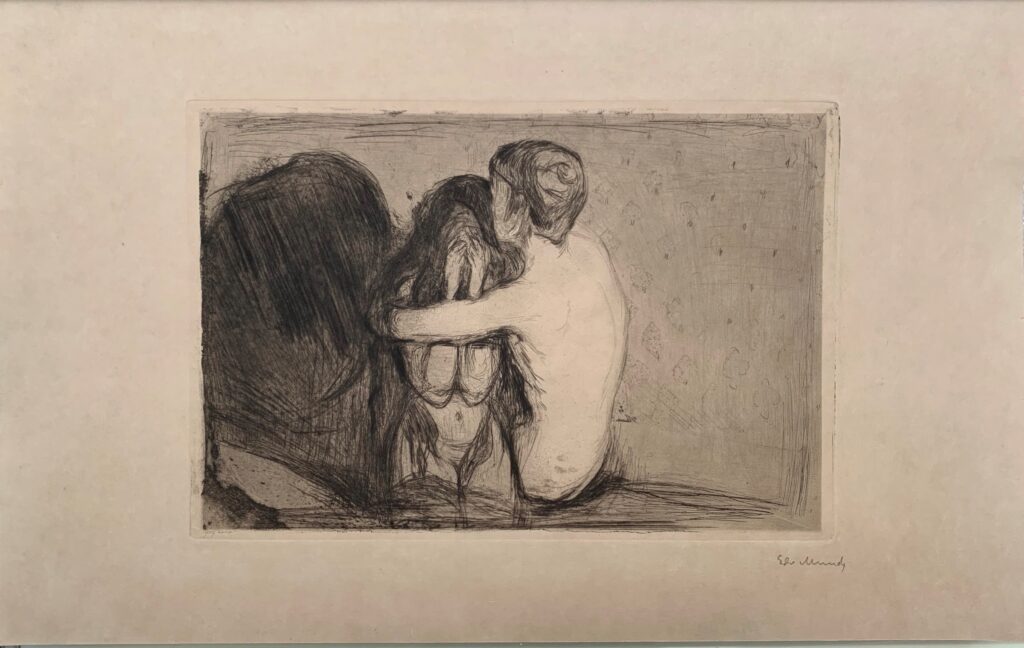
Trøst (Consolation) (1894), Edvard Munch
He Made 700+ Prints. That Number Is a Philosophical Statement.
Munch produced over 700 individual print compositions – a body of work that dwarfs most artists’ entire output. This is not the behaviour of someone treating printmaking as a sideline. This is total commitment to a medium that the art world, for much of the 20th century, ranked below painting in its hierarchy of prestige.
Munch didn’t care. He understood – perhaps before almost anyone else – that the print’s so-called limitations were its gifts. The flatness, the grain, the resistance of material, the necessity of reversal, the economy of mark: these were not constraints but truths. Truths about perception, about memory, about how an emotion, once felt, is never felt the same way twice — only approximated, approached, pulled from a stone or a plank and pressed, imperfectly, onto paper.
He was not printing images. He was printing states of being. And the world, eventually, could not stop buying them.