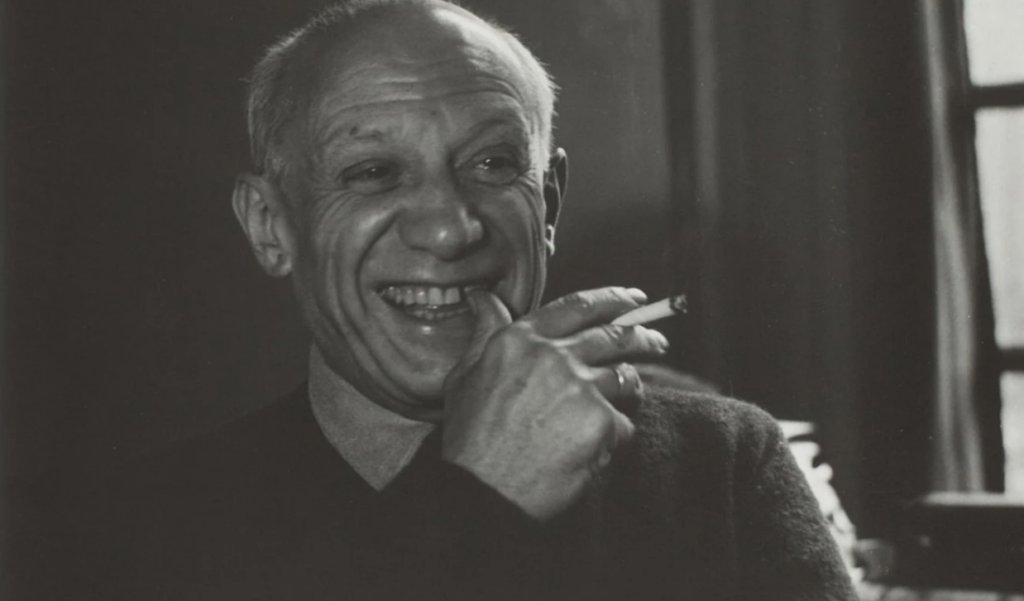
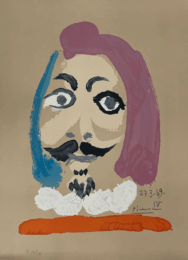
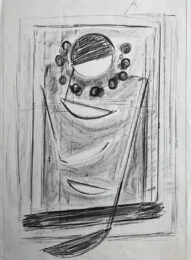
We speak endlessly of Picasso’s genius, his fury, his eroticism, his ego. We analyse the fractured planes of Les Demoiselles d’Avignon and the anguished geometries of Guernica with the gravity they deserve. Yet one of the most revealing — and least examined — windows into the man is a far simpler question: What made Pablo Picasso laugh?
The answer, it turns out, tells us almost everything.
The Absurd and the Everyday
Picasso was, at his core, a Mediterranean man who found deep comedy in the collisions of the mundane and the ridiculous. Friends and biographers consistently noted that he laughed loudest not at wit or wordplay, but at situations – at the accidental poetry of ordinary life going sideways. His longtime companion Françoise Gilot, in her memoir Life with Picasso, recalls him dissolving into laughter at a dog refusing to move from the middle of a Parisian café, holding up an entire lunchtime service. The image of bourgeois dignity stalled by animal indifference was, for Picasso, a kind of visual joke – the sort of thing he spent his entire career painting.
This love of the absurd was not coincidental. It was deeply connected to his artistic philosophy. Picasso believed that conventional logic was the enemy of true seeing, and nothing dismantled conventional logic faster than a good absurdist gag.
He Laughed at Authority – Especially His Own
Picasso had a notorious talent for self-mockery, though he wielded it selectively and strategically. He was fully aware of the cult that had formed around him, and he took enormous, private pleasure in puncturing it. He would, on occasion, sign worthless scraps of paper – grocery lists, cigarette packets – and hand them to overly reverent admirers with a perfectly straight face, knowing full well they would frame them. The joke was on pomposity itself.
He also loved to laugh at the art world’s pretension. When a critic once delivered a long, earnest interpretation of one of his paintings that was entirely incorrect, Picasso did not correct him. He simply grinned. The gap between what art meant and what people decided it meant was, to him, a permanent and delicious comedy.
Animals, Children, and the Unguarded Moment
Those who knew Picasso intimately – his children, his studio assistants, his lovers – all noted the same thing: he was helplessly amused by animals and small children, because both operated entirely outside the theatre of adult self-consciousness. His dachshund, Lump, reportedly made him laugh daily. His Afghan hound, Kabul, sent him into fits by crashing through the studio with aristocratic obliviousness to the canvases in its path.
Children, too, particularly his own, could reduce him to laughter in a way that almost nothing else could. There is a famous anecdote in which his young son Claude, having watched his father labour intensely over a composition, marched up and drew a cheerful scribble straight across it. Picasso – according to those present – laughed until he wept. The scribble stayed.
The Joke as an Artistic Tool
It would be a mistake to treat Picasso’s sense of humour as separate from his art. His ceramics, in particular, are full of visual puns and gentle jokes – faces lurking inside owls, fish that become women, bulls that wink. His assemblages were frequently mischievous: the famous bull’s head made from a bicycle seat and handlebars (Tête de taureau, 1942) is, at its heart, a masterpiece of deadpan comedy. Picasso wanted you to see it and laugh before you thought — and then to keep thinking long after the laughter faded.
He was, in this sense, an inheritor of the great Spanish picaresque tradition – the tradition of Cervantes, of Goya’s Caprichos, of art that uses laughter as a blade rather than a cushion.
He Laughed at Death, But Nervously
As he aged, Picasso’s humour darkened, as it does for anyone who stares long enough at their own mortality. He made jokes about death with increasing frequency, though his friends noted they were the jokes of a man who was not entirely sure they were jokes. He once quipped that he painted so prolifically because every canvas was a small argument with dying – and then laughed at the grandiosity of the statement before anyone else could.
There was, in this, something genuinely touching. The laughter was a form of courage. It was Picasso refusing to grant death the dignity of being taken entirely seriously.
Conclusion: The Grin Behind the Mask
To understand what made Picasso laugh is to understand that he was not the iron monument that legend made him. He was a man who found the world inexhaustibly, riotously funny – in its pretensions, its accidents, its animals, its children, and its stubborn refusal to make neat sense. That laughter was not separate from his genius. It was his genius, or at least its twin.
The next time you stand before a Picasso and feel slightly unsettled, slightly off-balance, slightly as though the painting is watching you rather than the other way around – that is Picasso laughing. He set the joke up decades ago. You are simply walking into the punchline.