
Why Do Artists Make Deliperate Nistakes?
From Islamic weavers to Andy Warhol, the intentional imperfection has a long, fascinating – and surprisingly valuable – history in printmaking
Pick up almost any hand-pulled print and look closely. Really closely. You’ll find it: an ink bleed at the edge, a ghost impression from a previous run, a registration that’s fractionally off. Your instinct might be to call it a flaw. But what if the artist put it there on purpose?
The idea of the intentional mistake is older than printmaking itself – and it runs surprisingly deep through the craft. Whether it’s a spiritual belief, a technical philosophy, or a marketing masterstroke, artists and printmakers have been building imperfections into their work for centuries. Here’s why.
“Only God Makes Perfect Things” – The Spiritual Case for Flaws
Long before the lithography press existed, Islamic carpet weavers were deliberately introducing a single mismatched knot into their intricate patterns – a tradition rooted in the belief that only God could create perfection, and that to attempt it was an act of arrogance. The deliberate error was an act of humility.
This thinking filtered through the decorative arts and, in time, into printmaking cultures. Japanese woodblock printing, the art of ukiyo-e, carries a related sensibility: the ghost impression – a faint echo of a previous print left on the block – was not always wiped away. Some Edo-period masters considered that spectral trace to be evidence of the print’s making, a kind of temporal depth that a “perfect” impression simply could not have.
Whether you find this persuasive or not, it points to something real: in many printmaking traditions, technical evidence of the process was considered part of the work — not a failure to hide, but a truth to preserve.
When the “Mistake” Is Actually the Technique
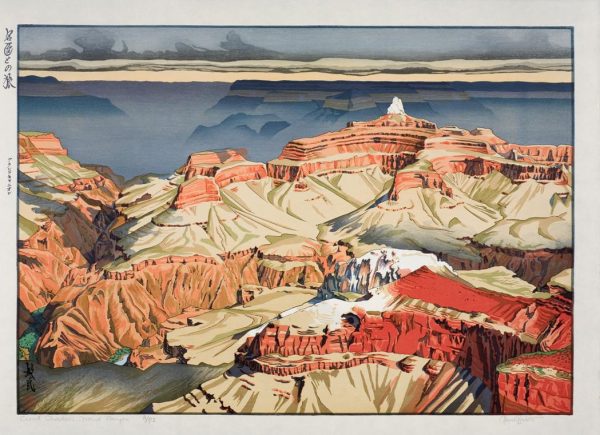
Many of what look like imperfections are, in fact, the result of techniques pushed deliberately to their edge. Take the reductive woodcut: an artist carves, prints, carves again from the same block – a process that is, by definition, irreversible. Each successive colour layer is locked in. There is no correcting course. The slight misalignment between layers, the areas where ink bleeds slightly beyond its intended boundary – these aren’t accidents. They’re the visual record of a method that demands commitment.
Viscosity printing: inks of different consistencies repel each other unpredictably. The uneven spread is the whole point — and no two pulls are alike.
Stanley William Hayter, the British printmaker who founded Atelier 17 in Paris, built an entire school around this philosophy. His students – Picasso, Miró, Pollock among them – were encouraged to treat the unexpected result not as something to correct, but as something to respond to. The “mistake” became a prompt.
The Edition Number That Doesn’t Add Up
Here’s where things get commercially interesting. Collectors of limited-edition prints know to look at the edition number – 3/50, say, means the third print pulled from an edition of fifty. But there’s a long-standing question about what those numbers actually mean.
In traditional intaglio printing, the earliest pulls from a plate are often the sharpest, the ink sitting cleanest in the freshly etched lines. As the edition progresses, the plate wears. Later prints can look softer, slightly different. The deliberate choice to not number prints sequentially – to mix early and late pulls within the edition – is, depending on who you ask, either an irrelevant technicality or a quiet manipulation of the collector market.
Some artists went further. Rembrandt – arguably the greatest printmaker in history – would rework his plates mid-edition, introducing new marks, scratching out others, and then continuing to sell prints. These “states” (different versions of the same plate) are now among the most collected and studied objects in art history. What looked like revision, or even error, turned out to be something closer to a serial artwork.
Warhol, the Silkscreen, and the Beautiful Mess
If Rembrandt is the historical case for deliberate imperfection, Andy Warhol is the modern one. His silkscreen works — the Marilyns, the Maos, the disaster series – are famously full of what a commercial printer would classify as defects: misregistered colours, ink blotches, uneven coverage.
These were not accidents. Warhol understood that the silkscreen process, derived from commercial mass production, carried with it the visual language of manufacturing – and manufacturing has variance. By using a technique associated with industrial repetition but allowing (and exaggerating) its imperfections, he created works that commented on the very nature of reproduction, celebrity, and the idea of the “original.”
The bleed at Marilyn’s hairline isn’t sloppy printing. It’s the argument of the piece.
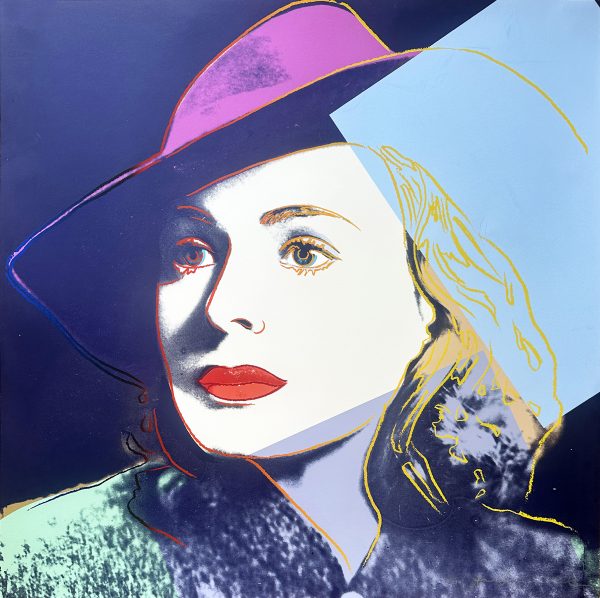
Ingrid Bergman With Hat 315 (Trial Proof), 1983, Andy Warhol
How Do You Tell a Deliberate Flaw from a Genuine One?
This is, frankly, the hard question – and it matters if you’re buying. A foxed, damaged, or poorly stored print has value-reducing flaws that are nothing to do with artistic intent. An ink spread at the edge of a Hockney screenprint is structural to the work. The difference lies in consistency and context.
A few principles that experienced collectors and dealers use:
Does the “flaw” appear consistently across the edition?
If the same bleed, ghost, or registration shift appears on multiple pulls, it’s part of the work. If it appears only on one print, it may be damage or a unique variant – both worth investigating, for different reasons.
Does the artist’s catalogue raisonné address it?
For significant artists, the catalogue raisonné will note known states, variants, and technical characteristics. An anomaly described there is documented – and often highly desirable.
Does it enhance or diminish the image?
This is subjective, but experienced eyes develop a feel for it. A feature that draws the eye into the composition is almost never accidental. A feature that distracts or reads as decay usually isn’t intentional.
The Imperfect Print as Perfect Investment
There’s a final twist worth noting. Rare states, known variants, and documented anomalies within limited editions consistently command premiums at auction. The reasoning is straightforward: scarcity within scarcity. If an edition of 50 contains three prints with a particular overinking that the artist later acknowledged, those three prints become a sub-edition of their own.
Whether the original “flaw” was deliberate, tolerated, or retrospectively elevated by the artist’s approval, the market’s response is remarkably consistent: it pays for difference. The print that looks least like the others is often the one collectors fight hardest to acquire.
So the next time you’re looking at a print and something catches your eye – a strange ink pool, an impression that seems to push just beyond the image – don’t assume it’s a problem. Ask instead whether it might be the most carefully considered mark on the sheet.