Of all the instruments that have shaped the history of Western printmaking, none is more fundamental – nor more demanding of mastery – than the burin. This deceptively simple tool, little more than a hardened steel rod set into a rounded wooden handle, has been the primary means by which artists have incised images into metal plates for over six centuries. To hold a burin is to hold a direct line to Dürer, Mantegna, and Goltzius; to push it through copper is to participate in one of the most physically and intellectually exacting traditions in the entire history of art.
The burin functions by displacement rather than removal. As the engraver drives the tool forward through the metal, it carves a clean V-shaped furrow, pushing a small curl of copper – known as a pip – ahead of its tip. The quality of the line produced depends entirely on the angle at which the burin is held, the speed and pressure of the push, and the subtle rotation of the plate beneath the tool. A line begun with hesitation will show it; a line driven with confidence sings with a clarity that no other printmaking technique can replicate. It is this unforgiving directness that makes engraving both the most disciplined and the most expressive of the intaglio processes.
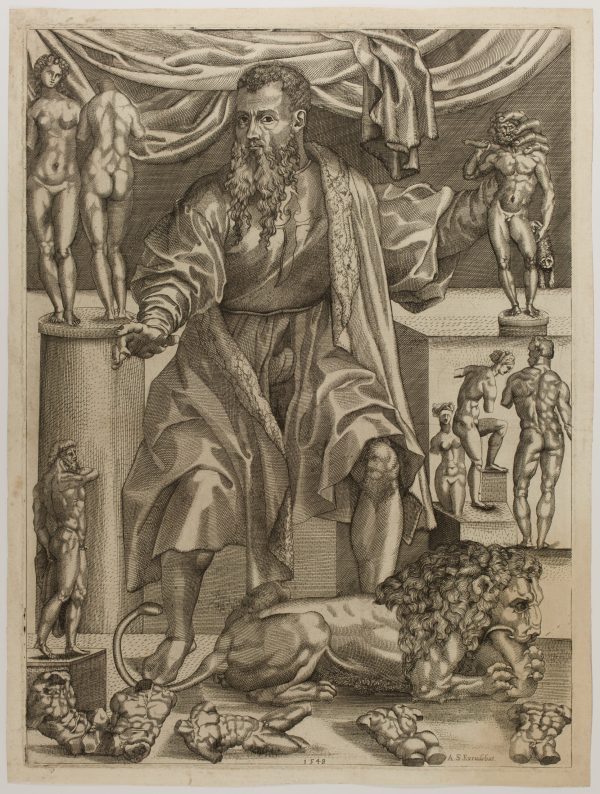
Baccio Bandinelli in his workshop (1548), Nicolo della Casa, Sarah Sauvin
Burins are manufactured in a range of profiles, each suited to a different purpose. The lozenge-point, with its diamond-shaped tip, is the workhorse of engraving, capable of producing lines that swell and taper with extraordinary sensitivity as pressure is varied mid-stroke. The square-point cuts a slightly wider channel and is prized for bold architectural lines. The flat graver is deployed to burnish and refine rather than incise, while the spit-sticker, with its elliptical tip, is the engraver’s instrument of choice for the finest, most delicate curves. A master printer will possess a roll of a dozen or more burins, sharpened to personal preference on an Arkansas stone, each as familiar in the hand as an old friend.
The tonal range achievable with the burin is remarkable. By varying the spacing and weight of parallel lines – a system of mark-making known as hatching – and by introducing cross-hatching, curved flick-lines, and stippled dots, an engraver can render everything from the deepest shadow to the most luminous highlight within a single plate. This tonal control is what elevated the engraving to the pre-eminent reproductive medium of the Renaissance and Baroque periods, capable of translating the paintings of Raphael and Rubens into widely distributable prints that circulated across Europe and shaped artistic taste for generations.
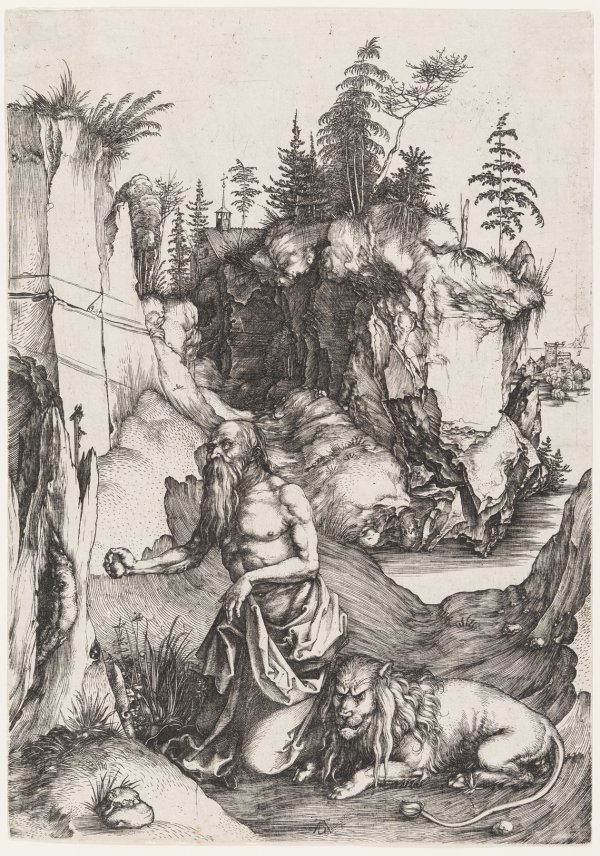
St. Jerome Penitent In The Wilderness (1496), Albrecht Dürer, Christopher-Clark Fine Art
Today, in an age saturated with digital imagery, the handmade engraving occupies a position of renewed cultural prestige. Contemporary artists and master printers who take up the burin do so with full knowledge of the tradition they are entering – and of the extraordinary demands it places upon them. Each plate can require hundreds of hours of concentrated work. There are no shortcuts, no undo functions, no digital filters. There is only the burin, the copper, and the accumulated skill of a lifetime. The prints that result carry within them something irreplaceable: the direct physical trace of a human mind working at the very edge of its capacity.