The finished print on the gallery wall tells only half the story. The other half lives in a battered notebook on a workshop shelf.
More Than a Craftsperson
When we speak of printmaking, we tend to speak of artists – of Rembrandt’s etchings, Hokusai’s woodblocks, or Hockney’s lithographs. The printer, the person who actually runs the press, mixes the ink, and pulls the edition, is so often cast as a skilled but secondary figure: a pair of expert hands in service of someone else’s vision. This framing does a quiet disservice to what a master printer actually does. Because a good printer is not simply a technician. They are a custodian of knowledge, a keeper of process, and – in ways that matter enormously to art history, scholarship, and the market – an archivist of the first order.
The archive a printer builds over the life of an edition is not incidental to the work. It is part of the work. Without it, a print is an object adrift from its own history.
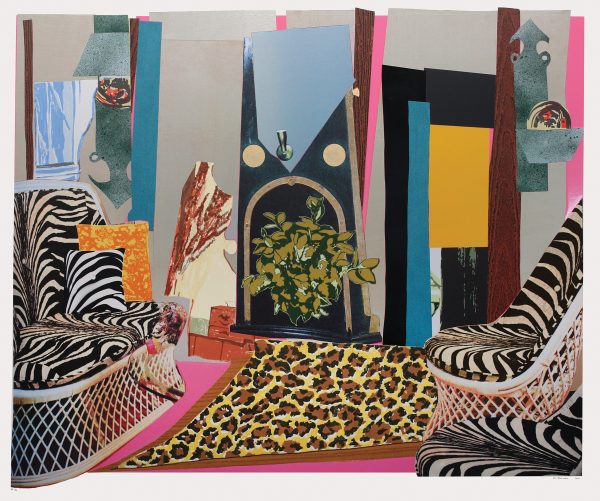
Interior: Zebra With Two Chairs And Funky Fur, Mickalene Thomas, Tandem Press
What Gets Written Down
Step into any serious printmaking studio and you will find, somewhere amid the smell of linseed oil and solvent, a record-keeping system that would not look out of place in a laboratory. Ink formulas – precise ratios of pigment, modifier, and base – noted down with the same care a pharmacist brings to a prescription. Pressure settings for the press, recorded by run and by paper type. The humidity in the workshop on a given day, because humidity matters when you are printing on fine Japanese tissue. Notes on which lot of paper was used for which segment of the edition, because paper from the same mill can vary between batches in ways that affect how ink sits on the surface.
Then there are the proof states: the artist’s proofs, the bon à tirer that establishes the standard the edition must match, the trial colour proofs showing paths not taken, the printer’s working proofs covered in pencilled annotations. Each one is a timestamp, a record of a decision made at a particular moment. Together, they form a kind of developmental biography of the image – evidence of how it changed, why it changed, and who drove those changes.
The Biography of a Print
Every print that enters the world carries, theoretically, a full life story. It was conceived as a drawing or a photograph or a mark on a plate. It went through proofing, revision, more proofing. An edition number was agreed. Paper was chosen, ink was mixed, the press was set. Sheets were pulled, examined, signed, numbered, and eventually released into the world. At each stage, something was decided, and those decisions shaped the object that now hangs on a wall or sits in a solander box in a collector’s study.
The printer’s archive is what makes that biography legible. It is the difference between a print that can be fully understood and one that can only be partially known. For scholars tracing the development of an artist’s practice, proof states and working notes are primary sources – as revealing as letters or diaries. They show the artist in the act of thinking, changing their mind, pushing the image somewhere new. For conservators assessing condition or planning treatment, knowledge of the original ink formula and paper lot is not merely useful – it can be essential. For the market, documented provenance and edition records are a foundation of trust.
Re-Strikes and the Living Edition
There is another dimension to the printer’s archive that is perhaps less understood outside the trade: it is what makes re-strikes possible. A re-strike is a new printing from an original matrix – a plate, block, or stone – sometimes years or even decades after the first edition was pulled. Done well, with reference to the original documentation, a re-strike can honour the spirit and appearance of the first edition. Done carelessly, without records, it becomes guesswork. The ink will be close but not quite right. The pressure will be estimated rather than known. The paper will be whatever is available rather than what was specified. The result is an object that looks like the work but is not, in any meaningful sense, a continuation of it.
This matters because matrices survive. Plates get rediscovered. Artists or their estates authorise new printings. The integrity of those printings depends entirely on the quality of the archive the original printer left behind. A workshop that records everything is one that cares about what happens after the edition leaves its hands.
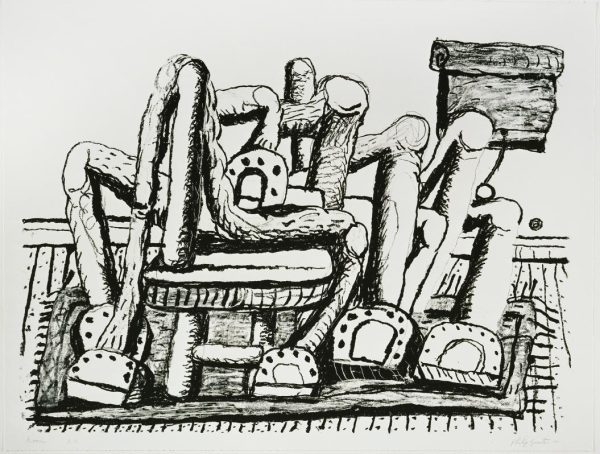
Room, Philip Guston, Gemini G.E.L. at Joni Moisant Weyl
The Workshop as Institution
It is worth pausing to consider what this means for how we value printmaking studios. The great workshops – Gemini G.E.L. in Los Angeles, Tamarind Institute in New Mexico, Tandem Press in the Wisconsin – are rightly celebrated for the quality of the work they produce and the calibre of the artists they have collaborated with. But they are also institutions in a deeper sense: places where knowledge accumulates, where practice is systematised, where the history of how images were made is preserved rather than allowed to evaporate.
The archive a workshop keeps is a form of public good, even when it sits in private hands. When those records are eventually donated to a museum or university collection – as the Gemini archive was, to the Museum of Contemporary Art in Los Angeles – they become research resources of lasting value. Future scholars will mine them for information we cannot yet anticipate needing.
Memory as Craft
There is something worth saying about the discipline that serious record-keeping requires. It runs counter to a certain romantic idea of the workshop as a place of instinct and physical intelligence, where things are known in the hands rather than written on the page. And of course, much of printmaking is exactly that – haptic, intuitive, difficult to fully articulate in words. But the best printers hold both things at once. They have the embodied knowledge that comes from years at the press, and they have the rigour to translate what they know into records that can outlast any individual’s memory.
That combination – mastery and documentation, instinct and record – is what defines a printer who understands the full weight of their role. The edition will disperse. The prints will travel to collections around the world. The plate or block may survive or may not. But the archive, if it has been kept properly, endures. It is the workshop’s quiet gift to the future: a memory that does not fade, a biography that remains complete.