The needle goes in. The acid bites. And something happens that no brush, however fine, can replicate.
For most of art history, painting has worn the crown. It commands the great museum walls, the auction records, the public imagination. And yet, for centuries, some of the most technically brilliant and emotionally penetrating artists – Rembrandt, Goya, Whistler, Käthe Kollwitz – kept returning to a small copper plate and a pointed tool. Not because they couldn’t paint. Because etching gave them something painting simply couldn’t.
The idea of the intentional mistake is older than printmaking itself – and it runs surprisingly deep through the craft. Whether it’s a spiritual belief, a technical philosophy, or a marketing masterstroke, artists and printmakers have been building imperfections into their work for centuries. Here’s why.
The Line That Cannot Lie
In painting, the artist can always come back. Wet paint is endlessly forgiving – blend it, scrape it back, overpaint. The etcher has no such luxury. When the burin or etching needle scores the wax ground, and the acid eats into the exposed metal, the mark is essentially committed. What you see in a great etching is therefore a kind of recorded thought, a line laid down with the confidence of someone who has internalised their subject completely.
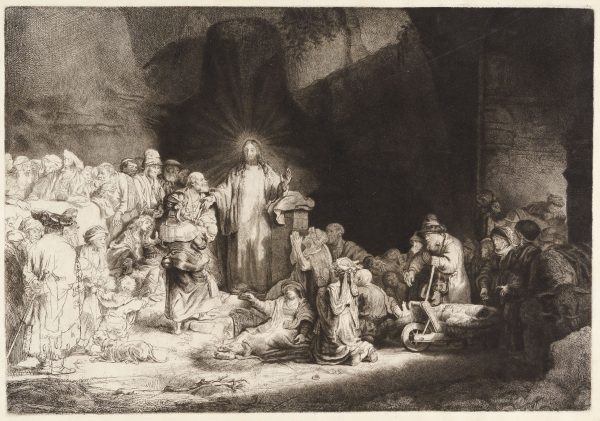
This is why Rembrandt’s etchings feel so alive. Look at Christ Healing the Sick (the so-called “Hundred Guilder Print”) and you encounter a line that breathes and hesitates and rushes, not because it was corrected but because it was felt. The nervous, searching quality that painters spend careers trying to fake is simply native to the etched line.
Christ Healing the Sick (“The Hundred Guilder Print”), 1649, Harmensz van Rijn Rembrandt
Darkness That Grows from Within
Painters construct shadow by adding pigment – they put darkness onto the surface. The etcher works in reverse. The more the acid bites into a cross-hatched area, the more ink the recessed lines hold, and the deeper the shadow that prints. Darkness in etching is literally carved out of the metal; it has structural weight that painted shadow, however skillfully glazed, tends to lack.
Goya understood this with terrifying clarity. The blacks in Los Caprichos and Los Desastres de la Guerra are not decorative. They press down. They suffocate. The monstrous figures emerging from those depths feel as though they have been physically excavated from the plate – which, in a technical sense, they have.
Multiplication as Meaning
A painting is singular. It exists once, in one place, owned by one person. This is often treated as a virtue, but it is also a profound limitation on what art can do in the world. The etched plate, by contrast, can produce dozens, sometimes hundreds, of impressions – each one an original, each one carrying the physical trace of the inked and wiped metal.
This reproducibility was not merely commercial convenience. It was philosophically transformative. Dürer used it to broadcast ideas across Protestant Europe. Hogarth weaponised it as social satire, distributing A Rake’s Progress to an audience no single painted canvas could reach. The etching didn’t just record an image; it multiplied a voice.
The Intimacy of Small Scale
Etching is almost always a small-format art. The plate must fit on a press, and the press determines the ceiling. What this enforces, unexpectedly, is a quality of intimacy that large-scale painting structurally resists. You lean into an etching. You hold it. The relationship between viewer and image becomes close, almost private – like reading a letter rather than watching a performance.
Whistler’s Venetian etchings exploit this completely. The city that Turner rendered in vast atmospheric sweeps, Whistler compressed into plates you could hold in one hand. And yet they feel more true to the experience of wandering Venice than many a monumental canvas, because they ask for the same attentiveness that the city itself demands.
Bellos consejos (Pretty teachings), 1799, Francisco Goya
The Accident That Stays
Finally, there is the matter of the happy accident – or the unhappy one. In etching, the acid doesn’t always do what you planned. It bites unevenly. A foul bite spreads unexpectedly across a sky. The ink resists a passage. The paper, damp and pressed, takes the impression differently each time. Painters can correct these accidents out of existence. Etchers must decide, often immediately, whether to work with what has happened or abandon the plate.
This negotiation with chance is one of the medium’s most generative constraints. Kollwitz, working in drypoint and etching, spoke of the plate as something that pushed back, that had its own demands. The resistance of the medium – its bluntness, its finality, its chemical wilfulness – forced a reckoning that the relatively compliant surface of a painted canvas rarely insists upon.
What Paint Gives You Is Freedom. What Etching Gives You Is Truth.
That is perhaps the simplest way to put it. Painting’s great gift is openness: colour, scale, the ability to revise endlessly. But etching’s gift is accountability. Every mark is a decision. Every shadow has structural weight. Every impression is a unique conversation between plate, ink, pressure, and paper.
The artists who have loved etching most have tended to be those for whom that accountability was not a constraint but a liberation – the discipline that allowed them to stop performing and simply say what they meant.