
The Workshop as Laboratory: How the Greatest Artist-Printer Collaborations Changed Art History
The most radical art of the twentieth century wasn’t always made in a studio. Sometimes it was made in a workshop, at midnight, with ink-stained hands and a master printer who knew something the artist didn’t yet.
That knowledge – technical, material, almost alchemical – is what separates a great print from a good one. And the story of great prints is almost always the story of a great partnership.
Picasso and Mourlot: The Obsession That Produced 400 Masterworks
In 1945, Pablo Picasso walked into the Mourlot workshop in Paris and didn’t really leave for twenty years.
Fernand Mourlot had built the finest lithographic atelier in Europe. His printers were craftsmen of rare skill – men who had worked with Matisse, Braque, Léger, and knew the stone the way musicians know an instrument. But nothing prepared them for Picasso.
Picasso treated the lithographic stone the way he treated everything: as something to be pushed until it broke, then pushed further. He worked directly on the stone with grease pencils, scrapers, and his fingers. He layered images, scratched them back, added new ones on top. He arrived before the printers and stayed after they left. Mourlot’s master printer, Charles Sorlier, became his closest technical collaborator – learning to anticipate what Picasso wanted before Picasso knew himself.
The output was staggering. Over 400 lithographs in two decades, including the iconic bull series – six stones that strip a bull from naturalistic rendering down to eleven pure lines – one of the most complete documents of how a great mind thinks. Also The Dove (1949), adopted as the symbol of the World Peace Congress, printed in an edition that spread across the world. Portraits, faces, mythology, animals – each one impossible without the Mourlot stone, each one bearing the fingerprint of that particular collaboration.
What Mourlot gave Picasso was resistance. The stone pushed back. And Picasso’s genius was at its sharpest when something pushed back.
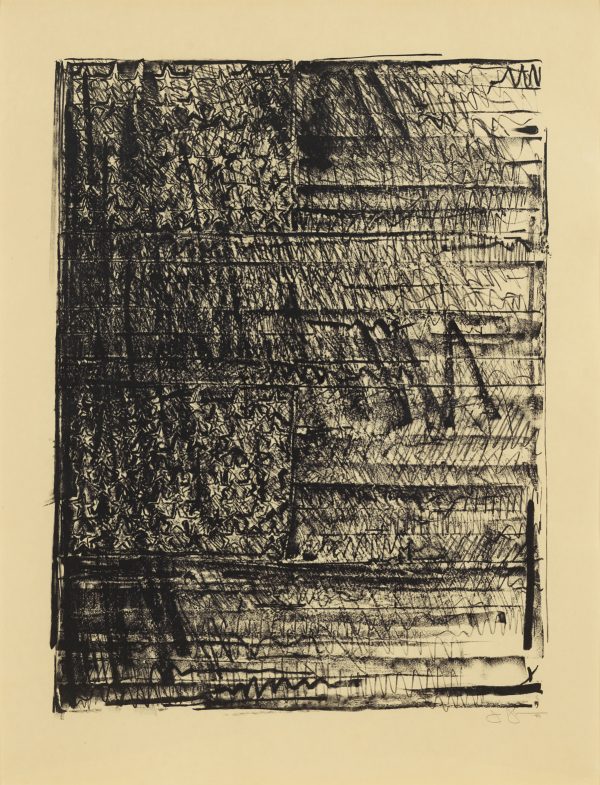
Two Flags, 1980, Jasper Johns
Jasper Johns and ULAE: Where Intellectual Rigour Met Perfect Craft
In 1960, Tatyana Grosman invited Jasper Johns to her Long Island studio – Universal Limited Art Editions, better known as ULAE – and changed American printmaking permanently.
Grosman was a refugee, a visionary, and a woman of almost terrifying standards. She believed that prints could be as intellectually serious as any painting and ran her workshop accordingly – small editions, meticulous craft, artists who were willing to think slowly. Johns was the perfect collaborator. He was already making work that demanded sustained looking: targets, flags, numbers – images so familiar they’d stopped being seen. Print, he discovered, could amplify that quality. The repetition built into the medium echoed the repetition built into his imagery.
His 0-9 series (1960-63) at ULAE became a landmark: ten lithographs of numerals, each one a meditation on how a mark accumulates meaning. His Ale Cans prints explored the same sculptural objects he was casting in bronze – the print not illustrating the sculpture but interrogating it. And Decoy (1971), a lithograph of such complexity that it required 37 runs through the press, remains one of the most technically demanding prints ever made at any workshop.
ULAE’s printers – particularly Bill Goldston, who worked with Johns for decades – developed an almost telepathic understanding of what he needed. Not speed. Not efficiency. Exactitude. The willingness to pull a proof, reject it, and start again without complaint.
The result was a body of work that sits comfortably in the permanent collections of MoMA, the Tate, and the Art Institute of Chicago. Not as documents of his painting. As works in their own right.
Hockney and Ken Tyler: Colour As You’ve Never Seen It
Ken Tyler is the most important printer in the second half of the twentieth century. That is not a controversial opinion among people who know prints.
He co-founded Gemini G.E.L. in Los Angeles in 1966, worked with Rauschenberg, Stella, Lichtenstein, and Johns, then founded Tyler Graphics in Bedford, New York, where he pushed the technical limits of what lithography, screenprinting, and papermaking could do. But his collaboration with David Hockney may be the most visually spectacular chapter of his career.
Hockney came to Tyler with colour problems. He wanted skies that felt like California. Water that moved. Light that didn’t flatten when it hit the paper. Tyler’s answer was more colours, more layers, more runs through the press than any sane economic calculation would justify. The Paper Pools series (1978) was made not just with ink but with handmade paper pulp – dyed, shaped, pressed into images that were simultaneously paintings, sculptures, and prints. Swimming pool water rendered in pigmented pulp, rippling across sheets of paper Tyler’s team had made by hand.
The Weather Series (1973) used lithography to capture something almost impossible – the atmospheric quality of rain, mist, snow – in a way that still feels technically audacious fifty years later. And his Moving Focus series explored perspective and time in landscape prints of such ambition they required new approaches to registration that Tyler’s workshop had to invent as they went.
What Tyler gave Hockney was permission. Permission to want more, to demand more, to believe the medium could hold ideas that had never been asked of it before. The workshop didn’t limit the vision. It expanded it.
Warhol and Factory Screenprint: When the Technique Was the Idea
Andy Warhol didn’t just use screenprinting. He understood it philosophically in a way no artist before him had.
The silk screen’s flatness, its mechanical precision, its ability to repeat an image with slight, unavoidable variation – these weren’t limitations Warhol worked around. They were the point. He collaborated closely with master printers Alexander Heinrici and later Rupert Jasen Smith, who ran the screenprinting operations that produced the Marilyn, Mao, Flowers, and Electric Chair series.
Smith in particular became crucial to Warhol’s later output, running a studio on 22nd Street that produced prints at industrial scale while maintaining the quality control Warhol’s market demanded. Their collaboration on the Endangered Species series (1983) — ten screenprints of animals rendered in Warhol’s signature acid palette – demonstrated that the partnership had developed its own visual language: colours chosen not for naturalism but for impact, registration that was precise where it needed to be and deliberately loose where looseness served the image.
The output from these collaborations is the most widely collected body of prints in the world. Not despite the mechanical process – because of it. The technique announced exactly what the work was about.
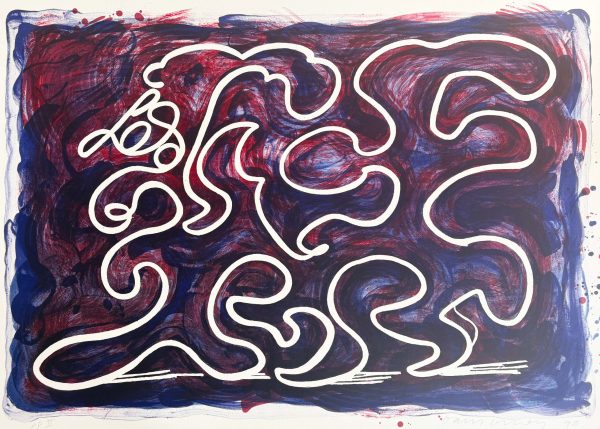
White Lines Dancing in Printing Ink, 1991, David Hockney
Matisse and Mourlot: The Line That Could Not Be Simpler
Before Picasso arrived at Mourlot, there was Matisse. And what Matisse did with lithography is, in some ways, more radical – because it looks so effortless.
The Jazz series (1947) is the most famous output of Matisse’s print years – technically pochoir rather than lithography, stencil-cut paper shapes filled with gouache – but his lithographic work at Mourlot reveals something else: an artist using the stone to distill line to its absolute minimum. Faces, nudes, plants – rendered in curves of such confidence that they appear drawn in a single gesture. They weren’t. They were worked, reworked, and arrived at through a process of sustained reduction that the lithographic stone makes visible in its layers.
Sorlier, who worked with both Matisse and Picasso at Mourlot, said the two couldn’t have been more different. Picasso attacked the stone. Matisse listened to it. Both were right. The stone gave back what you brought to it.
What This Means for the Print You Choose
Every serious print carries the ghost of its workshop.
When you look at a Hockney edition from Tyler Graphics, you’re seeing the result of a conversation between two men about what colour could do. When you hold a Johns from ULAE, you’re holding something that went through the press 37 times because anything less wasn’t good enough. When you study a Mourlot Picasso, you’re tracing the marks of a man who understood, perhaps better than anyone in history, that the act of making is the act of thinking.
The collaboration isn’t backstory. It’s in the ink.