
Where Vision Meets Press: The Colour Conversation
There’s a moment in every collaborative print studio that outsiders rarely see. The artist steps back from a proof, eyes narrowing at a passage of color that’s almost right but not quite. The master printer leans in, says nothing for a long moment, then reaches for a different ink base. Neither has spoken, yet something has been understood. This is the strange, intimate language at the heart of fine art printmaking – and it’s far more sophisticated than most people realise.
Colour Isn’t Chosen. It’s Negotiated.
We tend to think of colour as a fixed thing – you pick a swatch, you get that colour. A designer specifies “Pantone 186 Red,” a paint store mixes to a chip, and that’s the end of the conversation. But on press, colour behaves nothing like this. It is a living negotiation between pigment, paper, pressure, and time, and a printer doesn’t simply mix toward a target hue. They’re managing how multiple layers of translucent ink will sit atop one another, how each successive pass alters what came before it, and how the final stack will read as a unified image rather than a collection of separate decisions.
Consider a deceptively simple two-colour lithograph: a warm ochre ground beneath a cool blue line. Printed in isolation, that blue might read as crisp and saturated. Laid over the ochre, it shifts toward green, softens, takes on an entirely different temperature. Add a third colour – say, a deep violet for shadow – and the interactions compound further still. Each layer is a transparent film sitting atop the others, and the printer must mentally model these interactions in advance, because by the time the proof comes off the press, it’s too late to undo what’s already been layered. This is chemistry as much as it is art, and a printer’s expertise lives in anticipating those interactions before the first sheet ever touches the press bed.
This is also why editioning is so unforgiving. An artist might fall in love with a particular passage of color in a single trial proof, not realizing that passage exists in delicate balance with everything printed beneath it. Change one ink and the whole equation shifts. A master printer holds all of these variables simultaneously, the way a chess player holds multiple board states in mind at once.
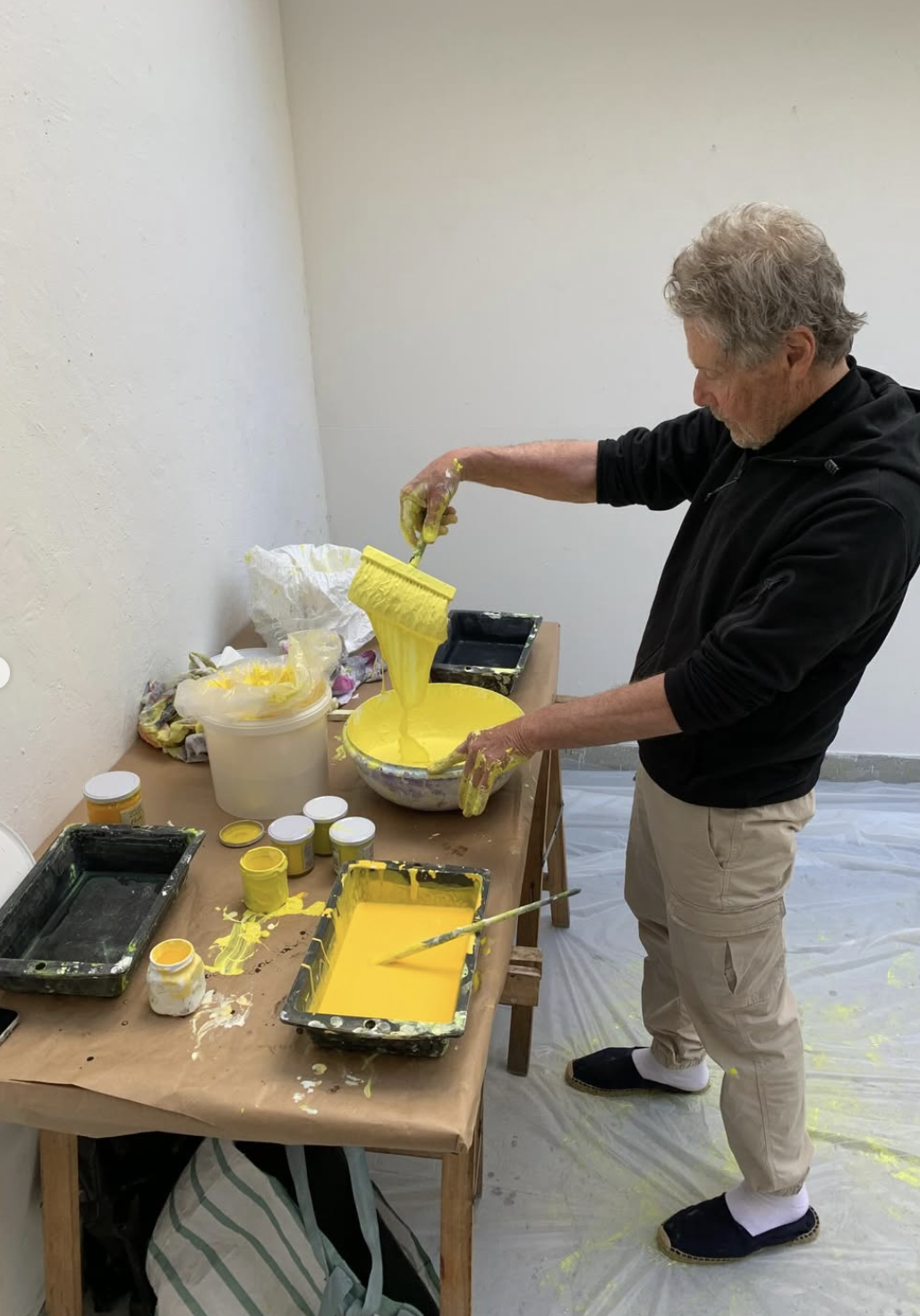
William MacKendree working on the correct yellow at Atelier Michael Woolworth.
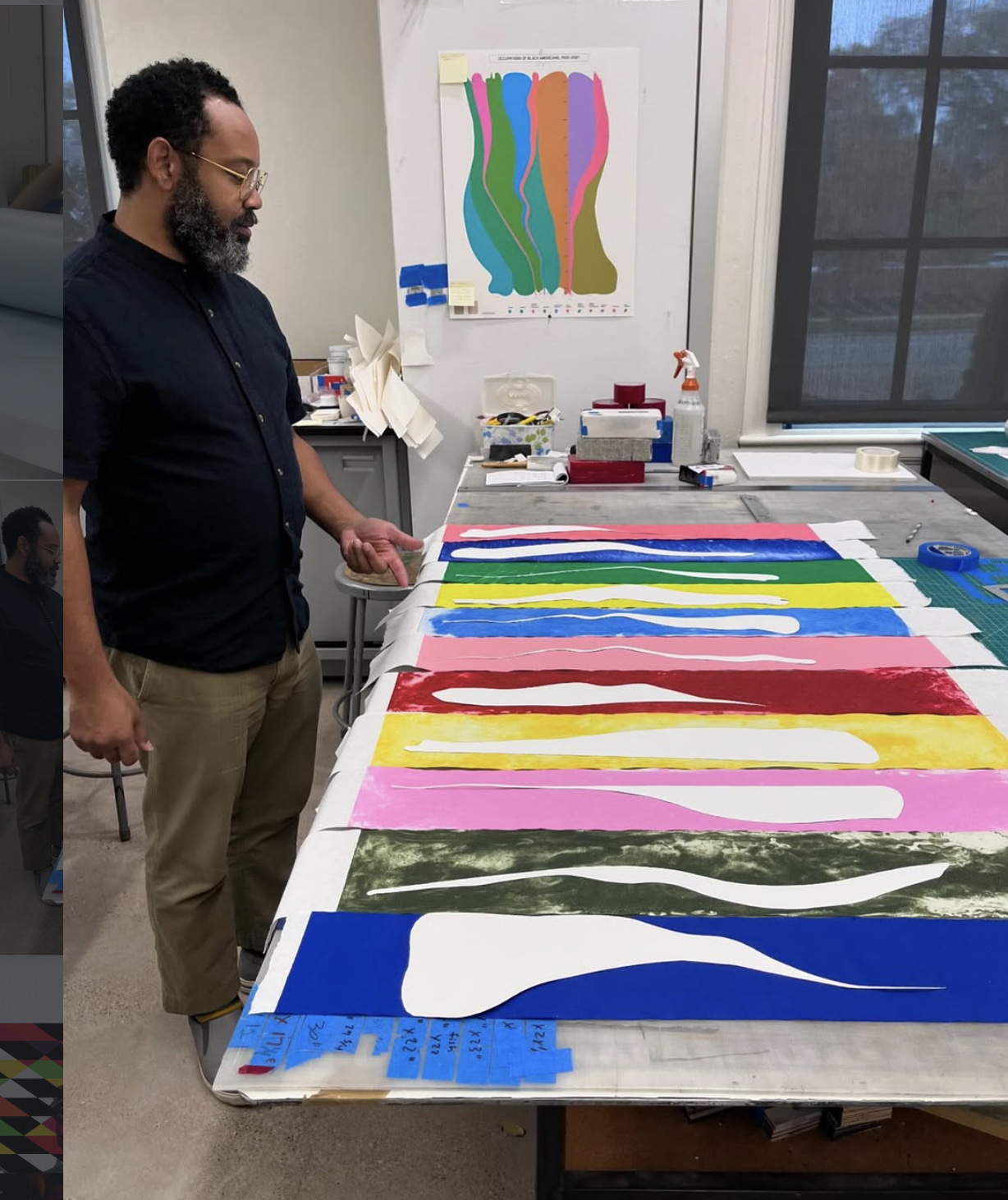
William Villalongo contemplating colour at Graphicstudio for the PBA project.
The Hue That Lies to You While It Dries
Here’s something almost no one outside the studio knows: the colour you see on a freshly pulled proof is, in a very real sense, temporary. Ink shifts as it cures – sometimes subtly, sometimes dramatically – as solvents evaporate, oils oxidise, and pigments settle into the paper’s fibres. A red that looks brash and electric wet on the sheet can mellow into something entirely different a day later. Blacks that appear flat and matte on press often deepen and gain richness as they cure. Metallic inks are particularly notorious for this kind of betrayal, appearing one way wet and an almost unrecognisably different way once fully set.
This drying shift is part of why proofing is such a slow, iterative ritual rather than a single decisive pass. A printer pulls a proof, waits – sometimes hours, sometimes overnight – and only then makes the next adjustment, because judging colour too early means judging a version of the image that won’t actually exist by the time it reaches a collector’s wall. A master printer has learned to look past the present moment and see the future color: to mix not for what’s in front of them, but for what the ink will become once it has fully dried and settled into the paper. This is knowledge built through thousands of proofs, failures, and small corrections, not something found in any manual or colour-matching app. It is earned, slowly, through years of watching wet colour become dry colour and learning, almost by feel, how far that gap will stretch each time.
The Gallery Lies Too
Even after the ink has dried and settled, the story isn’t over – because light itself is unreliable. A print that glows with warmth under a gallery’s tungsten lighting can turn cool and flat under fluorescent tubes, or shift again entirely in raw daylight streaming through a window. Walk the same print from a dim, amber-lit back room into a sunlit storefront and you may swear you’re looking at two different objects entirely.
This phenomenon – metamerism, in technical terms – means that two colours which appear identical under one light source can diverge wildly under another, depending on the precise pigments used to create them. Printers have to mix with this instability in mind, imagining the print’s entire future life beyond the studio: hung in a collector’s home under warm domestic bulbs, lit by a museum’s carefully calibrated daylight-balanced fixtures, or photographed for a catalog or website under yet another light source entirely, one that will compress and reinterpret the colour all over again through a camera sensor and a screen.
Getting colour “right,” then, isn’t a single fixed target the way a paint chip suggests. It’s finding a hue stable and considered enough to hold its essential character and emotional temperature across wildly different viewing conditions – confident, rather than merely lucky, that the deep indigo an artist fell in love with in the studio will still read as that same deep, considered indigo in a hundred different rooms, under a hundred different bulbs, for decades to come.
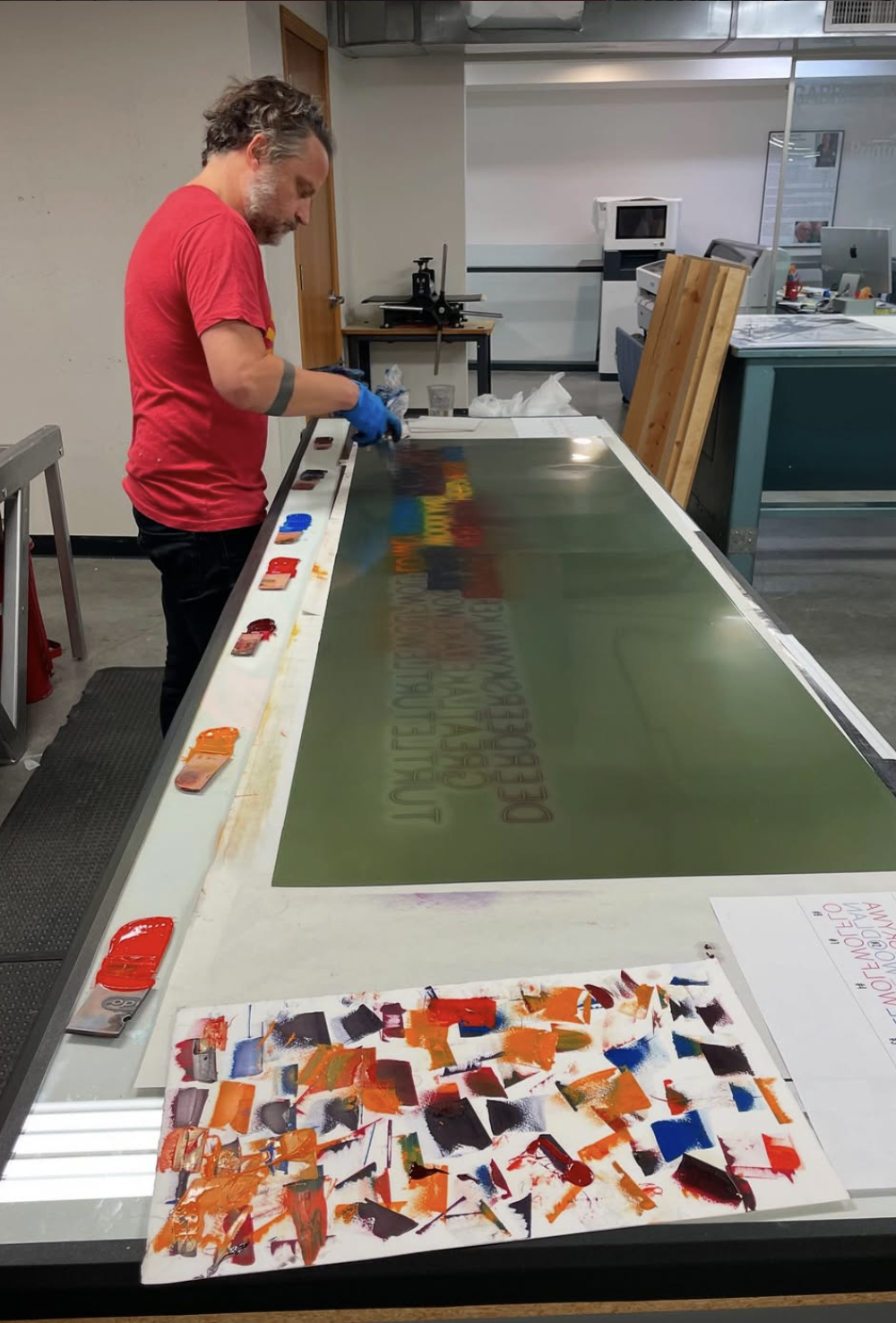
This intaglio plate is being inked up using the à la poupée technique, where multiple coloured inks are applied to a plate before it’s sent through the press. Tandem Press.
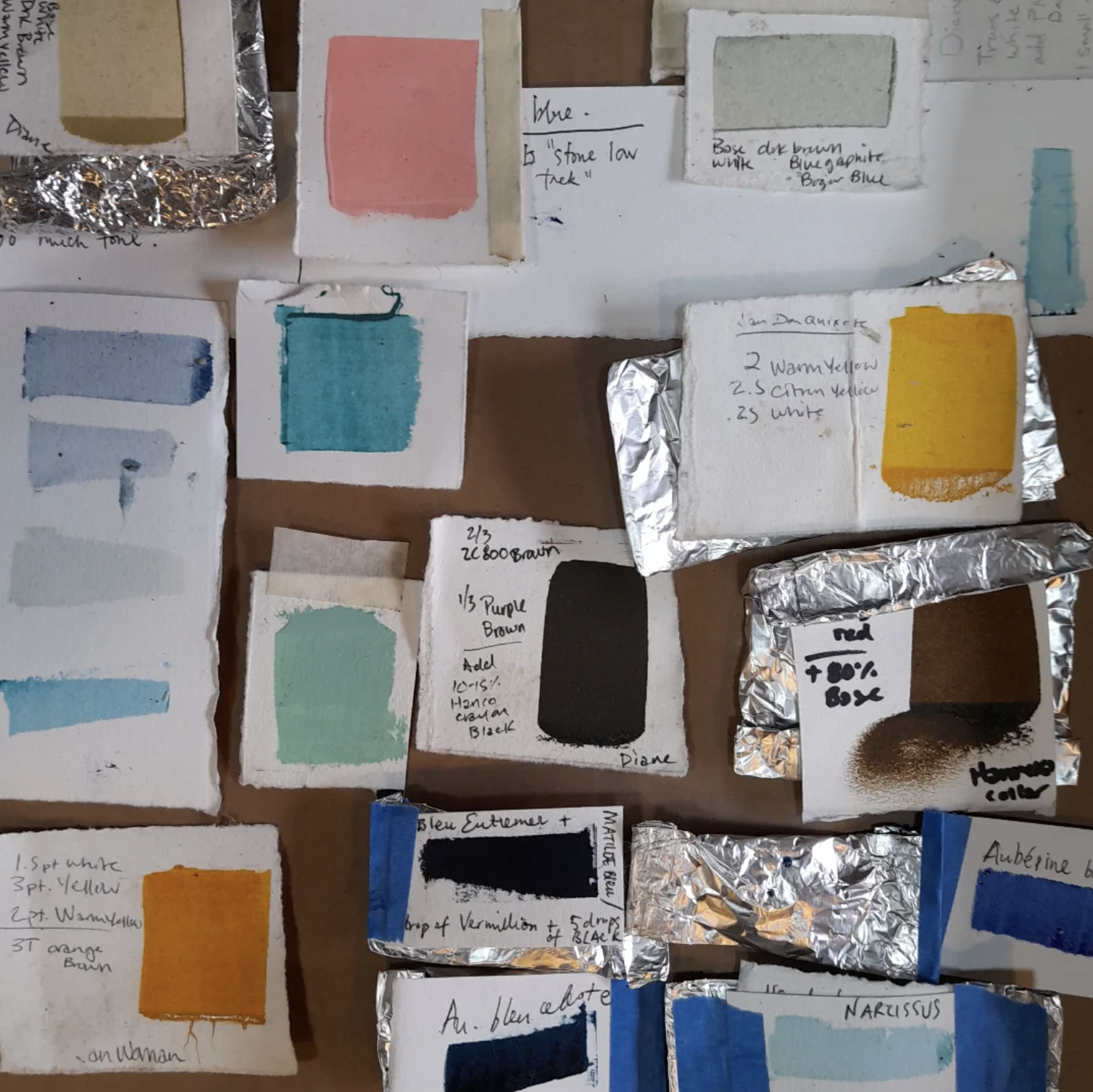
Colour recipes at Atelier le Grand Village.
Knowledge That Lives in the Hands, Not the Head
What makes a master printer indispensable isn’t a formula they could write down and hand off to an apprentice in an afternoon. It’s tacit knowledge – the kind that accumulates through repetition, touch, and failure, until it becomes almost instinctual rather than conscious. They can feel when an ink is too viscous before it ever causes a registration problem on press. They know, often without fully articulating why, that this particular red needs to run fractionally darker because of how this particular paper will absorb and diffuse it, or that a certain humidity in the studio that day means the drying time – and therefore the final hue – will behave just slightly differently than it did the week before.
This is craft knowledge in the truest sense: inseparable from the body that holds it, resistant to being fully captured in writing, earned only through years of standing at the press, hands stained with ink, watching thousands of sheets pass beneath the roller. It’s the kind of expertise that looks, to an outsider, almost like intuition or instinct — but is in fact the compressed residue of an enormous amount of accumulated experience, distilled down into a single confident gesture: reaching for the right ink, at the right moment, without needing to think it through from first principles.
A Partnership of Trust
This is why the relationship between artist and printer is so often described, by those who’ve experienced it, as a genuine creative partnership rather than a technical service rendered. The artist brings vision – an idea of mood, of feeling, of what a colour should do emotionally, what memory or sensation it should conjure in a viewer standing before the finished work. The printer brings the embodied expertise to translate that vision through the unpredictable physics of ink, paper, drying, and light, holding the whole unstable system steady enough to deliver, reliably and repeatedly, on the artist’s original intent.
Neither party could arrive at the finished print alone. The artist, however skilled, rarely possesses the printer’s accumulated technical knowledge of how layered ink behaves over time. The printer, however technically masterful, is not the one who decided this particular blue should feel like dusk rather than midnight. It’s a quiet collaboration, often conducted with very little said aloud – a raised eyebrow, a returned proof, a small adjustment understood without explanation – built on the kind of trust that only comes from someone proving, proof after proof, edition after edition, that they understand colour not as a fixed fact to be matched, but as a living, shifting thing they have learned, through years of practice, exactly how to hold.