
Drawing on Rock: The Secret Life of the Lithographic Stone
Before there was a print, there was a slab of solid limestone – heavy, cold, and older than the pyramids. Lithography, invented in the 1790s by Alois Senefelder, is often described as the most “magical” of printmaking processes, because it works on a principle that sounds almost like alchemy: grease and water refusing to mix. Unlike an engraved plate or a carved woodblock, nothing on a lithographic stone is physically cut away or built up. The image sits entirely on the surface, held there by chemistry rather than by a groove or a ridge. But none of that magic happens without exactly the right piece of rock. Here’s where that stone came from, who prepared it, why its particular geology mattered so much to artists, and how printers wiped the slate clean so the same slab could be drawn on again, sometimes for generations.
Born in Bavaria: The Quarry That Made Printmaking Possible
Not just any rock will do. The stone that launched an entire art form comes almost exclusively from a narrow band of quarries near Solnhofen, in Bavaria, Germany – the same fine-grained limestone deposits famous for preserving the fossil Archaeopteryx in exquisite, feather-by-feather detail. That fossil-preserving quality is exactly what made the stone so useful to artists: a limestone laid down in still, calm lagoon waters roughly 150 million years ago, compacting slowly enough that it formed with an almost unbelievably fine, even grain and virtually no visible crystalline structure. If a stone could capture the delicate imprint of a prehistoric feather, it could just as easily capture the faintest whisper of a crayon line.
Senefelder didn’t stumble onto this stone by luck – he lived near these deposits in Bavaria, and their unique properties (dense, smooth, chemically reactive to both grease and acid) happened to be exactly what his new printing method required. For over a century afterward, “Bavarian limestone” and “lithographic stone” were essentially synonyms in print workshops. Quarries in that single region supplied printmakers across Europe and, eventually, the world, and stones were shipped by cart, barge, and later rail to studios as far away as Paris, London, and New York – a genuinely global trade built around one narrow strip of German countryside.
Not All Stones Are Equal: Reading the Colour of the Rock
Printers learned to judge a stone’s character by its colour, and the differences weren’t cosmetic – they signalled real structural properties.
Blue-grey stones are the hardest and most prized, dense enough to hold the most delicate crayon textures and fine tusche washes without breaking down under repeated printing. These were reserved for detailed, high-run work where crispness had to survive hundreds of impressions.
Yellow stones are softer and more porous, easier to grain and often cheaper, but they wear faster and are less forgiving of heavy ink or long editions. They were often the choice for students, proofs, or work that didn’t need to survive a huge print run.
A skilled printer could tell almost at a glance, just from the tone of the stone, roughly how many strong impressions it had left in it – a kind of geological intuition passed down through apprenticeships in print workshops.
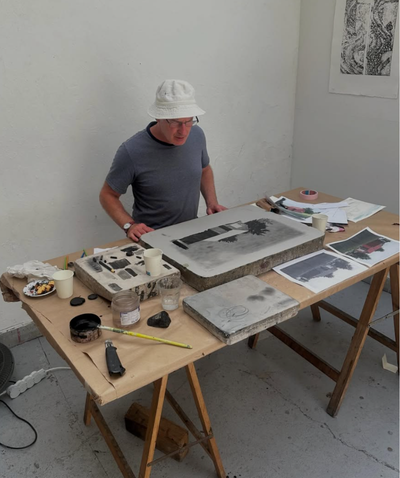
Blaise Drummond at Atelier Michael Woolworth, 2026
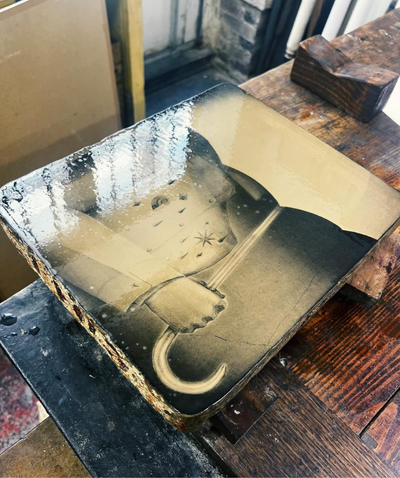
Clément Etienne at Le Garage Litho, 2026
The Flattening: A Job That Took Muscle and Patience
A quarried block of limestone doesn’t arrive ready to draw on – it arrives as a rough slab that needs to be planed dead flat and given a working surface, a job historically done by specialized craftsmen rather than the artists themselves.
In the earliest workshops, this meant grinding one stone against another by hand, using water and abrasive sand or carborundum grit between two slabs, rubbed in circular motions until both surfaces were perfectly level and matched to each other. Later, print shops used a tool called a levigator – a heavy, flat-bottomed disc with a handle, dragged across the stone’s surface in the same grinding motion, letting the printer control graining without needing a second stone as a partner.
The final surface could be finished two ways depending on what the artist wanted: a grained (or “grain,” matte) finish, produced by grinding with progressively finer grit, which gave a tooth similar to sandpaper that beautifully caught crayon and chalk marks; or a polished finish, smoothed to a glassy plane, ideal for pen-and-ink style tusche work where crisp, unbroken lines were the goal. Getting this surface exactly right was a craft in itself – too coarse, and fine details would be lost; too smooth, and the stone couldn’t hold enough grease to make a workable image.
Why Stone, Specifically? The Chemistry the Artist Relied On
Here’s the property that made this particular rock indispensable rather than merely convenient: limestone is calcium carbonate, and calcium carbonate is naturally porous and chemically receptive to both grease and water in a way most other materials aren’t.
When an artist drew with a greasy crayon or liquid tusche, the grease didn’t just sit on the surface – it actually bonded into the stone’s structure. Treating the stone afterward with a mix of gum arabic and a weak acid (commonly nitric acid) chemically fixed that greasy image in place while simultaneously making the untouched areas of stone even more receptive to water and repellent to ink. The result was a stone that, once processed, would forever “remember” the drawn image at a molecular level: dampen the whole surface with water, and only the fatty, drawn areas would refuse the water and accept an oil-based ink instead.
This is what made lithography feel so different from every other print technique to the artists who used it. An engraver or etcher had to think in terms of incised lines and physical removal of material. A lithographer could draw exactly as if working on paper – free, direct, tonal, even painterly – because the stone’s chemistry, not a carved groove, was doing the separating work between image and blank space.
After the Ink Runs Dry: Wiping the Slate Clean
Once an edition was finished, the stone wasn’t thrown away – limestone was valuable, heavy, and expensive to quarry and ship, so stones were reused again and again, sometimes for decades, across dozens of completely different images.
Cleaning a stone for reuse, called graining down or regraining, meant erasing the chemical memory of the old image entirely, not just wiping off visible ink. The printer would return to the same grinding process used to prepare the stone in the first place: two stones (or a stone and a levigator) worked together with water and an abrasive grit, ground in circular motions until a thin layer of the surface – sometimes just a fraction of a millimetre – was worn away completely. This physically removed the old grease-bonded layer along with any trace of the acid-etch treatment, exposing fresh, chemically neutral limestone underneath.
The stone would then be dried, examined for cracks or wear, and – if it survived – was ready to be re-grained to whatever tooth the next artist required, and drawn on again as though it had never held an image at all. A single stone, ground down repeatedly over its working life, might carry the ghosts of hundreds of prints before it finally became too thin, too worn, or too fragile to keep using — at which point it might be discarded, or in some documented cases, cut down and repurposed as a smaller stone for proofs or student work.
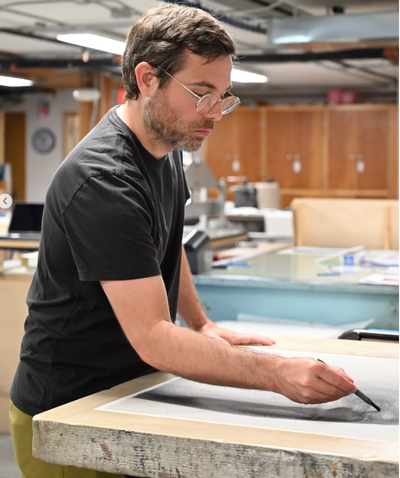
Mathew Cerletty at Tandem Press, 2026
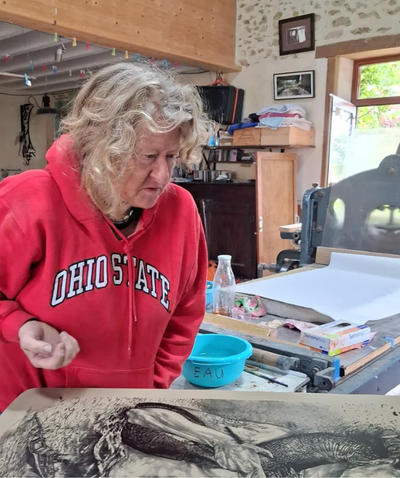
Diane Victor at Atelier le Grand Village, 2026
A Stone Worth Fighting Over: Why Artists Loved It
The appeal of this rock wasn’t purely chemical – it was also physical, in a way that changed how artists worked. Because the surface responded to crayon almost exactly like textured paper, artists who had spent careers drawing could step up to a stone with total confidence, no engraving apprenticeship required. Francisco Goya, already an old man when lithography reached Spain, took it up late in life for his Bulls of Bordeaux, using the same loose, expressive crayon strokes he’d have used on paper. Toulouse-Lautrec pushed it further still, exploiting the stone’s ability to hold flat, luminous washes of tusche for his Parisian cabaret posters – colour effects that felt more like painting than printmaking. This same versatility made lithography the engine behind an entirely new commercial industry: firms like Currier & Ives produced tens of thousands of images from stone, a business only possible because a single well-prepared slab could survive thousands of impressions before it needed regraining.
The Rock That Remembers, Then Forgets
There’s something quietly poetic about the whole cycle: a stone laid down over 150 million years in a quiet lagoon, quarried and flattened by hand, given a temporary chemical memory by an artist’s crayon, then deliberately ground back into blankness so another artist could begin again. Unlike a copper plate, which retained some trace of its history in every scratch and repair, a lithographic stone could be returned almost completely to a blank slate. Grind it down far enough, and there’s no way to tell whether the surface once held a Goya bullfight, a Toulouse-Lautrec dancer, or nothing at all – a temporary alliance between ancient rock and a human hand, dissolved the moment the edition was done, so the same 150-million-year-old surface could be handed to someone else entirely.