Most printmaking techniques were invented on purpose. Lithography was invented because a broke playwright in Munich didn’t have any paper handy.
A Laundry List That Changed Printmaking Forever
In 1796, a young Bavarian actor and playwright named Johann Alois Senefelder (1771-1834) was experimenting with ways to print his own plays cheaply, since he couldn’t afford a professional typesetter. He’d been etching designs onto slabs of fine-grained limestone as a cheap substitute for copper plates.
One day, with no paper within reach, he scribbled a laundry list using a greasy crayon – a mix of wax, soap, and lampblack – directly onto a polished limestone slab he used for mixing ink. Later, when he went to etch the stone with acid as he normally did, he noticed something strange: the acid bit into the bare stone but left the area under his greasy writing untouched and slightly raised.
He had stumbled onto something far bigger than a printing shortcut. The stone could hold an image based purely on the chemical relationship between grease and water – no carving, no etching required.
The Chemistry Trick Behind the Magic
Senefelder spent the next few years refining what he first called Steindruck (“stone printing”), patenting it in 1799. The process worked like this: an artist draws directly on the limestone with a greasy medium, the stone is treated with a weak acid-and-gum-arabic solution, then dampened with water and rolled with oily ink. Water clings to the untouched stone and repels the ink; the greasy drawing repels the water and grabs the ink instead. Press paper against it, and the image transfers perfectly.
It became known by its Greek-derived name – lithography, from lithos (stone) and graphein (to write) – and it was the first major innovation in printmaking since engraving and movable type centuries earlier. For the first time, an image could be reproduced based on surface chemistry rather than physical carving.
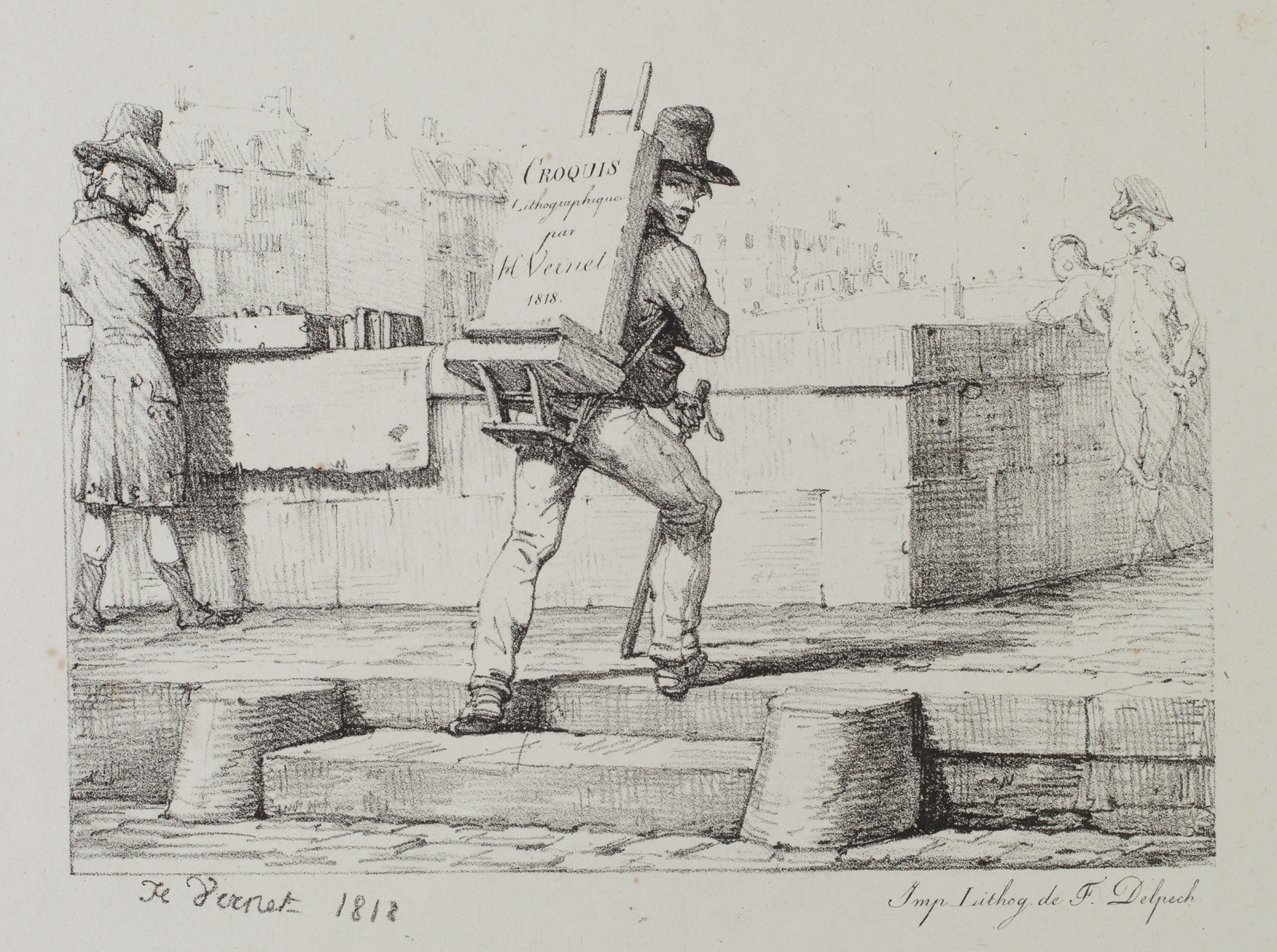
Lithographic Sketches (1818)
Horace Vernet Sarah Sauvin
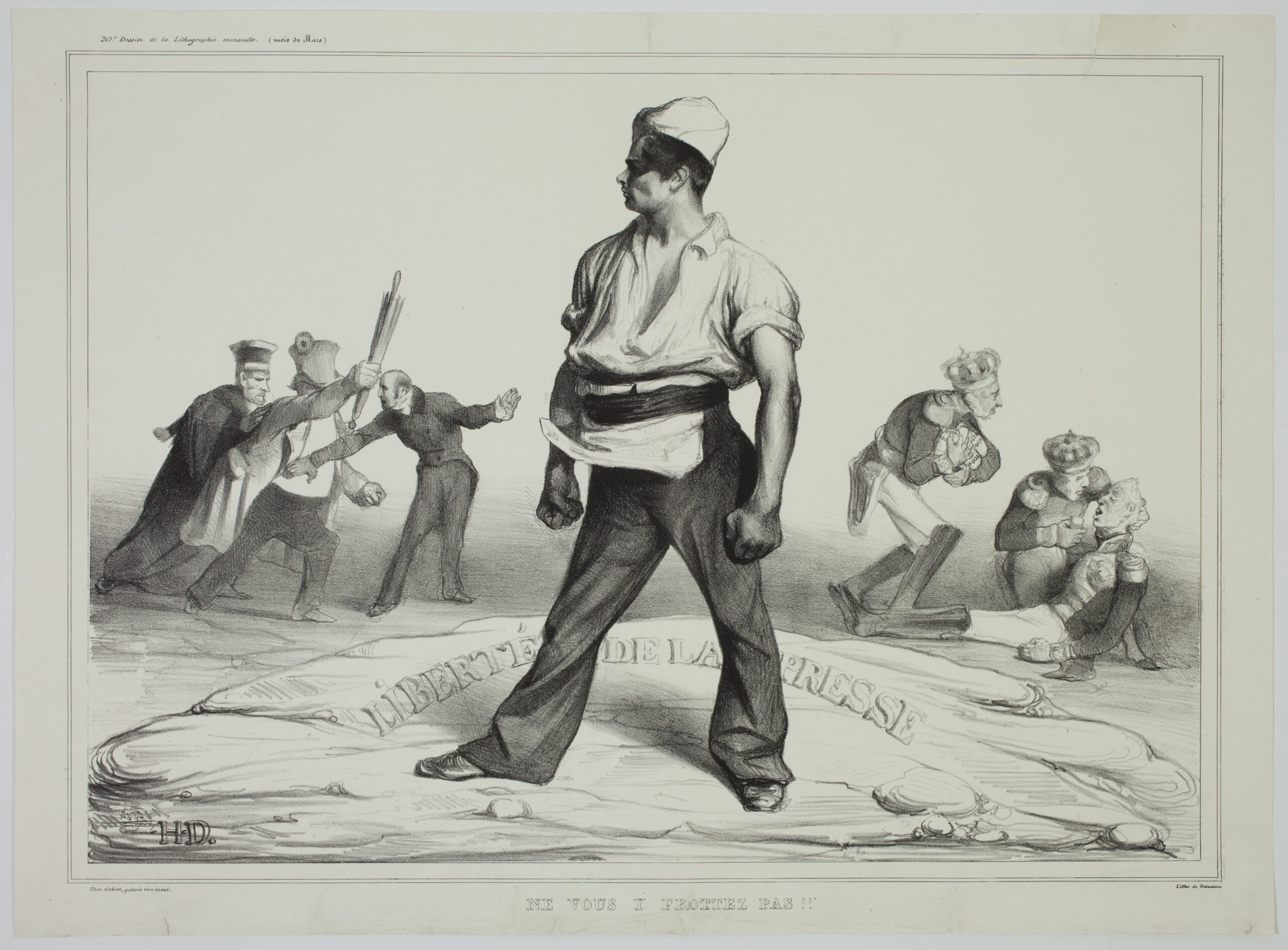
Do not get on the wrong side of them!! (1834)
Honoré Daumier Sarah Sauvin
Goya Finds a Second Wind
The first major artist to seize on lithography’s expressive potential was, fittingly, one near the end of his career. Francisco Goya didn’t encounter the medium until his seventies, while in exile in Bordeaux – but he immediately grasped what it could do for him. Drawing crayon directly on stone let him preserve the loose, smudgy, almost charcoal-like quality of his late style, something etching’s hard lines could never capture. His series “The Bulls of Bordeaux” (1825) remains one of the great early proofs that lithography wasn’t a cheap substitute for engraving – it was its own language, rich with tone and atmosphere.
Géricault and the Need for Speed
In France, Théodore Géricault was among the first painters to treat lithography as fine art rather than mere reproduction, starting around 1817-1820. He’d studied under Carle Vernet, whose son Horace was also an early enthusiast of the technique. For Géricault, lithography offered something his Romantic sensibility craved: the ability to draw as freely as pencil on paper, capturing galloping horses, military scenes, and his haunting studies of psychiatric patients with the same raw immediacy as a sketch. No process before it had let an artist move that fast and still produce a printable image.
Delacroix Gives the Stone a Storyteller’s Touch
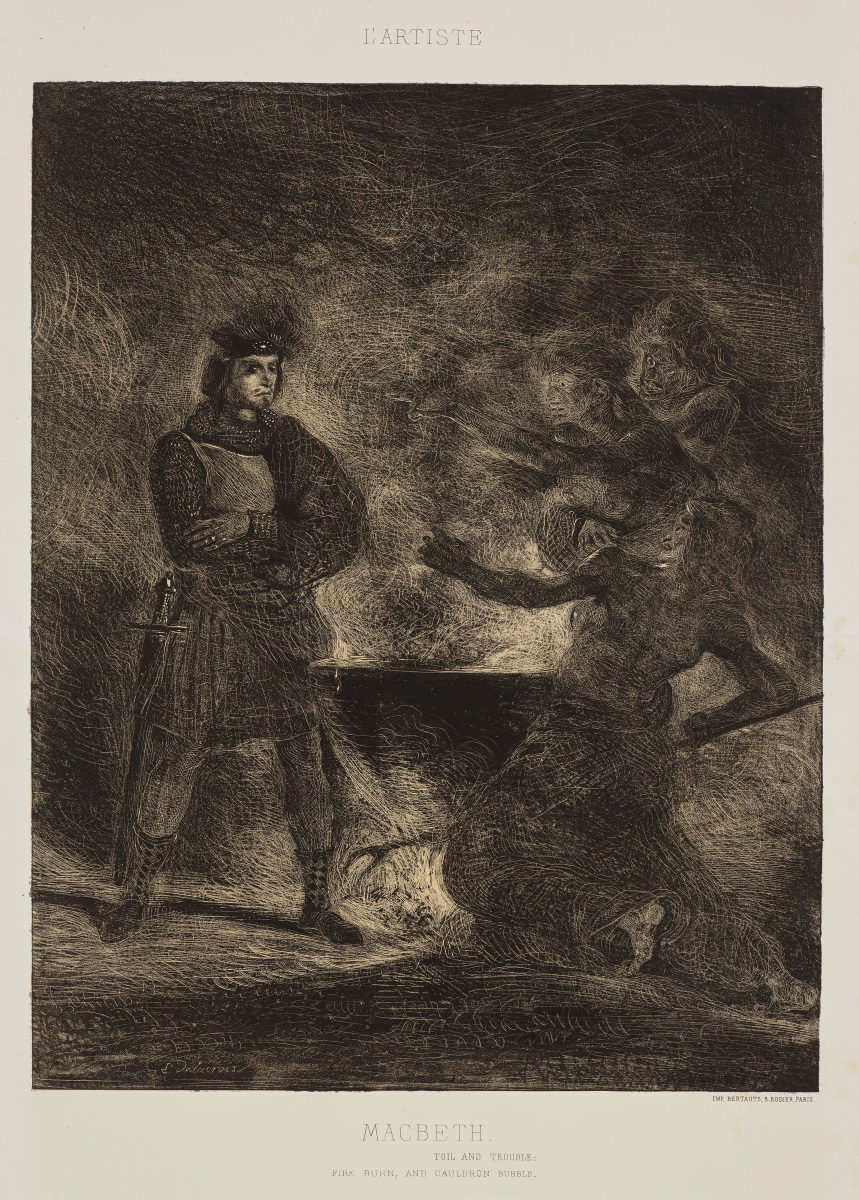
Eugène Delacroix, the towering figure of French Romantic painting, turned to lithography in the 1820s mainly for book illustration – most famously his suite for Goethe’s Faust (1828). He treated the stone exactly as he treated canvas: dramatic light and shadow, swirling movement, real emotional weight. Goethe himself is said to have praised the series as surpassing his own imagined vision of the scenes. Delacroix’s Faust prints marked a turning point – proof that lithography could carry serious literary illustration, not just decorative or commercial work.
Macbeth consultant les sorcières (1825)
Eugène Delacroix Emanuel von Baeyer – Cabinet
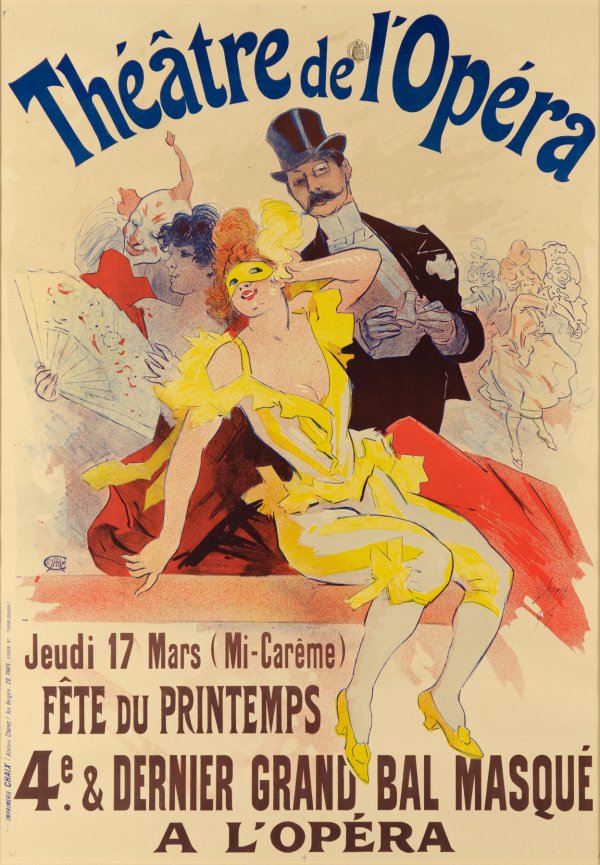
Théatre De L’opéra (1896)
Jules Cheret Christopher-Clark Fine Art
Daumier Turns the Stone Into a Weapon
If Goya, Géricault, and Delacroix proved lithography belonged in the world of fine art, Honoré Daumier proved it belonged on the front lines of public life. Starting in the 1830s, he churned out thousands of lithographs for French satirical journals like La Caricature and Le Charivari, using the medium’s speed to skewer politicians, lawyers, and the bourgeoisie almost as fast as the news broke. Lithography’s freehand immediacy and ease of mass printing made it the first true medium for political cartooning at scale – and Daumier pushed it further than anyone, turning caricature itself into a respected art form.
One Discovery, Four Completely Different Uses
What’s remarkable is how differently these four artists exploited the exact same technical breakthrough: Goya for tonal, painterly drawing; Géricault for motion and immediacy; Delacroix for narrative and literary depth; Daumier for satire and mass communication. Within roughly thirty years of one man’s accidental discovery on a slab of Bavarian limestone, lithography had already proven flexible enough to serve high Romantic art and daily newspaper caricature – a range almost no other printmaking technique before or since has matched.
But the medium’s story doesn’t end in the 19th century salons and satirical journals. What came next changed how the entire world saw printed images.
Colour Arrives: Chromolithography and the Poster Age
By mid-century, printers had worked out how to register multiple stones in sequence – one per colour – so a single image could be built up layer by layer in full, vivid colour. This process, chromolithography, exploded in popularity from the 1840s onward and became the engine behind Victorian-era prints, illustrated children’s books, advertising cards, and decorative wall art. It put color printing into ordinary households for the first time in history.
That same multi-stone color technique reached its artistic peak in 1890s Paris, where Henri de Toulouse-Lautrec used it to invent the modern advertising poster. Works like his Moulin Rouge poster (1891) treated commercial advertising as genuine art – bold flat color, sweeping silhouettes, and graphic compression that anticipated 20th-century design. Lautrec, along with contemporaries like Jules Chéret, made Belle Époque Paris feel papered in lithographs, plastered across kiosks and walls as the world’s first mass-market visual advertising.
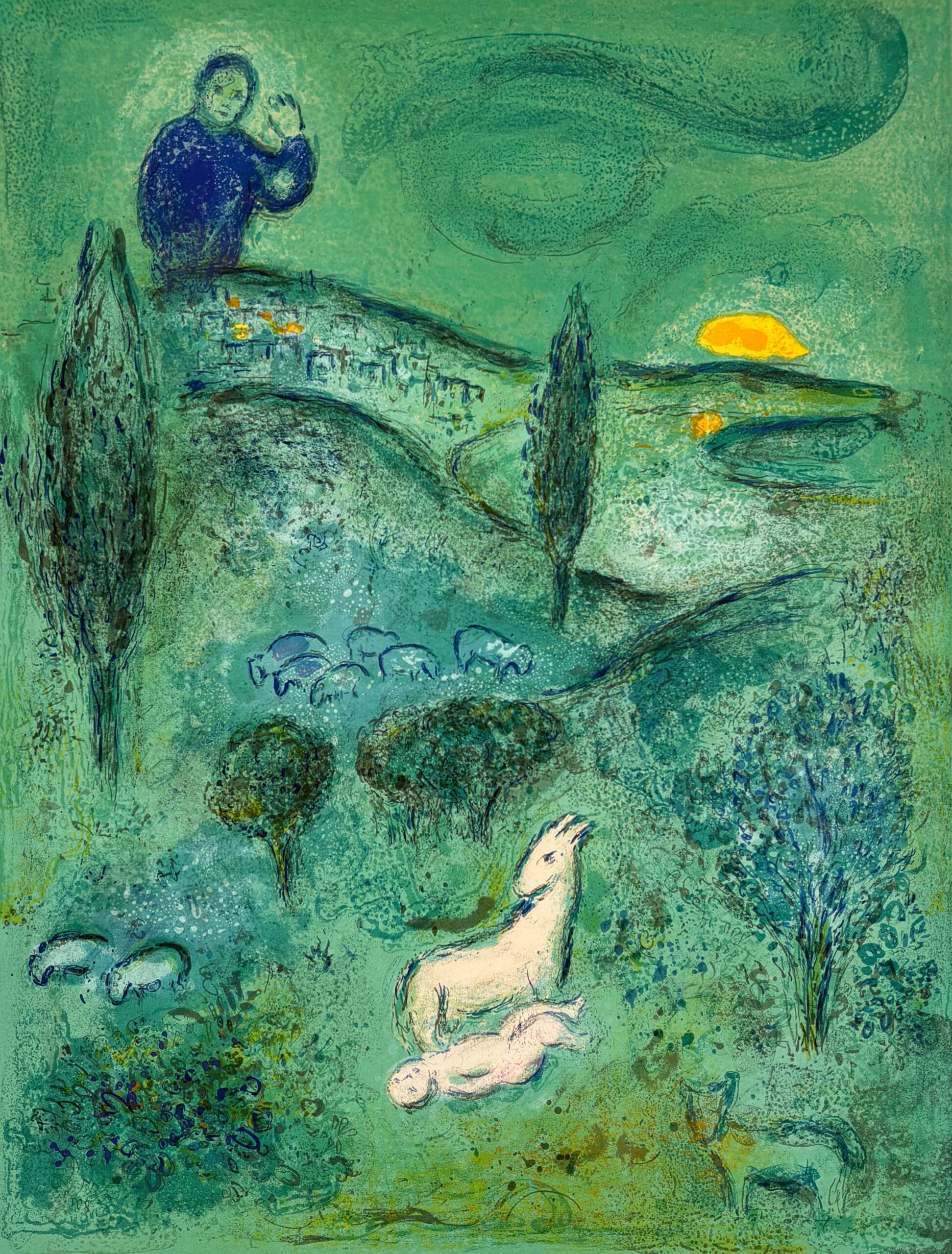
Discovery of Daphnis (1961)
Marc Chagall Gilden’s Art Gallery
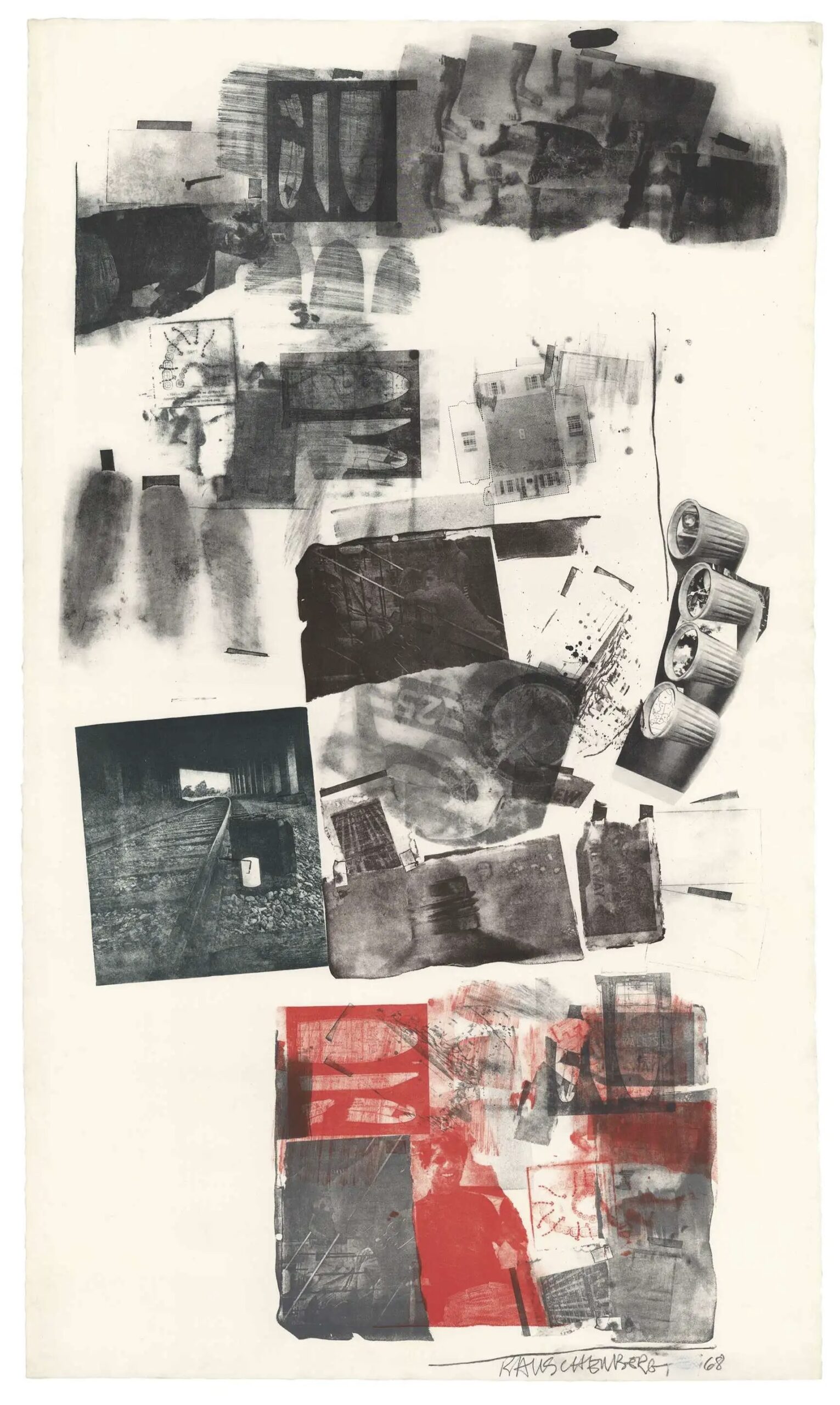
Water Stop (1968)
Robert Rauschenberg Robert Fontaine Gallery
The 20th Century: Lithography Becomes a Fine Art Print
As photography took over commercial reproduction in the 20th century, lithography didn’t disappear – it retreated into the artist’s studio and became prized precisely because it was handmade. Major modern artists embraced it not for mass communication but for its painterly intimacy: Pablo Picasso produced hundreds of lithographs, famously including his “Dove of Peace,” treating the stone with the same freedom he brought to drawing. Marc Chagall, Joan Miró, and later Robert Rauschenberg and Jasper Johns all used lithography extensively, often working with master printers at ateliers like Mourlot in Paris or Tamarind Lithography Workshop in Los Angeles, which helped revive and professionalize fine-art lithography in the U.S. during the 1960s.
From Stone to Machine: Offset Lithography
While artists kept the hand-drawn tradition alive, industry took the underlying chemistry in a completely different direction. In the early 20th century, printers discovered that the image could be transferred first to a rubber cylinder before reaching the paper – “offsetting” it – which allowed flexible metal or polymer plates to replace heavy limestone slabs entirely. Offset lithography could run far faster, cheaper, and at much larger scale, and by the mid-20th century it had become the dominant printing method worldwide for newspapers, magazines, books, and packaging. It still relies on Senefelder’s original grease-and-water principle – just executed by rollers and plates instead of a hand-drawn stone.
Photolithography: An 18th-Century Idea Inside Every Microchip
Perhaps the strangest afterlife of Senefelder’s discovery is in modern electronics. Photolithography – which uses light-sensitive chemicals instead of grease to define a pattern on a surface – is the foundational process used to etch circuit patterns onto silicon wafers in computer chip manufacturing. The core concept is the same one Senefelder hit upon in 1796: protect certain areas of a surface chemically so that only the unprotected areas can be altered. A technique born from a forgotten laundry list now underpins the entire semiconductor industry.
A Discovery That Never Stopped Working
From a desperate playwright’s shopping list to Romantic-era masterpieces, from Belle Époque advertising to museum-grade fine art prints, and finally to the offset presses and silicon chips of the modern world, lithography has proven to be one of the most quietly versatile inventions in history. Few technical accidents have managed to shape both high art and industrial mass production so thoroughly – and fewer still are still, in some form, running in the background of daily life more than two centuries later.