
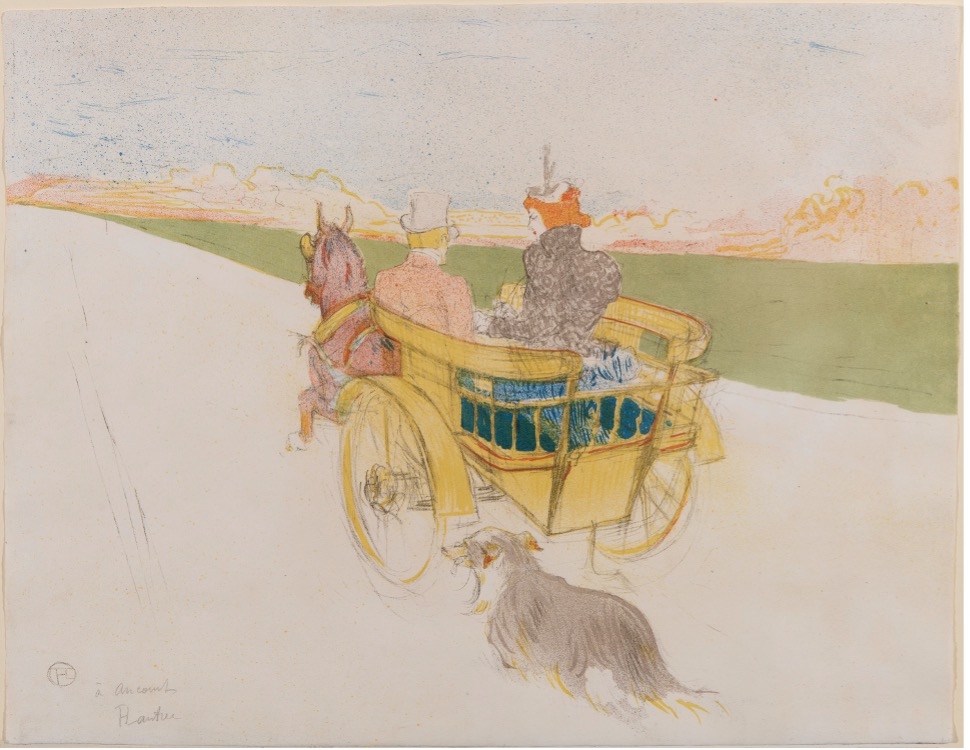
Partie de Campagne ou La Charette Anglaise
Artwork details
- Artist
- Henri de Toulouse-Lautrec
- Title
- Partie de Campagne ou La Charette Anglaise
- Description
-
Provenance:
Presumably a gift from the artist to Edouard Ancourt;
David David-Weill (1871-1952), by whose estate sold, Drouot, Paris, 26th May 1971, lot 312;
Sale, Christie’s, London, 2nd December 1982, lot 277 (£30,240);
Private collection, South Germany.Literature:
Loys Delteil, Le Peintre-Graveur Illustré: H de Toulouse-Lautrec, Volume XI, 1920, No.219. Our impression;
Jean Adhémar, Toulouse-Lautrec: His Complete Lithographs and Drypoints, 1964, No.322. Our impression;
Götz Adriani, Toulouse-Lautrec. Das Gesamte Graphische Werk, 1976, No.216. Our impression;
Wolfgang Wittrock, Toulouse-Lautrec, the Complete Prints, 1985, Volume 2, No.228. Our impression;
Götz Adriani, The Complete Graphic Works – A Catalogue Raisonne, 1986, No.228 (“a dedicated copy”). Our impression.Printed by Auguste Clot, a dedicated impression apart from the numbered edition of 100 published by Ambroise Vollard in L’Album d’Estampes Originales de la Galerie Vollard.
This image is one of the most treasured Toulouse-Lautrec created and is dedicated to one of his most trusted friends and print makers. This lithograph was published as part of Ambroise Vollard’s Album d’Estampes Originales. In his memoirs, Vollard recalled meeting Toulouse-Lautrec to discuss his contribution to the album: ‘I can still see Lautrec, a bandy-legged little man, saying to me “I will do you a Femme de Maison”. In the end he decided upon Partie de Campagne, which today is considered one of his masterpieces’.
The composition was inspired by a visit to Le Relais at Villeneuve-sur-Yvonne, the country house of Thadée Natanson (1868-1951), the publisher of La Revue Blanche, and his wife, the pianist and socialite, Misia (1872-1950), who is depicted as the driver of the elegant horse trap. Misia was the muse and symbol of La Revue Blanche and was regularly depicted on posters created by Toulouse-Lautrec, Bonnard and Vuillard. The male figure in the carriage is Charles Conder (1868-1909), the English born artist, who later became a close friend of Toulouse-Lautrec and a key figure in the Heidelberg School of Impressionist art in Australia.
The composition is a slightly enlarged and more sophisticated adaptation of the slightly earlier print, Attelage en Tandem, which shows two figures in a similar carriage, drawn by two horses, with the same dog running alongside. For Partie de Campagne, Toulouse-Lautrec revised the composition significantly by turning the perspective to a more oblique angle, foreshortening the trap and horse. The composition is dominated by the diagonal line demarcating the green meadow and the country road, which occupies half of the picture plane and is daringly left almost blank.
Edouard Ancourt, to whom the work is dedicated, was Lautrec’s favoured printer for most of his graphic work, though Partie de Campagne was printed by Auguste Clot – a former employee of Ancourt who had left the atelier to set up his own. Consequently, it was no doubt a diplomatic gesture, as well as one of friendship, for Lautrec to dedicate this impression to Ancourt, his more customary printer.
- Date
- 1897
- Medium
- Colour Lithograph
- Edition
- 100
- Signature
- Signed
- Catalogue Raisonne
- Delteil 219; Adhemar 322; Adriani (1976) 216; Wittrock 2.228; Adriani (1986) 228.
- Sheet
- 39.7 x 51 cm
- Status
- Available
- Price
- Price on request