Every great technique needs an origin story, and carborundum’s is a delightful case of failing upward.
In 1891, an American inventor named Edward Goodrich Acheson was trying to manufacture artificial diamonds. He heated clay and powdered coke in an iron bowl using an electric arc. No diamonds appeared. Instead, he found glittering, hard, dark crystals clinging to the carbon. Believing he had created a compound of carbon and corundum, he christened it carborundum.
It was actually silicon carbide, one of the hardest synthetic materials ever made, ranking just below diamond. Acheson founded the Carborundum Company, relocated to Niagara Falls to harness hydroelectric power, and the stuff became the backbone of sandpaper, grinding wheels and abrasive tools worldwide. (Fun twist: natural silicon carbide, called moissanite, was identified a couple of years later by Henri Moissan in fragments of a meteorite.)
For roughly seventy-five years, carborundum was strictly for sanding, sharpening and polishing. Lithographers did use it to grind their stones flat, so it was already hanging around print studios, waiting for its big break.
Even so, the material never quite left the creative world’s orbit. Lithographers used graded carborundum powders to grind their stones flat before drawing, so printmakers handled the gritty stuff constantly, and the graduated particle sizes that industry had standardised for abrasives would turn out to be exactly what artists needed later. The raw ingredients of a new technique were sitting in the studio cupboard, waiting for someone to look at them differently.
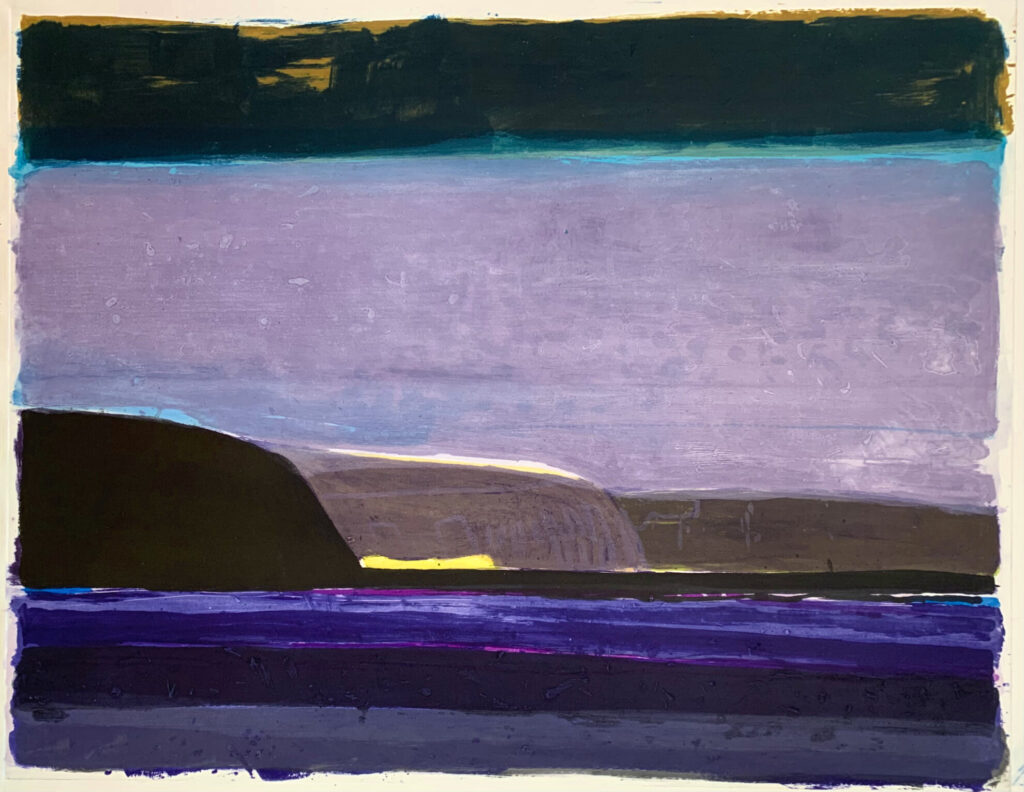
Northwest Passage (2021) Barbara Rae
Stoney Road Press
Paris, 1968: the grit gets its close-up
The artistic breakthrough is credited to Henri Goetz, an American-born painter and printmaker based in Paris. Goetz was a teacher and experimenter who ran a hugely influential workshop, and in the late 1960s he realised that carborundum grit, bound to a plate with an acrylic medium, could hold ink the way no etched line could.
The result was a revelation. Instead of biting metal with acid, you could build a plate, painting, dusting and layering grit like an alchemist. The printed tones came out rich, soft and almost three-dimensional, with a velvety depth that resembled the legendary darkness of mezzotint but achieved in a fraction of the time.
Goetz promoted the method through teaching and writing, and it spread through the international print world from there. It arrived at the perfect moment: the 1960s and 70s were an era of printmaking experimentation, with artists happily mixing intaglio, relief and collage. Carborundum sat naturally alongside the collagraph, a related build-up technique named by Glen Alps in the 1950s, and became one of its most beloved cousins.
What made the method so appealing was how directly it matched the mood of the moment. Printmakers were tired of being told that a plate must be incised line by line, and carborundum let them work more like painters, laying down tone in broad, confident gestures and discovering the image as it emerged. Because the materials were cheap and the chemistry was minimal, teachers could introduce it to students in an afternoon, and the technique travelled quickly from Parisian studios to art schools and community workshops far beyond France, where it remains a staple of the contemporary print curriculum.
How it actually works
The beauty of the process is its low-tech honesty. Everything begins with a plate, and printmakers use whatever sturdy surface suits their ambitions: thick card, aluminium, plexiglass or thin sheets of metal all work well. The artist then applies carborundum powder in one of two ways. The first is to mix the grit directly into acrylic gel or medium and brush, stipple or scrape the paste across the plate. The second is to paint the medium on first and sift dry grit over it, letting the grains stick wherever the wet surface allows.
The grade of grit is the artist’s tonal dial. Coarse grains create deep valleys that trap generous amounts of ink and print as rich, dark passages, while fine grains hold only a whisper of ink and produce soft, misty greys. Once the plate has dried and been sealed, it looks like a miniature mountain range, a tactile topography of hills and hollows that the artist can already read as a map of future tones.
Printing follows the logic of intaglio. Ink is pressed into the texture, the surface is wiped back so that the pigment remains in the hollows, and the plate is laid on the bed of an etching press with a sheet of dampened paper on top. Under the pressure of the rollers the paper is forced into every crevice, drawing the ink out and often leaving a faint embossed relief that gives the finished print a sculptural presence.
The tonal range is the headline act. One plate can deliver everything from pale mist to near-black, depending on grit size and how heavily it is applied. Printmakers also love that it rewards painterly, spontaneous mark-making rather than the fussy precision of traditional line etching.
Why artists adore it
Printmakers cherish carborundum first for its atmosphere. Few techniques deliver such velvety, luminous darks so quickly, and doing so without acid baths or aquatint boxes makes it far friendlier for classrooms and home studios. The method also rewards a painterly temperament, inviting artists to brush, pour, stipple and scrape where traditional etching demands meticulous, fussy line work.
Then there is the touch. Because the paper is pushed deep into the grit, a carborundum print often carries an embossed texture that begs to be touched, though curators will politely ask you not to. That physical quality makes the prints feel less like reproductions of an image and more like objects with weight, shadow and skin.
The Yellow Man (2018) Hughie O’Donoghue
Paupers Press
The honest caveats
Even gods admit imperfections. Carborundum is notoriously tough on equipment: the grit can abrade press blankets and wear down plates, so printmakers use dedicated or sacrificial blankets and expect shorter editions than with etched metal. The fine powder is also hazardous to breathe, so a dust mask and careful handling are essential. And the grit is hard to correct once it’s down, so planning your darks and lights matters.
None of this is a reason to avoid the technique, only to approach it with planning. Many printmakers sketch their tonal map before the first grain goes down, keep a dedicated set of blankets for gritty work, and treat the plate as a one-way journey in which commitment is part of the charm.
Why it still matters
In an age of digital perfection, carborundum is gloriously analogue: grit, glue, ink and muscle. It connects industrial history to fine art, turning a material designed to grind things away into one that adds depth, shadow and mystery. Not bad for a failed diamond.
Its legacy is also a reminder of how art history really advances. Rather than arriving in a flash of genius, new techniques tend to emerge when a curious person borrows something from a neighbouring trade, as when an industrial abrasive ended up in a Paris studio. Some of the most interesting innovations in printmaking have come from this sort of cross-pollination between workshop and factory.
Next time you see a print with shadows so deep you could fall into them, lean in. You might be looking at the happiest accident in the history of sandpaper.