Chine Collé: The Art of Cheating Your Paper
A Technique Born From a Problem Nobody Wanted to Solve
Picture a printmaker in early nineteenth-century Paris, hunched over a lithographic stone, frustrated. European printmaking paper was sturdy and reliable for etching and engraving, but it was too coarse and absorbent to capture the whisper-thin gradations a lithographic crayon could produce. Every delicate smudge of tone got swallowed by the tooth of the paper. Meanwhile, thin, luminous sheets imported from China and Japan could hold every subtle mark with almost unnerving clarity – but they were far too fragile to survive the crushing pressure of a printing press on their own. Run one through a press by itself and it would tear, wrinkle, or simply disintegrate.
The obvious answer – pick one paper and live with its limitations – wasn’t good enough for artists chasing a very specific kind of visual richness. So printmakers arrived at a stranger, more elegant solution: don’t choose between the two papers. Use both, fused together, in a single pass through the press.
That workaround has a name – chiné collé, from the French for “glued china [paper]” – and more than two centuries later, it’s still one of the most quietly seductive techniques in the printmaking toolkit.
How Do You Print on Paper That Can’t Survive Printing?
The trick is almost sleight-of-hand, and it happens in a matter of seconds. A thin, tissue-like sheet – historically Chinese or Japanese paper, though contemporary printmakers now use all kinds of lightweight papers – is laid directly onto the freshly inked plate, stone, or block, image-side down. A thin layer of adhesive, traditionally wheat paste or rice paste, sits between that fragile sheet and a much heavier, sturdier backing sheet placed on top of it. The whole sandwich – thin paper, adhesive, thick paper – goes through the press together in one motion.
The pressure of that single pass does three jobs at once: it forces ink from the plate into the delicate china paper, it presses the thin sheet permanently into the paste so it bonds to its heavier support, and it leaves behind a faint, almost imperceptible ridge where the edge of the thin paper sits just barely proud of the surrounding backing sheet. That soft, slightly raised outline is the technique’s signature – a small piece of physical evidence, visible under raking light, that tells you exactly how the print was made.
Get the timing, moisture, or pressure wrong, and the thin paper tears, bubbles, or shifts mid-press, ruining the impression. That razor-thin margin for error is part of why chiné collé has always carried a reputation among printmakers as a technique that rewards precision and punishes impatience.
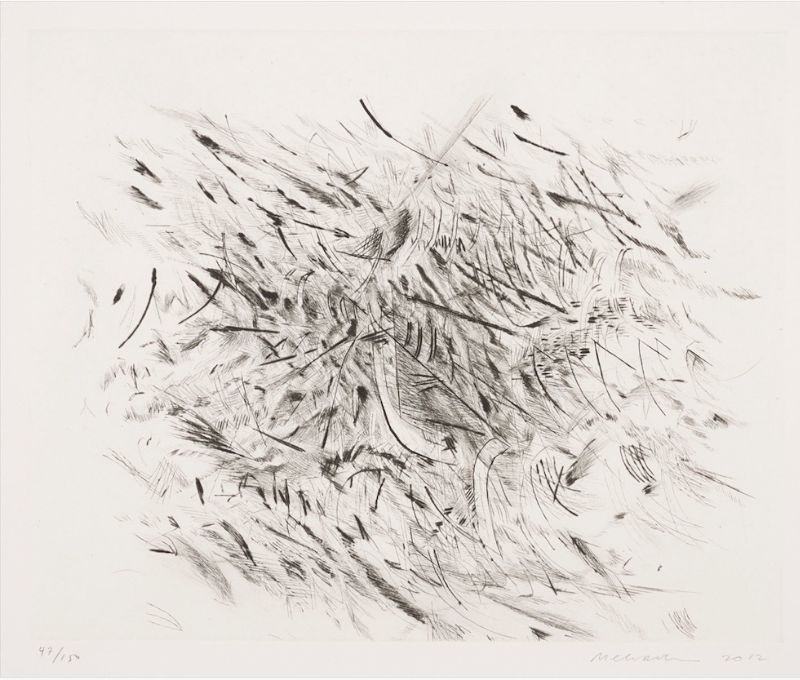
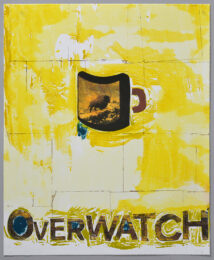
Haka (2012)
Julie Mehretu
Turner Carroll Gallery
The Secret Ingredient Nobody Notices
What makes chiné collé so seductive isn’t just the technical problem it solves — it’s the tonal effect it produces, one that’s easy to feel and hard to name if you don’t already know what you’re looking at.
The thin paper is often tinted in warm, muted tones – buff, grey, ivory, blush – or textured with visible laid lines, fibers, or a faint sheen. Because that colored, textured sheet sits beneath the ink rather than being printed onto a stark white ground, the color glows through the image from behind rather than competing with it from the surface. Blacks read as richer and more velvety. Whites take on warmth instead of a clinical, paper-store brightness. Shadows gain a hazy, atmospheric depth that a single sheet of uniform white paper simply cannot produce, no matter how carefully the artist inks the plate.
It’s the printmaking equivalent of an underpainting in oil painting – an invisible structural decision made before a single mark of the visible image goes down, one that quietly shapes the mood and depth of everything the viewer eventually sees. Two impressions of the exact same plate, one printed straight onto white paper and one printed with chiné collé, can feel like entirely different works of art.
The Artists Who Turned a Workaround Into a Signature Style
By the mid-1800s, chiné collé had migrated from a practical fix into a deliberate aesthetic choice, and it became closely tied to the great lithography boom of the period. Artists were hunting for ways to make prints feel less like mechanical reproductions and more like drawings, watercolors, or wash sketches – objects with the intimacy of a unique work rather than the coolness of a multiple. French Romantic and Barbizon-adjacent printmakers, working in a period obsessed with atmosphere and mood over crisp linear precision, found in chiné collé exactly the softness they were after.
- The technique found a second wind at the turn of the twentieth century among Symbolist printmakers drawn to its veiled, dreamlike quality. Odilon Redon, whose lithographs already trafficked in shadow, ambiguity, and half-formed visions, used papers and tonal effects that leaned into that same hazy register. Painter-printmakers working in etching and drypoint discovered that a tinted chiné ground could soften the harsh contrast of a needle-scratched line, giving even aggressive, expressive mark-making a kind of muffled warmth.
Later generations of modern and contemporary printmakers kept the technique alive precisely because it never stopped solving the same problem: how to make a printed image feel handmade, singular, and tonally alive rather than flat and mechanically repeated. Studios working in etching, lithography, and relief printing today still reach for chiné collé whenever a project calls for a print that reads less like a stamped multiple and more like an object touched by hand.
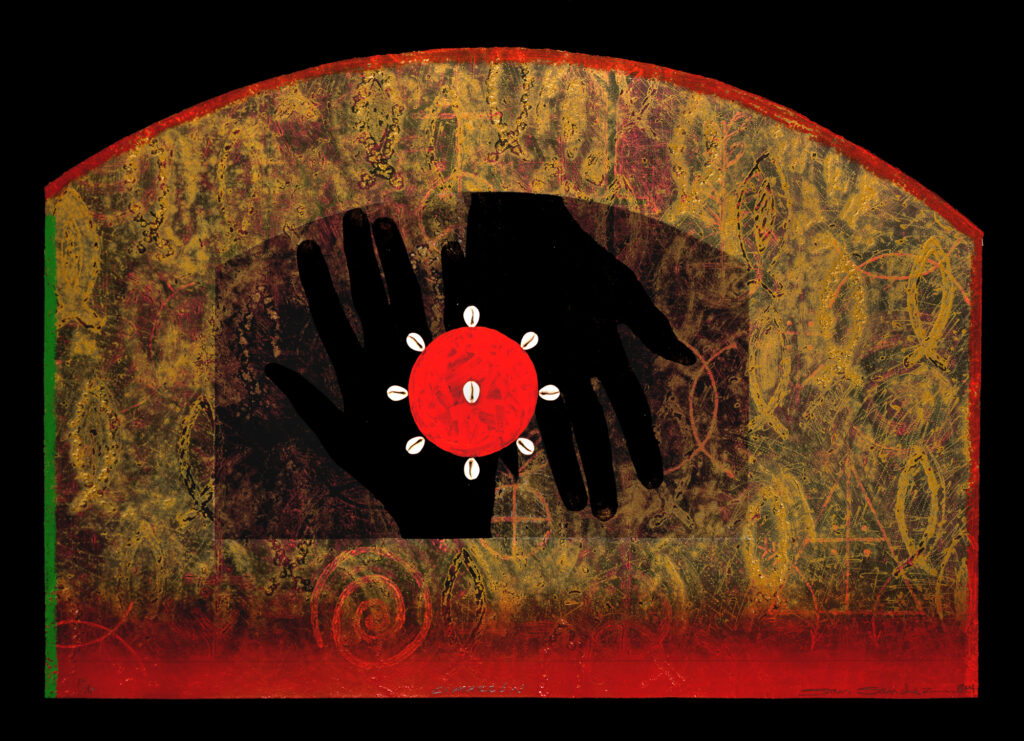
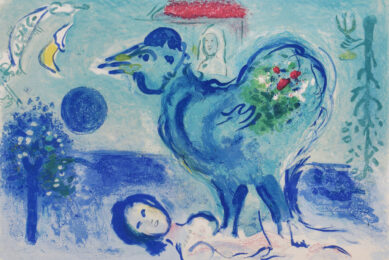
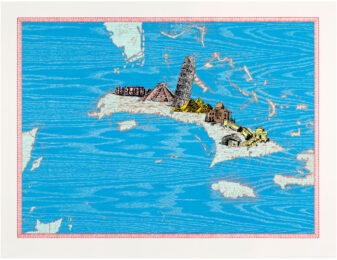
Cimarrón (2004)
Juan Sánchez
Wildwood Press
Every Print Is Secretly One of a Kind
Here’s the detail that collectors, curators, and print historians tend to love most: even within a single “identical” edition – the same plate, the same ink, the same run through the same press — no two chiné collé impressions are ever quite alike.
The placement of the thin tissue shifts slightly from pull to pull. The adhesive catches and dries in slightly different patterns each time. The faint texture of the china paper’s fibers bleeds through the ink with tiny variations invisible to the naked eye until you compare sheets side by side. In an art form built almost entirely around the concept of the multiple – the same image, deliberately repeatable, numbered 1 of 50, 2 of 50, and so on – chiné collé smuggles in a bit of the unique, one-off object. Every print in the edition is technically identical and quietly, materially individual at the same time.
That tension is part of the technique’s enduring appeal. It lets an artist have the reach of an edition and the intimacy of a single sheet, simultaneously.
A Technique That Rewards the Patient and Punishes the Rushed
Ask any printmaker who works regularly with chiné collé and they’ll tell you it’s less a single technique than a small collection of finicky variables that all have to align at once. The thin paper has to be cut or torn to exactly the right size and shape before it ever touches the plate – torn edges, in fact, are often preferred over cut ones, because they feather out gradually rather than stopping abruptly, blending more convincingly into the surrounding sheet once printed. The adhesive has to be mixed to the right consistency: too thin and it won’t hold the tissue in place through the press; too thick and it seeps out from under the edges, leaving visible smears or lumps in the final print.
Timing matters just as much as materials. Paste applied too early dries out before the press does its work; applied too late, it hasn’t had a chance to properly wet the fibers of the china paper, and the bond fails. Registration – lining the thin paper up precisely where the artist wants it relative to the image – has to happen in the brief window between inking the plate and running it through the press, often by eye or with the help of small registration marks, with no room to stop and reposition once the press engages.
All of this means a chiné collé edition takes considerably longer to pull than a standard one. Many studios treat it as a specialty service, reserved for artists willing to accept a smaller edition size in exchange for the technique’s particular richness. That scarcity has, over time, only added to its appeal among collectors, who tend to view a well-executed chiné collé print as evidence of real craftsmanship rather than a shortcut.
Why This Centuries-Old Trick Still Matters
Chiné collé never became obsolete, and it likely never will, because it never stopped solving the same underlying problem it was invented to solve: how to get maximum tonal sensitivity and textural richness out of a printed image without sacrificing the structural durability a press demands. Contemporary printmakers still turn to it constantly – sometimes with historically faithful Asian papers sourced the same way nineteenth-century artists sourced theirs, sometimes with modern handmade or machine-made alternatives, sometimes layering multiple colored tissues in a single print for effects the technique’s original inventors never imagined possible.
It’s a reminder of something true across a lot of art history: many of the techniques we now admire as refined, deliberate aesthetic choices started out as someone’s clever fix for an annoying material problem. Chiné collé is a workaround that got so good at what it did – so good at making a print feel warmer, softer, and more singular – that it never stopped being useful, and it never stopped being beautiful.