Cyanotype: The Printmaking Technique Invented by a Scientist Studying Something Else Entirely
The Blueprint for Blueprints Was Never Supposed to Be Art
Most printmaking techniques were built by artists chasing a specific visual effect. Cyanotype was built by an astronomer chasing an entirely different goal: a reliable way to copy his own mathematical notes and diagrams. In 1842, the English scientist Sir John Herschel discovered that a mixture of two iron compounds, when coated onto paper or fabric and exposed to sunlight, turned a deep, vivid Prussian blue wherever light struck it – and stayed pale and unreacted wherever it was shielded from light entirely. It was a chemical curiosity as much as anything else, a byproduct of Herschel’s broader research into how light interacts with various compounds.
Herschel had no interest in making art. He wanted a cheap, reliable way to reproduce technical drawings and documents, and cyanotype delivered exactly that – so effectively that the process went on to become the industrial standard for architectural and engineering drawings for the next century, giving the English language the word “blueprint” itself, straight from the deep cyan-blue reproductions rolling off drafting tables around the world.
That a chemistry demonstration for copying diagrams eventually became a beloved fine-art photographic printmaking process is one of the odder detours in art history – and it happened almost immediately, thanks to one woman who saw something in Herschel’s blue chemistry that he never intended to be there.
How Do You Print With Nothing But Sunlight?
Cyanotype belongs to a category of process called a photogram or contact print, and unlike almost every technique discussed so far, it requires no plate, no press, and no ink whatsoever. Paper or fabric is coated with a light-sensitive solution of two iron salts – ferric ammonium citrate and potassium ferricyanide – and left to dry in the dark, since the coating remains sensitive to light from the moment it’s applied.
Once dry, an object or a transparent negative is placed directly on top of the coated surface, and the whole arrangement is exposed to sunlight or ultraviolet light for anywhere from several minutes to over an hour, depending on the strength of the light. Wherever light reaches the coated surface, a chemical reaction occurs that will eventually turn that area a deep Prussian blue. Wherever an opaque object or the dark areas of a negative block the light, the chemistry underneath never triggers, and that area stays pale, closer to white or a faint yellow-green.
After exposure, the print is simply rinsed in plain water, which washes away the unreacted, still-soluble chemicals and leaves behind only the areas that were permanently fixed by light. As it dries and continues to oxidise over the following day, the exposed blue areas deepen and intensify, settling into the rich, saturated cyan the process is named for. No darkroom, no press, no ink – just light, chemistry, and water.

The Light of the World (2017)
Kiki Smith
Krakow Witkin Gallery
The Woman Who Turned a Copying Trick Into Art
Within a year of Herschel’s discovery, the British botanist and photographer Anna Atkins recognized something Herschel himself had overlooked: cyanotype wasn’t just useful for copying documents. It was an extraordinarily precise way to record the delicate, complex shapes of plants. Atkins, an accomplished botanical illustrator already frustrated by how difficult it was to accurately draw the intricate structures of algae and ferns by hand, began laying actual specimens directly onto cyanotype-coated paper and exposing them to the sun.
The results were remarkable: crisp, ghostly white silhouettes of seaweed, ferns, and algae rendered in exacting botanical detail against a field of deep blue, capturing every delicate branch and frond with a precision no hand-drawn illustration could match, because the object itself, not an artist’s interpretation of it, was doing the recording. In 1843, Atkins compiled her cyanotype specimens into a book documenting British algae, widely considered the first book ever illustrated with photographic images – predating other major photographically illustrated publications and putting a scientist-artist’s cyanotype experiments at the very origin point of photography as a medium for books.
Atkins wasn’t trying to make fine art any more than Herschel was; she was trying to solve a genuine scientific documentation problem. But in doing so, she demonstrated something that would echo through more than a century of cyanotype use afterward: the technique’s greatest strength wasn’t reproducing existing documents. It was recording the direct, unmediated impression of real, physical things.
A Process That Doesn’t Need a Camera at All
What makes cyanotype so enduringly appealing to artists, well over a century after its invention, is that it requires no camera, no darkroom, and almost no specialised equipment beyond the coated paper itself and a sunny day. Anyone can lay objects directly onto a coated sheet – leaves, flowers, lace, feathers, keys, seashells, even a person’s hand or body — and expose it to create a photogram, a silhouette image formed entirely by the shapes of real objects blocking real light, with no camera or lens involved in the process at all.
- This direct, cameraless quality gives cyanotype photograms a distinctive character that photographic prints made through a camera lens don’t share: there’s no illusion of depth or perspective, no vanishing point, no sense of a scene captured from a particular vantage point. What you get instead is closer to a literal shadow, permanently fixed – an object’s actual silhouette, life-sized, printed by nothing more than the object itself standing between the sun and a piece of chemically treated paper. It’s less a photograph of something and more a direct trace left by something, which is part of why cyanotype has always felt slightly closer to sculpture or fossil-making than to conventional photography.
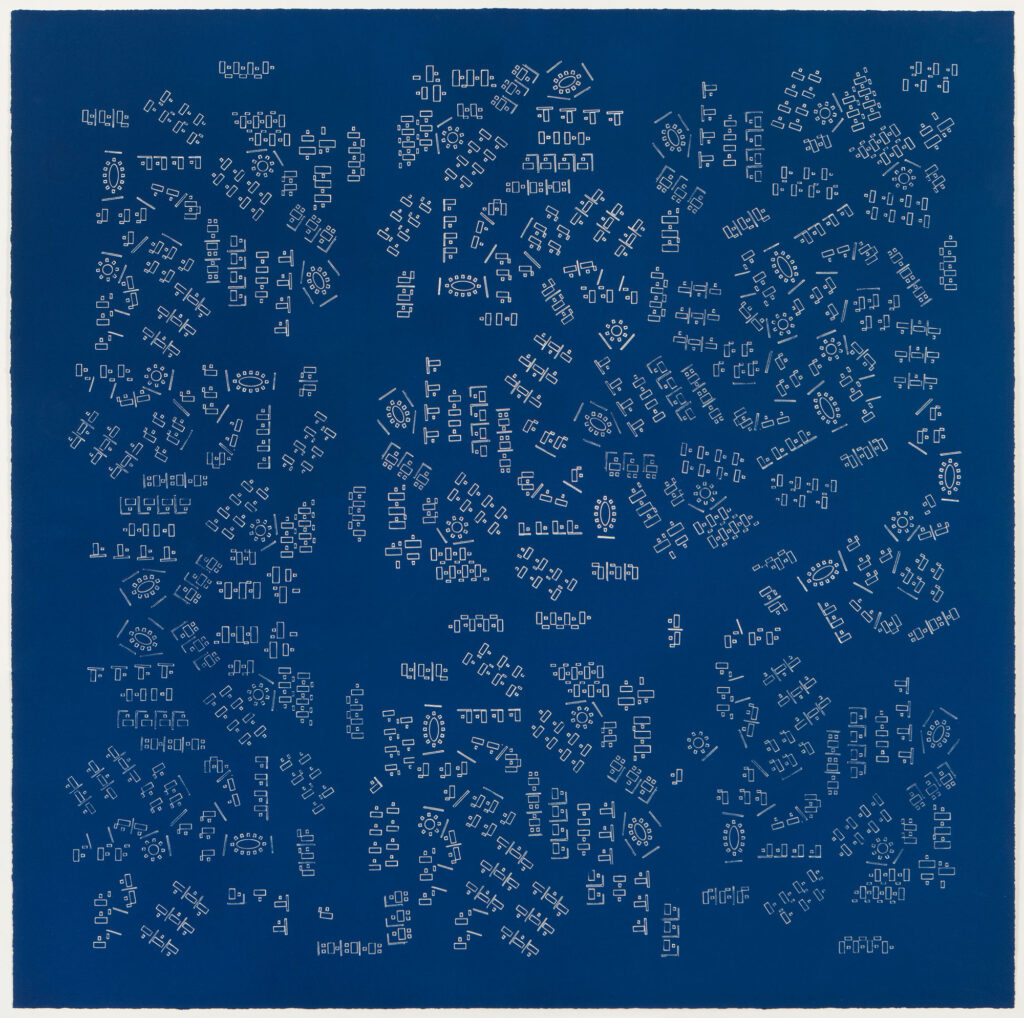
The Neufert Suite: Work Stations (2002)
Guillermo Kuitca
Graphicstudio
From Engineering Offices to Elementary School Classrooms
Cyanotype’s industrial life ran in parallel with its artistic one for well over a century. Well into the twentieth century, architects and engineers relied on the process to mass-produce cheap, durable copies of technical drawings, feeding paper through machines that exposed and developed blueprints on an industrial scale, long after most fine artists had moved on to other photographic processes. That dual identity – humble industrial workhorse on one hand, delicate art-making tool on the other – gave cyanotype an unusually broad cultural footprint few other printmaking or photographic processes can claim.
Its simplicity and low cost also made it one of the most accessible photographic processes ever devised, requiring no darkroom, no toxic developing chemicals beyond the two starting salts, and no equipment more sophisticated than sunlight and water. That accessibility has made cyanotype a perennial favorite for introducing people, including children, to the basic principles of photographic image-making, and pre-treated cyanotype paper kits remain widely available today for exactly that purpose, more than 180 years after Herschel first mixed the chemistry.
Why an Accidental Blue Keeps Coming Back
Cyanotype has undergone a genuine resurgence among contemporary artists and photographers in recent decades, valued precisely for the qualities that once made it feel like a scientific curiosity rather than serious art: its directness, its unpredictability, its dependence on actual sunlight rather than controlled studio lighting, and its refusal to look anything like a conventional photograph. Contemporary artists have used it to record everything from botanical specimens in the tradition Anna Atkins established nearly two centuries ago, to full-body photograms, to large-scale installations that use cyanotype’s light-sensitivity as a way to literally record the passage of time and weather across a surface.
That a technique invented purely to copy an astronomer’s notes ended up capturing some of the most direct, unmediated images in the history of art says something about how artistic value gets discovered rather than designed. Nobody set out to invent a fine-art medium in 1842. What they found, almost by accident, was a way to let sunlight itself become the artist’s tool – and that discovery has outlasted the industrial purpose it was built for by well over a hundred years.