Every printmaking technique makes some kind of trade-off between quality and quantity. Drypoint makes that trade-off more brutally than almost any other. Its lines are famous for a soft, velvety richness that no other intaglio method can quite match – and famous, in the same breath, for barely surviving contact with a press at all. A drypoint plate can produce a small handful of truly luminous impressions before its most distinctive quality begins to fade, and within a few dozen pulls, the image an artist labored over can be visibly, irreversibly diminished.
That fragility isn’t a flaw the technique has learned to live with. It’s the entire reason drypoint looks the way it does. Understanding drypoint means understanding a printmaking process built, quite literally, on borrowed time.
What If You Skipped the Acid Bath Entirely?
Drypoint belongs to the same broad family as etching and engraving – techniques that cut or bite lines into a metal plate, ink the recessed grooves, wipe the surface clean, and force damp paper into those grooves under heavy press pressure to pull the ink out. But where etching uses acid to bite lines into the metal and engraving uses a specialized tool called a burin to carve clean, precise channels, drypoint skips both the chemistry and the precision engineering. An artist simply drags a sharp, needle-like point directly across the bare surface of a copper or zinc plate, scratching the image straight into the metal by hand, the same way you might scratch a mark into a bar of soap.
That simplicity is part of drypoint’s appeal. There’s no waiting for acid to bite, no worrying about how long to leave a plate in the acid bath, no risk of over-etching a line into unwanted thickness. What you scratch is what you get, immediately and directly – which makes drypoint one of the most spontaneous, gestural printmaking techniques available, closer in feel to drawing than almost any other intaglio process.
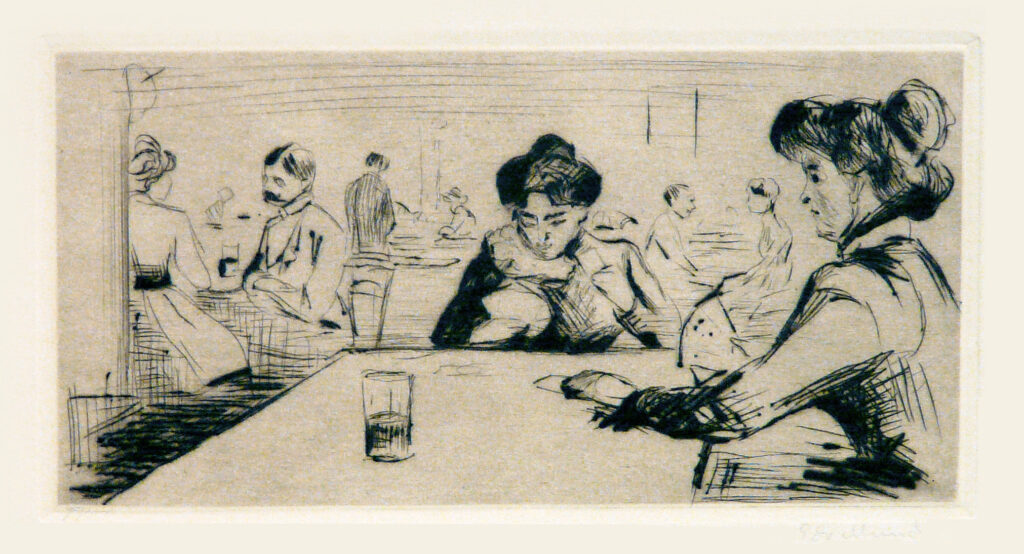
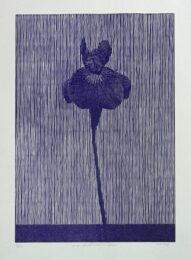
Hopfenblüte (1902)
Edvard Munch John Szoke Gallery
The Accident That Became the Whole Point
Here’s where drypoint gets genuinely strange. When a needle drags through metal, it doesn’t cut a clean channel the way a burin does. It pushes displaced metal up and out to either side of the scratched line, like a plow pushing dirt up alongside a furrow. That ridge of displaced metal is called the burr, and by every measure of careful craftsmanship, it should be considered a mess – a rough, irregular byproduct of an imprecise tool that a “proper” engraving technique would clean up and polish away.
Drypoint artists do the opposite. They leave the burr exactly where it lands, because that ragged ridge of metal is what makes drypoint look like nothing else. When the plate is inked, ink catches not only in the scratched groove itself but also in the tiny irregular crevices of the burr standing beside it. When that ink transfers to paper under the press, the line that results isn’t the clean, hard edge you’d get from an engraved or etched line – it’s soft, fuzzy, and slightly blurred, almost as if the mark had been drawn in charcoal or soft pencil rather than cut into metal. It’s an accident of the tool’s mechanics, deliberately preserved and celebrated rather than corrected.
Why the Most Beautiful Part of Drypoint Is Also the First to Go
The burr is magnificent, and the burr is doomed. It’s a fragile, delicate structure of raised metal, standing proud of the plate’s surface by a fraction of a millimetre – and every single trip through a printing press, under enormous mechanical pressure, flattens it a little more. The first few impressions pulled from a freshly worked drypoint plate, while the burr is still fully intact, are almost always the richest: deep, velvety, atmospheric lines with a softness bordering on smoky. By the tenth or fifteenth impression, the burr has usually started to compress and wear. By the twentieth or thirtieth, in many cases, it’s essentially gone, and the line that remains is thin, hard, and comparatively lifeless – technically the same scratched groove, but stripped of the quality that made drypoint worth choosing in the first place.
This is why drypoint editions are, almost as a rule, small. Where an engraving or a well-maintained etching plate can sometimes yield hundreds of quality impressions, a drypoint plate might only offer a genuinely satisfying twenty or thirty before the artist and printer have to accept that the print run has essentially run its course. Collectors and print historians pay very close attention to where in that sequence a given impression falls – an early, burr-rich pull and a late, burr-worn pull from the identical plate can look startlingly different, even though nothing about the underlying image has changed.
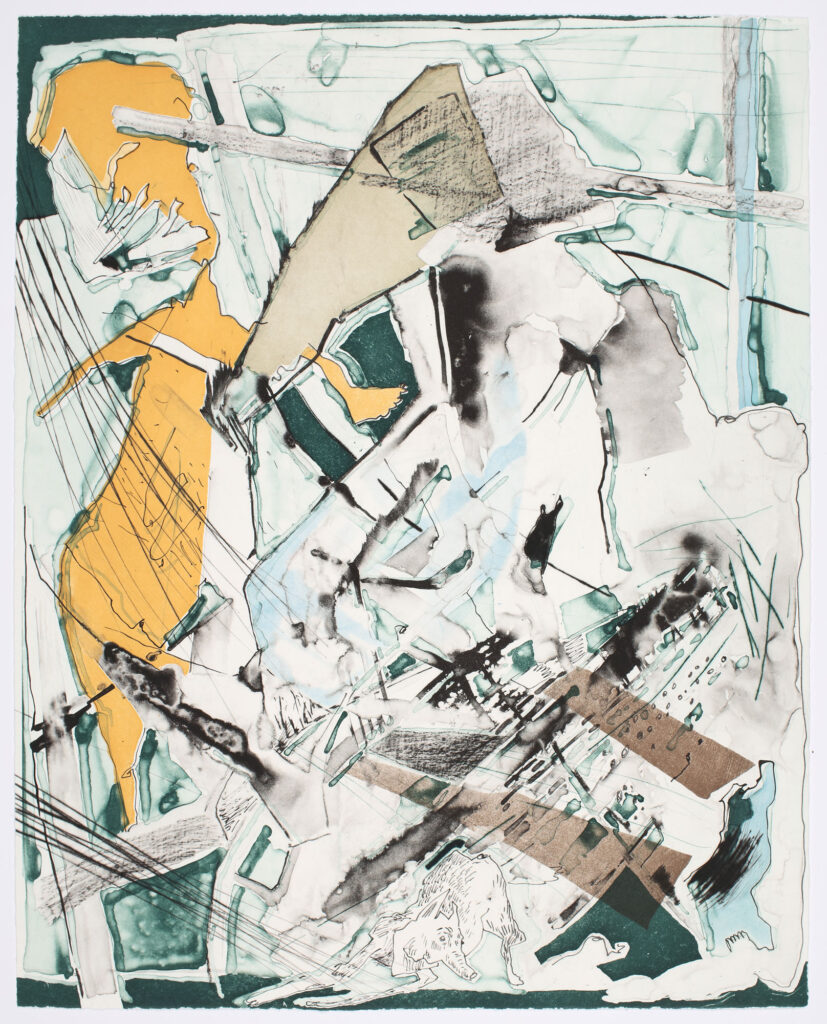
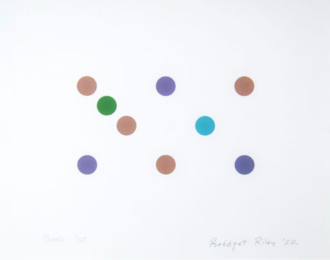
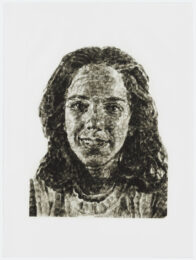
Mute Walk (2015)
Iva Gueorguieva Graphicstudio
Rembrandt’s Secret Weapon
Drypoint’s built-in expiration date bothered enough printmakers and publishers over the centuries that real effort went into finding ways around it. The most significant fix arrived with steel-facing, a process developed in the nineteenth century in which a thin layer of steel is electroplated directly onto the surface of a softer copper or zinc plate, hardening the delicate burr and dramatically extending how many quality impressions a plate can produce before wearing down.
Steel-facing solved the durability problem, but it came with trade-offs of its own – some printmakers felt the hardened surface subtly changed the quality of the burr itself, trading a bit of drypoint’s characteristic softness for durability. Other artists simply accepted the fragility as an unavoidable cost of the technique’s particular beauty, choosing to work in drypoint specifically because they wanted the small, precious, rapidly changing editions it produced, treating scarcity itself as part of the work’s meaning rather than a problem to be engineered away.
A Technique That Refuses to Pretend It’s Permanent
Most printmaking techniques are built around the idea of the reliable multiple – pull the hundredth impression, and it should look essentially like the first. Drypoint quietly rejects that premise. It offers, instead, a printmaking process that’s honest about its own impermanence, one where the artist’s most beautiful mark is also, unavoidably, the first thing to start disappearing.
That’s an unusual thing for an art form built on repeatability to admit, and it’s exactly what makes drypoint feel so different from its intaglio cousins. Etching and engraving promise consistency across an edition; drypoint promises something more fleeting and, in its own way, more honest – a technique that captures the immediacy of a single gesture and then, almost as if on principle, refuses to let you have that exact moment more than a handful of times.