Why a Print’s Paper Is Catalogued With the Same Reverence as Its Edition Number, Date, and Size
The Detail Everyone Skips – and Shouldn’t
Open any respectable print catalogue raisonné and you’ll find a strange ritual repeated on every page. Alongside the artist’s name, the title, the date, the edition size, and the sheet dimensions, there sits a small, almost bureaucratic-sounding line: laid paper, wove paper, Japon nacré, Arches, chine collé, BFK Rives. To the untrained eye, it looks like packaging material – the box the real artwork came in. To a curator, a dealer, or a serious collector, it is nothing of the sort. It is one of the four or five facts that determine whether a print is what it claims to be.
This is the paradox at the heart of print connoisseurship: the support is not support. It is evidence.
A Sheet of Paper Is a Fingerprint, Not a Backdrop
Every batch of handmade or mould-made paper carries a signature written into its fibres – the mould marks, the chain lines, the watermark, the thickness, the tone, even the way it absorbs ink. Printmakers didn’t select paper the way we select printer paper today, indifferently, for whatever’s in the tray. They chose it the way a painter chooses pigment: for how it would behave under pressure, how it would hold a burr, how it would age.
When Rembrandt pulled impressions of the same plate onto Japanese paper in one run and European laid paper in another, he wasn’t being inconsistent – he was producing two different objects. The image is identical. The object is not. A connoisseur reading “laid paper” versus “Japan paper” in a catalogue entry isn’t absorbing trivia; they’re being told which version of the print they’re looking at, because the paper often correlates with the print’s place in the printing sequence, its rarity, and sometimes its market value multiplied several times over.
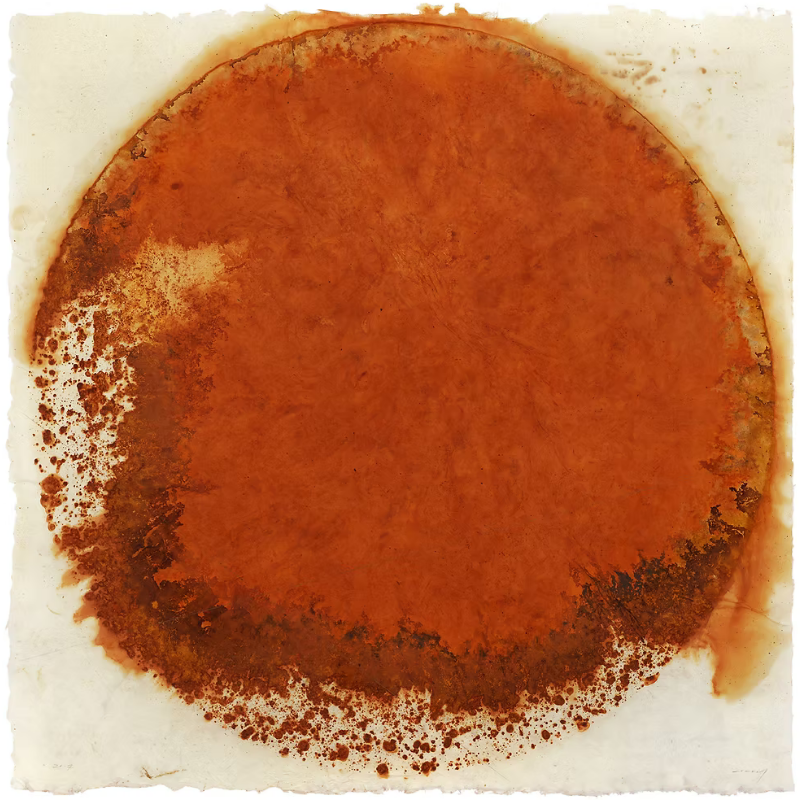
Relative Points 9 (2017)
Christine Corday Wildwood Press
Paper Doesn’t Lie – Even When Everything Else Can
Here is the uncomfortable truth of the print market: signatures can be forged, dates can be altered, and edition numbers can be fabricated by anyone with a pencil and nerve. Paper is far harder to fake convincingly, because faking it means faking chemistry and history simultaneously.
Wood-pulp paper wasn’t in wide industrial use until the mid-19th century. A “16th-century woodcut” printed on wood-pulp stock isn’t a 16th-century woodcut – it’s a later restrike, a reproduction, or worse.
Watermarks can often be traced to specific mills and, in some cases, specific decades, giving scholars a forensic timestamp independent of what’s written on the sheet itself.
Fluorescence under UV light reveals optical brighteners used in modern papers – chemicals that didn’t exist before the 20th century – instantly unmasking a print that claims to be older than it is.
This is why paper analysis sits alongside connoisseurship of line, plate wear, and provenance as one of the primary tools for authentication. It is one of the few elements of a print that resists narrative – you can lie about a print’s story, but you cannot easily lie about its cellulose.
The Same Image, a Different Object: Why “Edition Size” Alone Is a Trap
Collectors sometimes assume that if they know the edition size and the print number, they know everything meaningful. But two impressions numbered consecutively – say 12/50 and 13/50 – may be printed on entirely different papers, especially in editions produced over years or with irregular runs, deluxe subsets, or artist’s proofs.
Publishers have long used paper stock to create tiers within a single edition:
Standard edition on a workaday wove paper for the general run.
Deluxe or “tirage de tête” editions on a luxury stock – often a fine Japon, a vellum, or a heavier rag paper – reserved for patrons, the artist’s own use, or subscribers who paid a premium.
Artist’s proofs (épreuves d’artiste), sometimes pulled on trial papers before the “real” edition even began.
In these cases, the paper type isn’t a footnote to the edition number – it is the real edition structure. A cataloguer who lists only “50 impressions” without specifying the paper has told you the quantity but concealed the hierarchy.
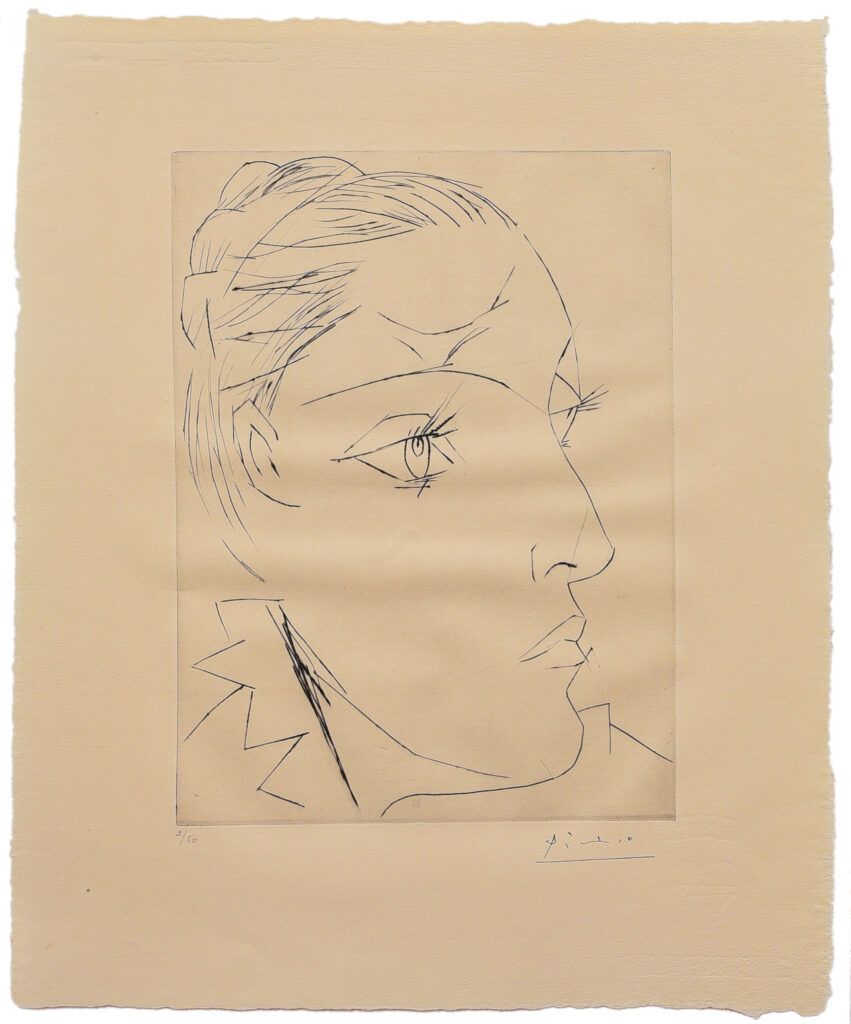
Portrait de Dora Maar au chignon II (1936)
Pablo Picasso Galerie Raphael
Condition, Value, and the Chemistry of Aging
Beyond authentication, paper type is a direct predictor of a print’s condition today and its condition tomorrow. Not all papers age equally, and the difference is not cosmetic – it’s structural.
Rag papers, made from cotton or linen fibres, are naturally low in acid and can remain stable, flexible, and bright for centuries.
Wood-pulp papers, cheaper and more common from the 19th century onward, contain lignin, which yellows, embrittles, and self-destructs over time – the same reason old newspapers turn the colour of weak tea and crumble at the fold.
So when a listing specifies the paper, it is quietly answering a question every serious buyer eventually asks: will this still exist in good condition in fifty years? A print on acidic pulp paper is, in a sense, carrying a slow-burning fuse. One on handmade rag stock is built to outlast its owner. Two prints of identical image and edition size can have wildly different long-term value trajectories purely because of what they’re printed on.
So Why Does Paper Get Top Billing?
Line it up next to the other “vital statistics” of a print and the logic becomes obvious:
Detail – What it tells you Date – When the image was conceived or printed Edition size – How many exist, in theory Sheet size – The physical footprint of the object Paper type – Authenticity, hierarchy within the edition, physical durability, and often the artist’s own aesthetic intent
To omit the paper from a catalogue description, in these cases, is to omit part of the artwork itself – as strange as describing a sculpture without mentioning whether it’s bronze or marble.
Paper isn’t competing with these facts for attention – it completes them. Date tells you when; paper often tells you whether that date can be trusted. Edition size tells you how many; paper tells you which tier of that edition you actually hold. Sheet size tells you the dimensions; paper tells you what those dimensions are made of, and how long they’ll last.
Next time you see “laid paper” or “chine appliqué” tucked into a print listing, don’t skim past it as boilerplate. It’s the print quietly telling you its own life story – where it came from, whether it’s genuine, how privileged its position within the edition was, and how gracefully it intends to grow old.