The Monotype: Where Accident Becomes Genius
There is a moment in the studio that every artist quietly chases – when control slips just enough to let something unexpected breathe. The monotype lives entirely in that moment. It is the printmaking medium that refuses to behave, and that is precisely why it has seduced some of the greatest minds in art history, from Degas to Blake to Gauguin. If you have never made one, you are missing a conversation with chance that no other medium can offer. If you have never owned one, you are missing the chance to hang a singular miracle on your wall.
The Beautiful Tyranny of the One: Why “Only Once” Changes Everything
The name says everything. Mono – one. Type – impression.
You paint or draw onto a smooth plate – glass, metal, plexiglass – and then press paper onto it, transferring the image in a single pull. What comes off the plate exists nowhere else in the universe. There is no edition of fifty. There is no second chance to get it right.
The medium has a built-in scarcity that no certificate of authenticity can manufacture: the process itself makes the work irreplaceable.
For the artist, this is both liberation and terror. The ink behaves differently under pressure than it did on the plate. Edges blur. Textures emerge from nowhere. A figure that looked flat suddenly glows with atmosphere. The press is a collaborator – sometimes a ruthless one – and learning to trust it is one of the deepest lessons a printmaker can receive. You plan, and then you surrender. That negotiation between intention and accident is where great art is often born.
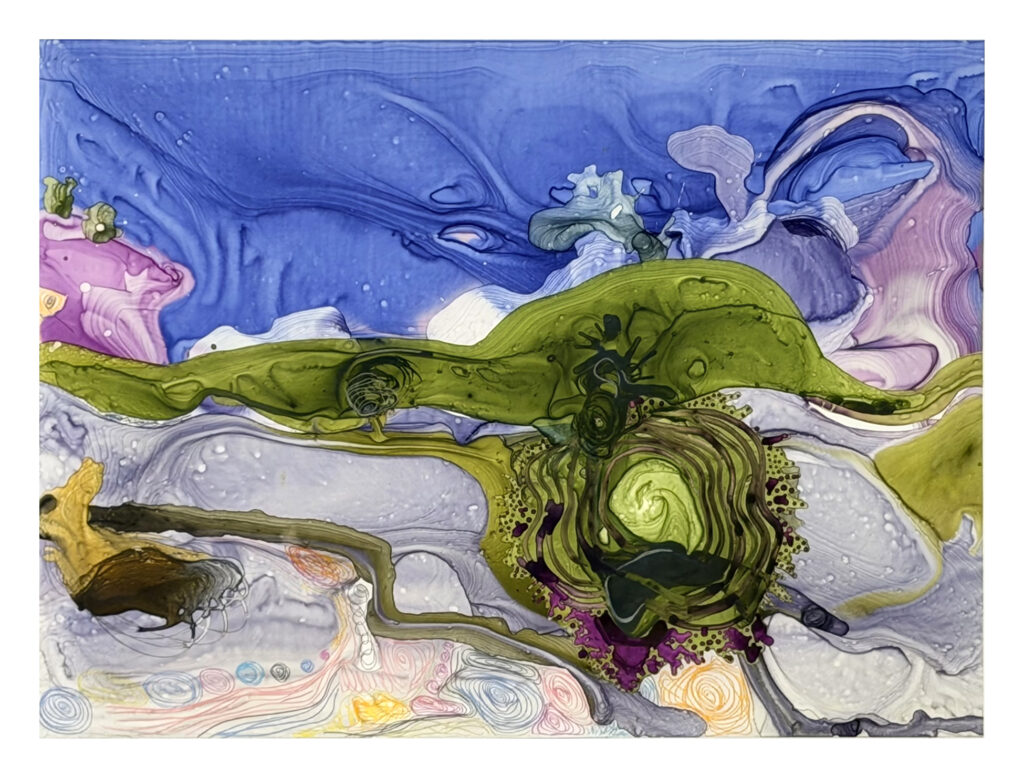
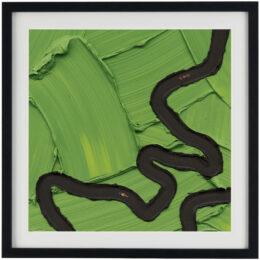
Presence 6 (2026), Eva Lundsage, Center Street Studio
A Brief History: The Masters Who Couldn’t Resist It
The monotype is not a new obsession.
Artists have been drawn to its peculiar alchemy for centuries.
Edgar Degas is perhaps the most celebrated practitioner in the medium’s history. He made over 400 monotypes – more than any other artist of his era – and treated them not as studies or curiosities but as finished works in their own right. His dancers, café scenes, and landscapes translated through the press with a softness and luminosity that his paintings could not always achieve. He credited the medium with fundamentally reshaping how he understood light and tone.
William Blake used monotype as a vehicle for his visionary imagery, pulling figures from mythology and prophecy with a physical urgency that matched the intensity of his verse. The smeared, atmospheric quality of the printed surface gave his characters a dreamlike weight that felt entirely intentional – even when it wasn’t.
Paul Gauguin, working in Tahiti and Brittany, developed his own idiosyncratic approach, drawing through dampened paper onto inked surfaces to produce lines of extraordinary delicacy. His monotypes have a skeletal, primitive energy unlike anything else in the printed tradition.
In the twentieth century, artists from Picasso to Cy Twombly to Richard Diebenkorn all passed through the medium, each finding in it a freedom that their primary practices couldn’t provide. The monotype has never been fashionable in the way that other print media have, and that is precisely why serious artists keep returning to it.
How a Monotype Is Actually Made: The Process Behind the Magic
Understanding how a monotype is made changes how you look at one. The process is deceptively simple and endlessly variable.
Step 1: Prepare the plate. The artist begins with a smooth, non-absorbent surface – traditionally a metal plate, but glass and plexiglass are equally common today. The plate is wiped clean and sometimes lightly inked as a base.
Step 2: Work the image. Using oil-based or water-based inks, the artist paints, draws, or marks directly onto the plate. Some artists build up layers of colour; others subtract ink from a fully covered plate using rags, brushes, and tools to reveal light. Both approaches – additive and reductive – produce entirely different visual qualities.
Step 3: The press. A sheet of dampened paper is laid over the plate and run through a printing press – or in some cases simply pressed by hand. The pressure transfers the ink from plate to paper in a single pull.
Step 4: The reveal. When the paper is peeled back, the image that emerges is always, to some degree, a surprise. The ink has spread, softened, or lifted in ways the artist could not fully predict. This moment of revelation is at the heart of what makes the medium so compelling.
Step 5: The ghost. After the first pull, a faint impression of ink remains on the plate. Many artists work back into this residual image – adding new marks, scratching into the surface, re-inking selectively – to produce a second print, known as the ghost. The ghost is typically lighter and more ethereal than the original, but often carries a haunting beauty entirely its own. Both pulls are unique; neither can ever be exactly repeated.

Monotype vs. Other Print Types: What Makes It Different
The word “print” covers a vast spectrum of techniques, and not all prints are created equal – especially from a collector’s perspective. Here is how the monotype compares to the most common alternatives.
Monotype vs. Etching: An etching is made by incising a design into a metal plate with acid. Because the plate is durable and the incised lines hold ink reliably, an etching can be printed in editions of dozens or hundreds. A monotype plate, by contrast, cannot reproduce the same image twice. Where an etching offers consistency and repeatability, the monotype offers singularity.
Monotype vs. Lithograph: Lithography works on the principle that oil and water repel each other, allowing an image drawn in greasy crayon to be printed repeatedly from a stone or plate. Again, editions are possible – sometimes large ones. The monotype bypasses this entirely; the edition size is always one.
Monotype vs. Screenprint: Screenprinting forces ink through a mesh screen onto paper or fabric. It is highly reproducible, well-suited to bold flat colour, and central to both commercial and fine art printing. The monotype could not be more different: it is hand-made, unrepeatable, and intimate in a way that screenprinting rarely is.
Monotype vs. Giclee / Digital Print: A giclee is an inkjet print, typically produced in large editions from a digital file. It can be a legitimate and beautiful object, but it is, by definition, a reproduction – a copy of something that exists elsewhere. The monotype is the original. There is no file. There is no elsewhere.
What Happens to an Artist Who Discovers Monotype? They See Differently.
Painters who discover monotype frequently describe it as seeing their own instincts for the first time.
Because you are working in reverse – painting what will become the shadow before the light, building an image you can only partially predict – the process dismantles your usual habits and forces a rawer, more gestural response. Degas made hundreds of monotypes and credited the medium with teaching him to think about tone in ways that transformed his painting. That is not a small thing.
The monotype also collapses the hierarchy between drawing and painting. You can work with oil paint, water-based inks, lithographic crayons, or etching inks. You can use brushes, rags, fingers, palette knives, or the end of your thumbnail. The technique asks only one thing of you: commit to the plate, because the press will expose every hesitation and reward every conviction.
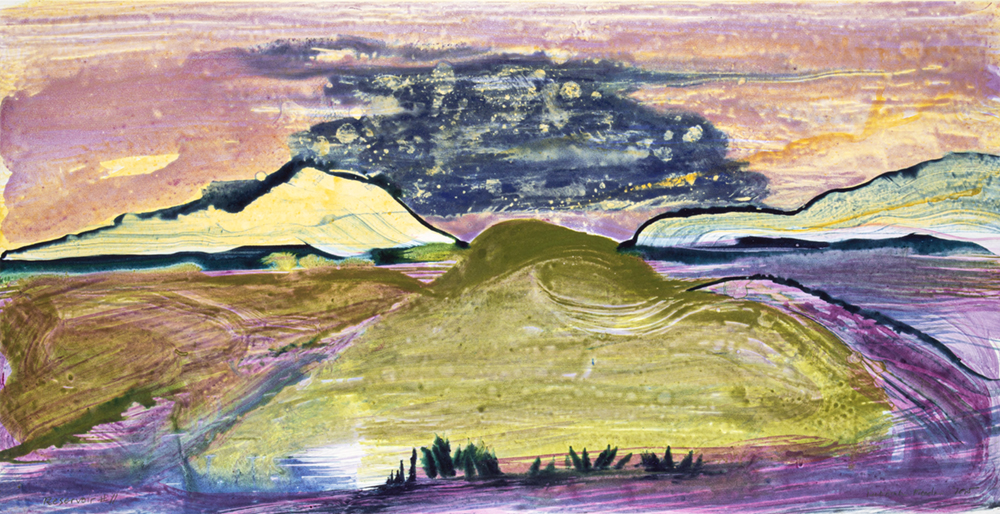
Reservoir #11 (2025), Deborah Freedman, Oehme Graphics
Why Collectors Are Missing Out If They Overlook Monotypes
For the art buyer, the monotype offers something the market often struggles to deliver honestly – genuine singularity.
In an age of open editions, giclee prints, and unlimited digital reproductions, the monotype is structurally, irrevocably unique. It cannot be reprinted. It cannot be editioned. Even if the artist made a ghost print, that ghost is its own separate work. What you are holding has never existed before and will never exist again.
This matters beyond sentiment. It means you are not buying a copy of an artist’s vision; you are buying the moment the vision met the world. The smear, the soft edge, the place where the ink lifted unexpectedly – those are not flaws. They are the evidence of a live encounter between a human mind and a physical process, preserved in its original state. Collectors who understand this tend to become deeply attached to their monotypes in ways they do not always feel about other works on paper.
The Hidden Value Hiding in Plain Sight
There is also a remarkable accessibility to monotypes relative to their quality. Because printmaking has historically sat below painting in the market’s hierarchy – unfairly, but consistently – extraordinary monotypes by serious artists are often available at prices that would seem absurd for a comparable painting.
The collector willing to look with their eyes rather than the auction catalogue will find that monotypes offer some of the finest value in the contemporary and modern art markets.
Why Collectors Are Missing Out If They Overlook Monotypes
The monotype is not a medium for the timid artist or the passive collector. It demands that the artist risk the work with every pull of the press, and it rewards the collector who is willing to love the unrepeatable over the safely reproducible.
In a world that increasingly mistakes abundance for value, the monotype quietly insists on the opposite truth: that the rarest thing of all is the moment that happened only once.
If you are ready to collect something that cannot be copied, cannot be reprinted, and cannot be replicated – something that carries the live energy of the artist’s hand and the press’s unpredictable force – then the monotype is waiting for you.