Ask someone who’s never set foot in a print studio what printmaking is, and you’ll usually get some version of “it’s like stamping, right?” Ink goes on a surface, paper goes on top, you press down, you lift it off. Done.
Here’s the problem with that mental model: it’s wrong in almost every way that matters. A rubber stamp asks for a flat surface, a firm hand, and a few seconds. An etching press asks for calibrated tonnage, dampened fiber, chemically tuned ink, and a release phase measured in fractions of a second. One is a gesture. The other is closer to a controlled industrial process you’d find humming in a materials lab – except the output is a Rembrandt instead of a gasket.
It’s Not Pressure. It’s Pressure Over Time, Over Area
The first thing that surprises people is that printmaking isn’t about slamming something hard. It’s about controlling force per unit area – and doing it consistently across an entire sheet, which turns out to be a much harder engineering problem than it sounds.
An etching press can apply several tons of linear pressure through its rollers, but that tonnage is meaningless without knowing the contact area it’s spread across. This is the same principle behind why a stiletto heel sinks into soft ground while a snowshoe of the same weight doesn’t – force divided by area is what does the damage, not force alone. Too much pressure concentrated too narrowly, and you tear paper or crush a plate’s finer lines into mush. Too little, and the ink never fully transfers – you get a print that looks anaemic, patchy, starved.
Master printers spend years calibrating this by feel, adjusting the packing (the layers of felt or blanket material between the paper and the roller) in fractions of a millimetre. That packing isn’t padding for comfort – it’s an engineering variable, distributing force evenly so a two-foot-wide plate transfers ink with the same intensity at the edges as it does in the center. Change the felt’s thickness by the width of a few sheets of paper, and an entire edition can shift from crisp to muddy.
There’s also a timing dimension that’s easy to miss. The rollers of an etching press don’t strike all at once; they roll through, so any point on the paper experiences a brief, continuous window of loading rather than an instantaneous hit. That’s part of why press-printed marks have a different quality than hand-stamped ones – the pressure builds, peaks, and releases in a smooth curve rather than a sudden spike.
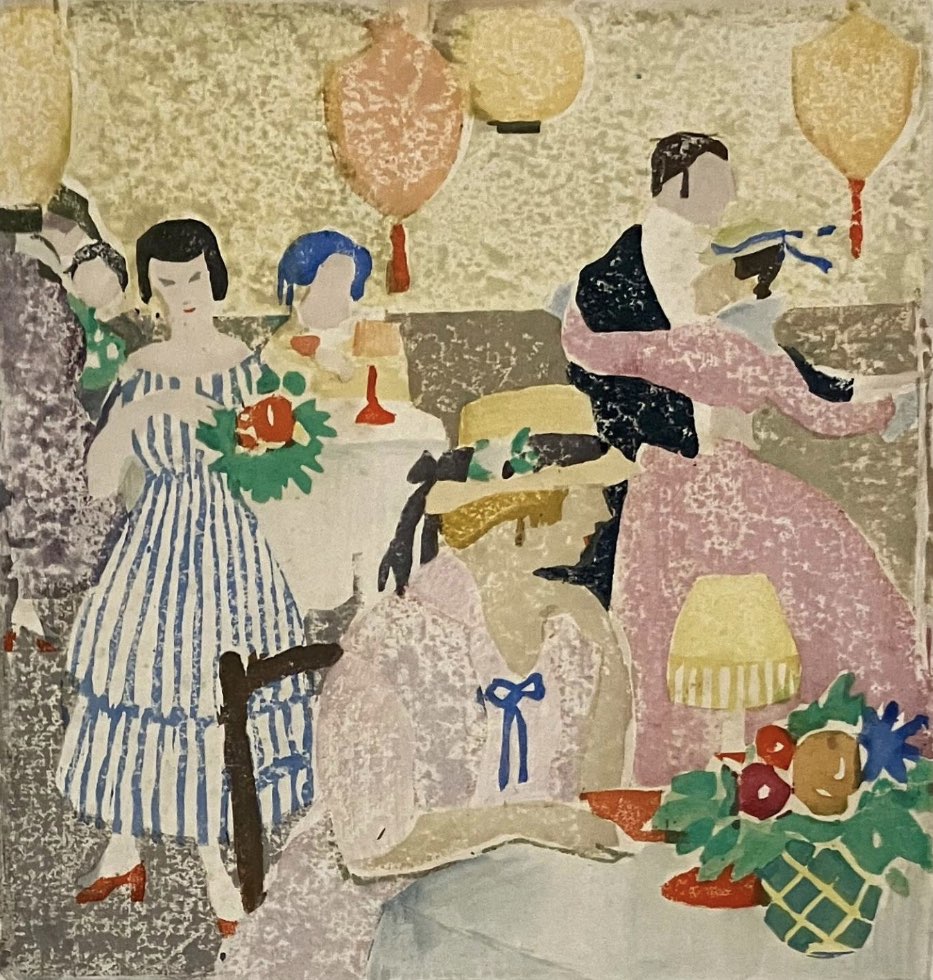
Garden Party (1903) Ethel Mars
Susan Sheehan Gallery
Paper Isn’t Passive – It’s a Participant
Most people think of paper as a neutral surface: a blank thing that receives an image. In reality, paper is an active mechanical participant in the print, and its fiber structure determines almost everything about how a print will look.
Printmaking papers are typically made from cotton or linen rag, and under a microscope those fibres look less like a smooth sheet and more like a loosely woven mat – full of gaps, valleys, and irregular surfaces. When a press forces damp paper against an inked plate or block, it isn’t just touching the ink; it’s being physically driven into the crevices of the printing surface, wrapping around every incised line or raised ridge.
This is why printmakers dampen paper before printing intaglio work. Wet fibers are more pliable – they swell slightly and become soft enough to deform under pressure, pushing into the tiniest engraved grooves to pull ink out that a dry, stiff sheet could never reach. Skip that step, and even a perfectly inked plate will produce a weak, incomplete print. The paper has to want to follow the terrain.
The dampening itself is its own small science. Paper is typically interleaved between damp blotters and left to equilibrate for hours, sometimes overnight, so moisture distributes evenly through the sheet’s thickness rather than sitting only on the surface. A sheet that’s damp on top but dry in its core will still resist deforming into fine lines, because the stiffness that matters is happening below the surface, in fibers the press never directly touches.
This is also why different papers behave like entirely different materials under the same plate. A heavily sized, machine-made paper resists deformation and picks up less ink in the deep areas of a plate; a soft, unsized cotton rag collapses into every crevice and can pull a rich, velvety black out of lines that looked thin on the stiffer sheet. Printmakers don’t just pick paper for colour or weight – they’re selecting a mechanical partner suited to the specific pressure and ink they’re working with.
Ink Transfer Is a One-Way Chemical Handshake
Here’s where things get almost counterintuitive: successful printmaking depends on ink failing to stay where it started.
Printing ink is engineered with specific viscosity and tack – its internal stickiness, essentially how much it resists being split apart. When paper presses onto an inked surface, the ink has two options: stay on the plate, or transfer to the paper fiber. The entire outcome hinges on which surface the ink “prefers” more at the moment of separation, a property governed by surface tension and the relative absorbency of the substrate.
Too much tack, and the ink refuses to let go cleanly, leaving weak, incomplete impressions. Too little, and it transfers too easily but smears or fails to hold fine detail. This is why printmakers formulate or modify their inks – adding plate oil, magnesium carbonate, or other agents – to hit an exact tack window for a specific paper, humidity level, and technique. It’s less like painting and more like adhesive chemistry.
Temperature complicates things further. Ink viscosity is sensitive to heat – a cold studio can turn a perfectly tuned ink stiff and sluggish, forcing the printer to warm the slab just to get back the tack they had the day before.
The transfer problem also changes depending on where on the plate it’s happening. In relief printing, ink sits on raised surfaces and needs enough tack to resist smearing sideways under the roller, but not so much it refuses to release evenly. In intaglio, ink is trapped in grooves below the surface, and it’s capillary action and the paper’s willingness to deform into those grooves – not tack – that decides whether it comes out at all. The same ink chemistry that works beautifully for a woodcut can behave completely wrong dropped into an etched line.
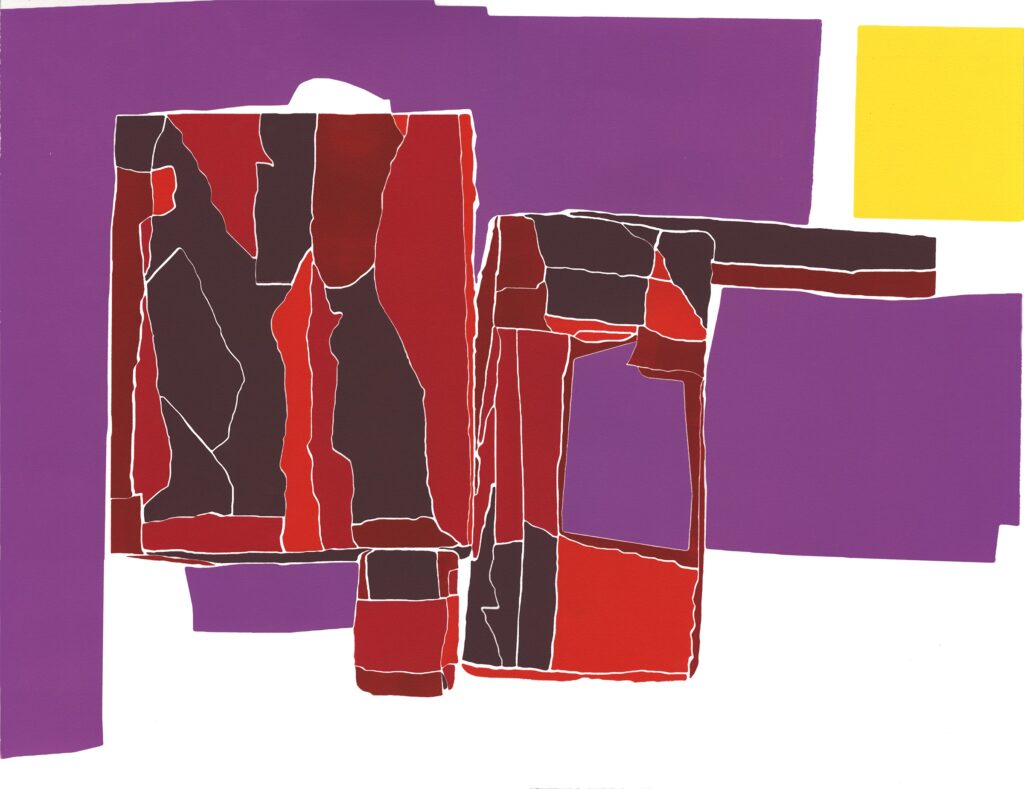
Refreshed from Significant Other (2017) Arlene Shechet
LeRoy Neiman Center for Print Studies
The Moment of Separation Is Where the Print Is “Born”
If there’s a single instant where printmaking physics becomes almost theatrical, it’s the peel – the moment paper lifts away from the plate.
As the paper separates, it doesn’t come away uniformly. Peeling happens progressively across the surface, a rolling front of separation rather than an all-at-once release. This is why registration, evenness of pressure, and even the angle of lift matter so intensely: an uneven peel can drag ink sideways, blur fine linework, or leave “ghosting” where ink partially transfers back onto the plate on a second pass.
Printmakers who’ve done this for decades develop an intuitive feel for exactly how fast and how evenly to lift – too fast and delicate details tear or smear; too slow and the ink starts to skin over and refuses to let go cleanly.
The direction of the peel matters too. Lifting from one corner versus lifting evenly from a hinge changes how the separation front travels across the sheet, and printmakers working with large plates build in a deliberate, consistent lifting motion – rolling the paper back like removing a sticker – specifically to control that wave. Do it inconsistently across an edition, and you’ll see it: subtle differences in edge sharpness or ink density traceable directly back to how the paper came off the plate that time.
Why No Two Prints in an Edition Are Ever Truly Identical
This is the detail that surprises people most: even a “limited edition” of hand-pulled prints, each numbered and signed as part of an identical run, is never actually identical at the physical level.
Every variable above – packing thickness, paper moisture, ink viscosity, room temperature, peel speed – shifts slightly from pull to pull, even within one session. The plate itself changes with use, too: fine lines wear down microscopically over repeated trips through the press. This is why collectors and printmakers talk about “early state” versus “late state” impressions – prints pulled early in a run, before wear sets in, are often considered richer than those pulled near the end.
Master printers see this not as a flaw but as the reason hand-pulled printmaking has never been fully replaced by mechanically consistent processes. A print isn’t a copy the way a photocopy is a copy – it’s the physical residue of one unrepeatable mechanical event.
Why This Should Change How You Look at a Print
Once you understand the mechanics – the force distribution, the fibre deformation, the tack calibration, the physics of separation – a printed image stops looking like a copy and starts looking like the record of a very specific physical event. Every print carries the fingerprint of the exact pressure, moisture, and timing that produced it. That’s why no two pulls from the same plate are ever perfectly identical, even under the most controlled studio conditions.
So the next time someone calls printmaking “just stamping,” you now have the ammunition to tell them: it’s applied physics, wearing an artist’s smock.