Cy Twombly’s marks look like they shouldn’t survive an edition. A loop that wanders, a line that trails off, a smear that seems to have happened rather than been made: this is handwriting at its most unguarded, and printmaking is supposed to be the opposite, a disciplined business of plates, stones, and repeatable results. Twombly spent roughly a decade proving that the two could coexist. He didn’t do it by taming his scrawl. He did it by finding processes that could carry the accident along with the mark.
The Outlier Who Only Dabbled
Twombly was never a prolific printmaker. The bulk of his activity was confined to a single decade, from the late 1960s to the late 1970s, and his output is modest next to the editions produced by his friends Jasper Johns and Robert Rauschenberg. Most of the editions he did make came about through his closeness to Rauschenberg. Edition sizes were generally small, and many appeared as portfolios, which suited an artist who painted and drew in cycles.
Yet within that short window he tried almost everything: line etching, mezzotint, aquatint, lithography, and screenprint. He had toyed with the medium once before, in a 1952 woodcut, The Song of the Border-Guard, but then left it alone for years. When he came back, it was in a very particular place.
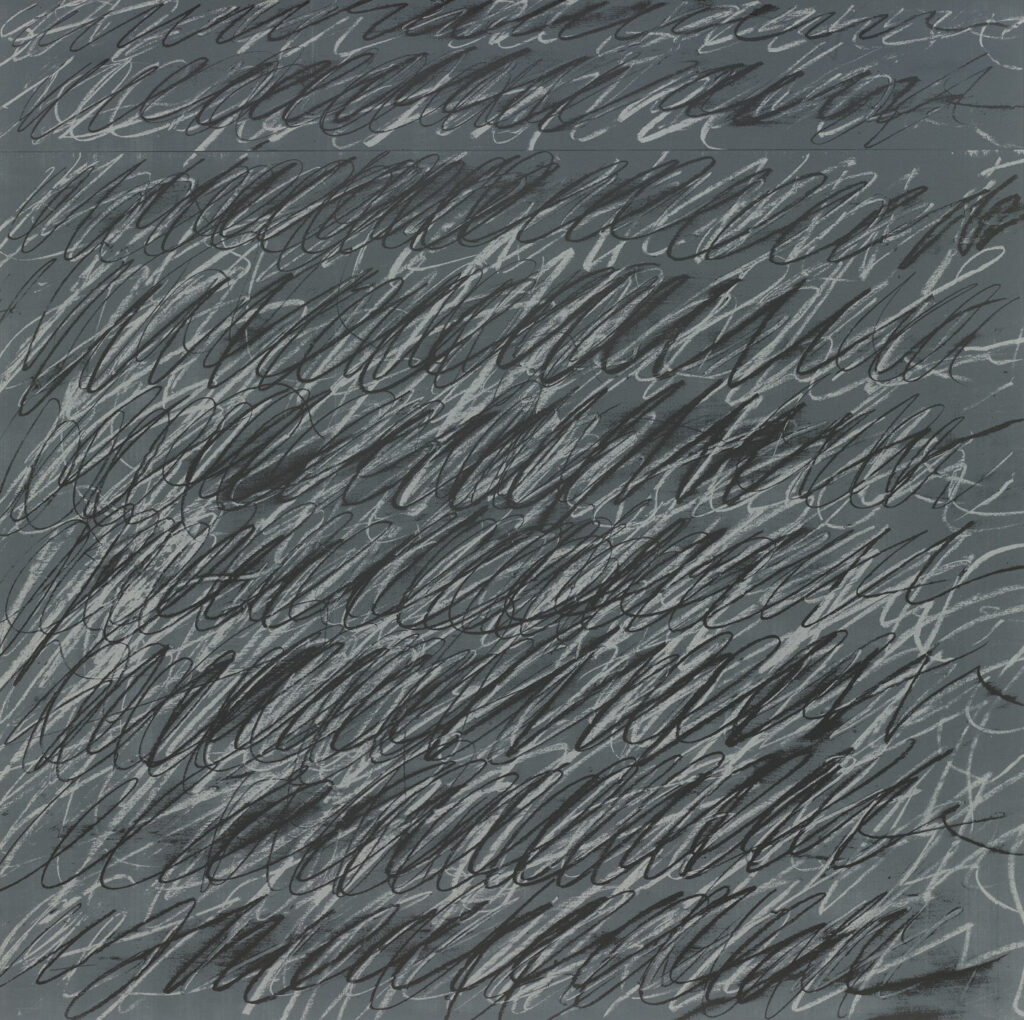
Untitled (1969) Cy Twombly
Susan Sheehan Gallery
A Trip Down to the Etching Basement
In 1967, Twombly was spending time in New York, working in downtown studios on Canal Street and the Bowery, though he had moved to Italy a decade earlier. He accompanied Rauschenberg to Universal Limited Art Editions (ULAE) on Long Island and ended up in the “etching basement,” where over the following months he made a number of intaglio plates.
The earliest of them, the Sketches, were approached without premeditation, and he described them as practice plates. With a needle on metal, he let his hand wander over the surface in loops and notations that recall geometry, bodily forms, and sailing vessels. There was no preparatory drawing to follow, no composition to protect. The plate simply recorded a hand thinking.
Inviting the Accident: Open Bite and Mezzotint
Twombly’s real technical breakthrough in etching came with Untitled I and Untitled II (1967), two large aquatints that were the most ambitious prints he had made so far. Their loose, looping lines are surrounded by glowing haloes created using a process called open bite, in which acid is allowed to act on exposed areas of the plate in ways that can’t be fully controlled. Even the aquatint plate can wear down and shift slightly between impressions, so no two pulls are quite identical. For an artist who prized the unplanned, it was an ideal partner.
The same attitude shows in his mezzotint, a technique rarely used by contemporary printmakers because it is so unforgiving. The artist starts with a textured plate that prints solid black and works in reverse, burnishing away to find the lighter areas, and a mark once placed can’t be removed. That Twombly embraced it says something about his willingness to risk error. He shared the interest in chance with the composer John Cage, whom he had met at Black Mountain College in the early 1950s.
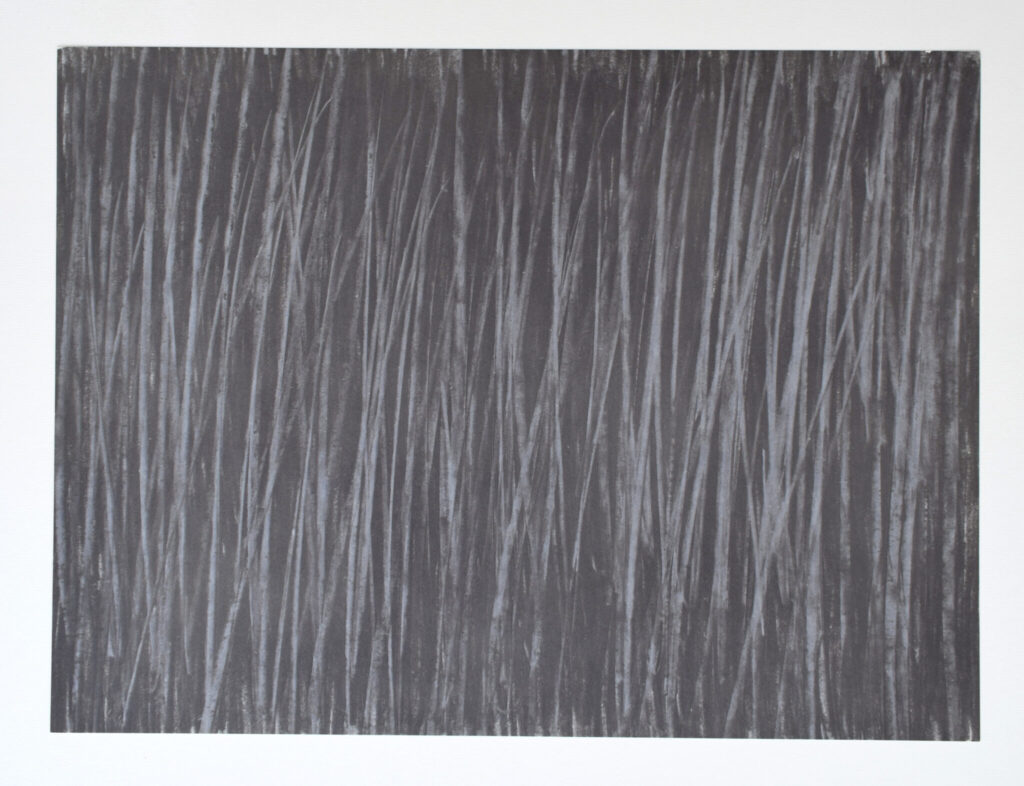
Untitled (1970) Cy Twombly
Gilden’s Art Gallery (IFPDA)
Why Etching Didn’t Last
Despite the early success, etching never became a permanent home. One specialist’s account notes that the process asks for a cognitive translation of form: a series of logical steps in dialogue with the printer, with plenty of reviewing, altering, and modifying. That is a lot to ask of an artist used to working freely and sporadically.
So Twombly followed Rauschenberg once again, this time to lithography, a far more direct medium. Drawing straight onto the stone, he could indulge in a more physical way of making marks, developing a kind of script that responded to the relationship between ink and paper. The shift coincided with the rise of his iconic grey-ground “blackboard” paintings, and the lithographs share their nervous, accumulating energy.
A Printshop on Captiva Island
The place that made this possible was Untitled Press, Rauschenberg’s own print house on Captiva Island, Florida, founded with lithographic stones from Gemini G.E.L. and a restored press. Twombly was the first artist to visit. The shop’s ethos suited him: small editions, specialist handmade papers, hand-mixed inks, and encouragement for experimentation with new processes.
In the winter of 1971 he produced a suite of six script-based lithographs that treats variation itself as the subject. Each sheet pairs a different ink with a different paper: brownish-red on cream Arches, grey on olive Canson, purple on white Arches, black on white Arches, brown on tan Canson, grey on white Arches. The density of his signature loops changes from image to image. Twombly clearly worked out which ink wanted which paper, and the result reads as a quiet meditation on the two basic ingredients of lithography.
Six Sheets, One Wall: Roman Notes
His first lithograph set, Roman Notes (1970), was conceived as a grid. Six sheets of equal size, printed in colour by offset lithography, combine into a composition more than six feet square, with the wall presence of a canvas. Few prints of that size existed at the time, though Rauschenberg had led the way with Booster in 1967.
Roman Notes shares ground with the blackboard paintings, but the palette is different: a subtle greyish-green backdrop, built up in layers, set off by strokes in two shades of Prussian blue. A small-scale cousin, a grey-and-white screenprint made for the On the Bowery portfolio of 1969–71, shows him bringing the same concerns to a very different format.
The Botanist’s Notebook
In the mid-1970s Twombly’s work turned from pure linear abstraction toward classical literature and plant life, and his prints followed. Natural History, Part I: Mushrooms (1974) was an ambitious project that combined several lithographic techniques with collage and hand-applied colour. Its ten images mix found photographic and printed material with bursts of line and handwritten notes, giving the impression of leafing through the notebook of an ingenious botanist. Natural History, Part II: Some Trees of Italy (1975–76) takes a similar approach.
Then the intensity faded. Heiner Bastian, who compiled the catalogue raisonné of Twombly’s prints, notes that the artist was wearied by the technical demands of these two editions. His next suites were more modest, Six Latin Writers and Poets (1976) and Five Greek Poets and a Philosopher (1978), text-based homages to the classics. After that his printmaking became sporadic and mostly confined to exhibition editions and group portfolios.
His Influence: A Microcosm, Not a Movement
It would be a stretch to call Twombly a major influence on printmaking itself. He didn’t build a workshop, invent a process, or produce hundreds of editions. His importance lies elsewhere. In a short, intense burst, his prints record an artist testing how far chance, handwriting, and the physical traces of a hand could be carried into editioned form, and they do it at an important moment in his career. The ULAE prints in particular show a restless curiosity about what intaglio could do.
That is part of why they matter. They show a significant painter treating the print shop as a place to explore unplanned outcomes rather than polish finished compositions, and they reflect his long relationship with Rauschenberg and with the workshops where the two artists pushed each other. As Twombly’s reputation grew, from the Menil Collection exhibition of 1989 through the Museum of Modern Art retrospective of 1994 and the Golden Lion at the 2001 Venice Biennale, his editions gained a place within the canon alongside his paintings and drawings.
The Takeaway
Twombly never became a professional printmaker, and he didn’t pretend to. What he did instead was visit the medium, take what he needed, and leave. In the etching basement he found acid and plate behaving like accomplices. On Captiva he found stone and paper responding to the pressure of a pencil. And in every case he found ways to let the scrawl, the drift, and the accident stay in the picture. That is a rarer achievement than it sounds.