Infinity, Multiplied: How Yayoi Kusama Turned Printmaking Into a Machine for Repetition
Yayoi Kusama spent more than seven decades trying to dissolve herself into pattern – painting dot after dot, net after net, until the individual mark disappears into an endless field. Printmaking, it turns out, was the medium built for exactly that ambition. A print is, by definition, an art of reproduction: one plate or screen, pulled again and again into multiples. For an artist whose entire practice is an argument about repetition and self-obliteration, that mechanical multiplication wasn’t incidental. It was the point.
An Artist of Repetition Meets an Art of Reproduction
There’s a neat, almost inevitable logic to how Kusama arrived at printmaking. As one retrospective on her print output puts it, since her creative activities are rooted in the proliferation of dots and nets, it is no exaggeration to say that Kusama inevitably encountered printmaking – an art of reproduction that could formally echo the compulsive multiplication already driving her paintings.
Her earliest engagement with the medium reaches back to the 1960s, during her years in the thick of the New York avant-garde, where she staged provocative happenings and exhibited the hallucinatory loop-and-dot paintings she called “Infinity Nets.” But it wasn’t until she returned to Tokyo in 1973, after a full decade immersed in downtown New York’s counterculture, that printmaking became a sustained, disciplined practice rather than an occasional experiment – with early lithographs and screenprints emerging around that return.

Pumpkin Army (1994)
Yayoi Kusama
Clifton Gallery
1979: The Year the Dots Went to Print
Kusama exhibited her first dedicated body of prints in 1979, a moment that marked a genuine turn in her output. What’s striking is the emotional register of that debut: in contrast to the paintings she was making at the time – pieces wrestling with themes of death and suffering in the aftermath of her New York years – her prints arrived rich in color and vivid with motif. Where her canvases of the era carried a darker psychological weight, the prints seemed to breathe a different air entirely, as if the printing process itself gave her permission to work in a lighter key.
From there, printmaking grew into something closer to a parallel career. It became an integral part of Kusama’s overall artistic practice, and across the decades that followed she built a substantial and carefully documented body of print work – an output cataloged today at roughly 340 prints held in the collection of the Matsumoto City Museum of Art alone, a testament to how central the medium became to her later career rather than a marginal sideline to the paintings.
Democratising Infinity: Why She Kept Coming Back to the Press
Ask why an artist as singular as Kusama would spend decades working through the constraints of editions and printers, and the answer circles back to accessibility. Printmaking offered Kusama a way to extend her artistic vision to a wider audience while staying true to her core themes of repetition and infinity, letting her replicate signature motifs – pumpkins, dots, Infinity Nets – at a scale and price point her large paintings and room-sized installations could never reach. In other words, prints let Kusama’s obsessive visual language leave the museum and enter ordinary living rooms, without diluting the intensity of the image itself.
That democratizing impulse mattered because Kusama’s core subject – infinity – is, almost by definition, something a single unique object struggles to convey. A one-off painting of a net pattern is still bounded by its edges; a print edition of forty or a hundred, all identical, starts to gesture at something closer to the endless proliferation she was actually after. The multiple wasn’t a compromise on the original. In a strange way, it was a more honest vehicle for the idea.
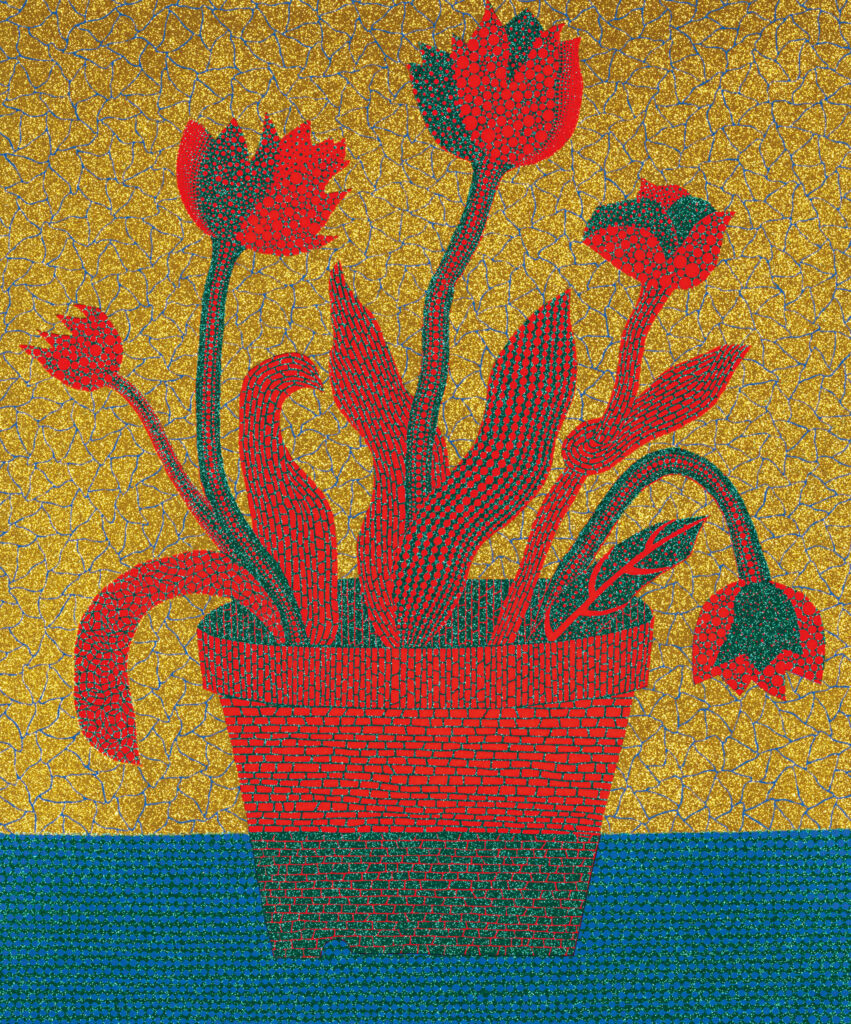
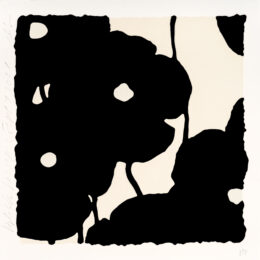
Flowers C (2005)
Yayoi Kusama
Vogtle Contemporary
A Restless Toolkit: Lithography, Screenprint, Woodblock, and Beyond
Kusama never settled into a single print process, and her range across techniques reads almost like a survey of printmaking history compressed into one career. Her body of work spans lithography, etching, and screenprinting, and each technique she reached for tended to serve a distinct visual purpose. Screenprinting, for instance, suited her most pattern-dense compositions – pieces like her Pumpkin and Infinity Nets series depend on consistent saturation and clean, uniform layering, exactly the qualities screenprinting delivers, since any inconsistency in the layers would disrupt the optical rhythm the pattern depends on.
Elsewhere, she pushed the medium in more experimental directions. Some print series combine techniques within a single sheet – silkscreen, etching, embossing, and stencil work layered together on thick, textured papers, an approach one gallery has described as the artist reflecting on her own way of life through the physical act of building up a surface. And in recent years she has reached even further afield, producing a “Mt. Fuji” series using traditional ukiyo-e woodblock printing – deliberately invoking centuries of Japanese print history – alongside a set of large-scale black-and-white silkscreens titled “Love Forever,” proof that even in her nineties she was still expanding, rather than repeating, her printmaking vocabulary.
Precision Inside the Obsession
It would be easy to read Kusama’s prints as simply pattern for pattern’s sake, but the discipline underneath is exacting. Her printmaking follows a highly disciplined and repetitive approach to form and subject matter, returning again and again to a tight set of motifs – pumpkins, dots, flowers, nets – the way a composer might return to a single musical phrase and vary it across an entire symphony. Her prints consistently maintain the same flatness of surface and density of pattern found in her paintings and soft sculptures, meaning the transition from canvas to plate never dilutes her visual language; if anything, the mechanical precision of print techniques amplifies the hypnotic, almost vibrating quality of her repeated forms.
That precision extends to how the work is issued and documented. Kusama has worked with established publishers and specialist printers, especially in Japan, producing editions that vary meaningfully in size and rigor from series to series – from tightly controlled runs of around forty impressions to larger editions closer to a hundred, each hand-signed, numbered, and dated by the artist herself. That level of control mirrors the obsessive, almost ritualistic attention she brings to the dots themselves: nothing about the proliferation is left to chance.
Her Influence: Making Repetition a Legitimate Subject
Kusama’s influence stretches well beyond printmaking narrowly, but her print practice is a clean lens onto why that influence has been so durable. She’s widely credited with shaping the trajectory of both Minimalism and Pop Art, and her orbit in 1960s New York put her in direct contact with – and, by some accounts, ahead of – artists like Andy Warhol, whose own screenprint-based repetition of consumer imagery echoes a strategy Kusama had already been exploring with her endless nets and dots.
What Kusama’s printmaking demonstrates, more than any single motif, is that repetition itself could be treated as the actual subject of serious art – not a production shortcut, not mere decoration, but the closest visual analogue to an obsessive psychological state. Later artists working across editioned media, pattern-based abstraction, and even immersive installation art inherited that idea: that a multiple, repeated without variation, can carry as much conceptual weight as a singular masterwork. Her enormous popular reach today – record-breaking museum attendance, a defining collaboration with Louis Vuitton, prints whose market value has risen sharply over the past decade – is itself evidence of how successfully that vision translated into an accessible, endlessly multipliable form.
The Takeaway
For most artists, printmaking is a departure from the main event – a chance to work differently. For Kusama, it was closer to a natural extension, maybe even the truest expression, of a practice already obsessed with proliferation. Every screenprinted pumpkin, every editioned net, restates the same quiet argument she’s been making since childhood hallucinations first filled her vision with dots: that identity dissolves into pattern, and that the single mark, repeated into infinity, is where the real meaning lives.
Explore Yayoi Kusama artworks