Some artists get museums named after them. Others get a single line in someone else’s biography: “his teacher.” Martin Lewis belongs to the second category – and it is one of the great injustices of twentieth-century American art.
Walk through any serious print collection and you’ll eventually meet him: a moody etching of a rain-slicked street, a woman darting into a subway stairwell, a lone figure caught in the hard glare of a streetlamp. These aren’t just technically dazzling prints. They’re the visual DNA of a mood we now call, almost automatically, “Hopperesque.” Except Lewis got there first — and taught the man who made it famous.
From a Sydney Wharf to a New York Etching Press
Martin Lewis’s own story reads like something out of a Jack London novel before it turns into an art-history footnote. Born in Castlemaine, Australia, in 1881, he left home as a teenager and spent his early years drifting through work as a laborer, logger, and merchant sailor before studying briefly with painter Julian Ashton in Sydney. By 1900 he’d landed in San Francisco, where he painted stage scenery, and by 1909 he’d made his way to New York, supporting himself as a commercial illustrator.
It wasn’t glamorous. It was survival work — the kind of grinding commercial-art career many painters quietly do while their “real” work waits in the evenings. But it sharpened Lewis’s eye for composition and gave him the discipline that would later define his prints: nothing wasted, every shadow doing a job.
He made his first etching in 1915, almost as an afterthought. It would end up defining the rest of his life.
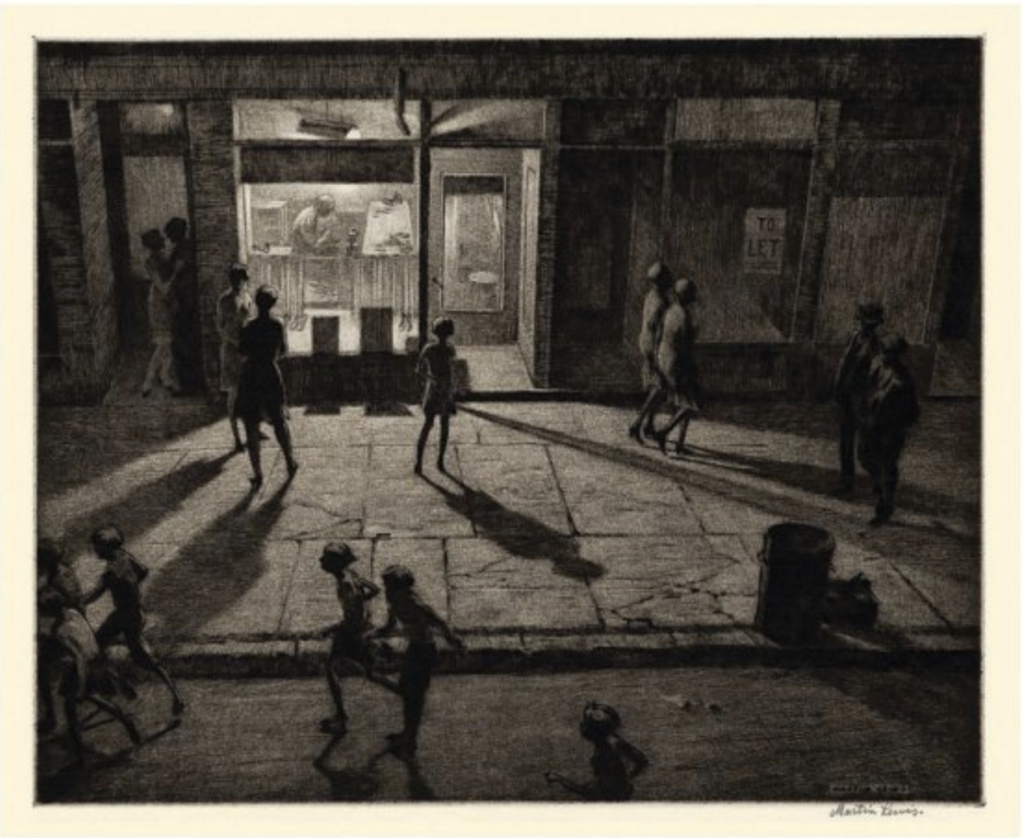
Spring Night, Greenwich (1930) Village
Martin Lewis Harris Schrank Fine Prints
The Teacher Behind the Legend
Here’s where the story gets its dramatic irony. Around this same period, Lewis struck up a friendship with a fellow illustrator named Edward Hopper. Hopper, intrigued by what Lewis was doing with acid and copper plates, asked if he could learn the craft from him. Lewis agreed, and effectively became Hopper’s mentor in the discipline of etching.
Lewis was later ranked alongside Whistler, Goya, and Rembrandt in a landmark multi-volume survey of the medium, and was described as one of the most psychologically astute chroniclers of New York life of his era. Hopper, for his part, took the lessons and ran — his own prints from the following decade share Lewis’s taste for stark contrast, deep shadow, and lonely urban geometry.
Hopper eventually set aside etching to focus on painting, but the influence didn’t disappear — it just changed medium. Hopper himself later credited his training under Lewis with shaping the interplay of light, shadow, and subject that would define his most iconic canvas, “Nighthawks.” It’s a strange kind of legacy: an entire painting movement’s most famous image, quietly indebted to a printmaker most people have never heard of.
Two Years in Japan, and a New Way of Seeing
In 1920, restless and dissatisfied with commercial work, Lewis did something bold: he spent his savings and moved to Japan for two years to study art and printmaking firsthand. It was a pivotal detour. Japanese woodblock prints — with their flattened perspective, dramatic cropping, and bold treatment of light — left a visible fingerprint on everything Lewis made afterward.
When he returned to New York in the early 1920s, his etchings had changed. Compositions grew bolder and more asymmetrical. Light itself became a compositional tool rather than just an effect — pools of lamplight, silhouettes against glowing windows, the graphic punch of black ink against white paper. This is the Martin Lewis most collectors recognize today: the poet of the American night.
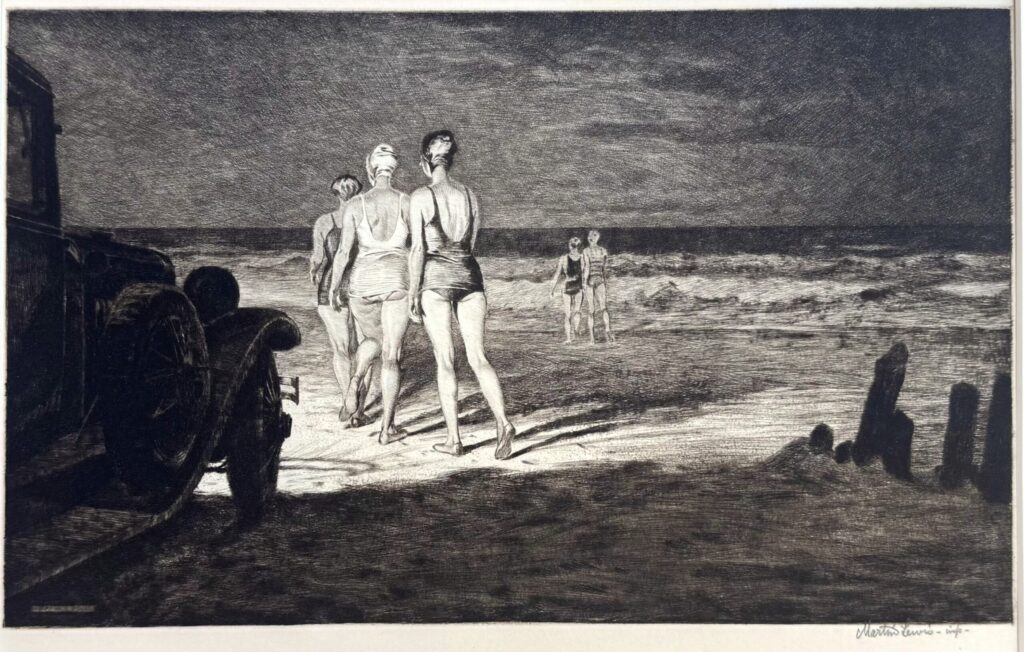
Down to the Sea at Night (1929)
Martin Lewis Catherine Burns Fine Art
Mastering a Notoriously Unforgiving Medium
Lewis worked primarily in etching and drypoint — mediums that punish hesitation. A drypoint line, scratched directly into a copper plate with a sharp needle, can’t be erased or softened; every mark is a commitment. Lewis’s technical command of both processes was, by every contemporary account, extraordinary. He could coax an astonishing range of tone and texture from a single plate, building velvety blacks and crisp highlights that made his prints feel almost photographic — despite being entirely hand-worked.
His 1929 solo exhibition was successful enough that he could finally abandon commercial illustration altogether and devote himself entirely to printmaking. The years that followed, roughly 1925 to 1935, produced the body of work he’s now best remembered for: atmospheric scenes of rain, snow, and gaslight glinting off wet Manhattan pavement. According to the standard catalogue raisonné compiled by researcher Paul McCarron, Lewis editioned 147 prints across his career.
A Bridge Between Two Americas
To understand why Lewis matters, it helps to place him between two artistic moments. Before him came the Ashcan School — painters like John Sloan and George Bellows who turned to the gritty, unglamorous streets of the modern city as legitimate subject matter, often with a reporter’s directness. After him came Hopper and the psychological realists, who used the city less as a subject to document than as a mood to inhabit — all that famous alienation, isolation, and quiet dread.
Lewis sits right in the hinge between the two. His prints are grounded in the same unglamorous urban terrain the Ashcan painters loved — fire escapes, elevated trains, tenement rooftops, construction derricks lit up at night — but he renders them with a theatrical, almost cinematic sense of mood that points directly toward Hopper’s later canvases. A Lewis print of a woman alone on a wet street corner isn’t really about the street. It’s about the feeling of being alone on it. That shift, from documentation to atmosphere, is arguably his single most important contribution to American art, and it’s one Hopper absorbed wholesale.
It’s also worth noting that Lewis’s circle extended well beyond Hopper. He counted poets William Carlos Williams, Lola Ridge, and Alfred Kreymborg among his friends, and moved in the same downtown New York milieu that was reshaping American literature and art simultaneously in the 1910s and 20s. Lewis wasn’t an isolated technician tinkering alone in a studio — he was embedded in one of the most fertile creative circles of his generation, even if history has been slower to credit him for it.
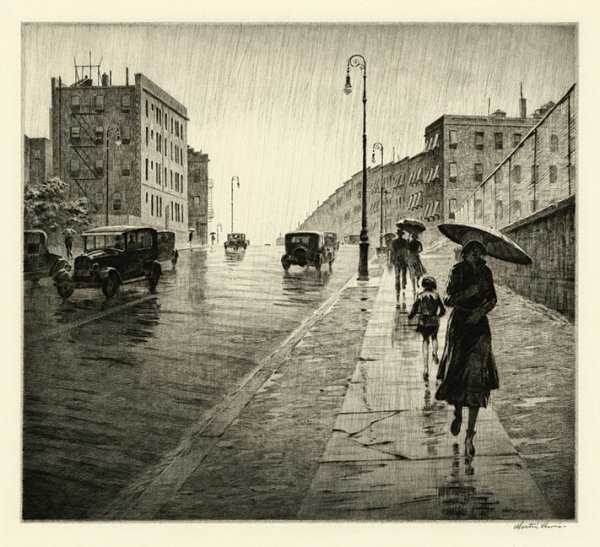
Rainy Day, Queens (1931)
Martin Lewis Harris Schrank Fine Prints
The Prints That Made His Name
Certain works keep resurfacing whenever Lewis’s career is discussed, and they’re worth knowing by name if you want to understand his range. Scenes like Shadow Dance and Stoops in Snow showcase his gift for capturing weather and texture — snow, rain, and reflected light rendered with a precision that borders on obsessive. Nocturnes such as Glow of the City reveal his most distinctive gift: building an entire mood out of the contrast between deep black shadow and a single glowing source of light. And urban scenes like Relics (Speakeasy Corner) and his many depictions of construction sites and elevated trains double as historical documents of a New York that no longer exists — captured, ironically, by a man who spent his first decade in the city as an outsider looking in.
What ties all of these together is restraint. Lewis rarely crowded a composition. He understood, the way a good film director understands, that what’s left in darkness often does more work than what’s lit.
Forgotten, Then Found Again
Then came the Great Depression — and with it, the collapse of the once-thriving American print market that had made Lewis’s career possible. Demand for etchings evaporated almost overnight. Lewis relocated briefly to rural Connecticut before eventually returning to Manhattan, where, from 1944 to 1952, he taught a graphic arts course at the Art Students League, quietly passing his technical knowledge on to a new generation.
He died in 1962, largely out of the public eye — a master craftsman whose moment had simply passed.
But moments have a way of circling back. In recent decades, collectors, curators, and art historians have rediscovered Lewis’s work, recognizing him not as a footnote to Hopper’s story but as a major American printmaker in his own right — a technical virtuoso who helped define how an entire generation of artists would depict the modern city after dark.
Why Martin Lewis Still Matters
Lewis’s real legacy isn’t just the individual prints, striking as they are. It’s the way he demonstrated that etching and drypoint could carry the same psychological weight as painting — that a black-and-white composition on paper could hold loneliness, tension, and atmosphere just as powerfully as oil on canvas. That idea rippled outward through Hopper and into the broader American realist tradition, shaping how generations of artists thought about urban light and shadow.
Martin Lewis spent his life mastering a craft that requires equal parts patience and nerve. He may not have gotten the fame Hopper did, but in the world of American printmaking, he’s finally getting something arguably better: recognition on his own terms.