Theodore Roussel went bareheaded in James McNeill Whistler’s presence. According to the Australian painter Mortimer Menpes, it was an act of pure deference, and Whistler, never short of a quip, supposedly replied that at last he had found a follower worthy of the Master. It’s a great anecdote, and it has shaped how Roussel is remembered: as a Whistlerian, a loyal pupil in the orbit of a giant. But look closely at how he actually worked at the press, and at the prints that survive, and a different figure emerges: a printmaker who took his mentor’s lessons and kept pushing them in directions of his own.
A French Painter in Whistler’s Chelsea
Roussel was born in France in 1847 and moved to England in 1877, eventually settling in Chelsea, where he befriended his neighbour Whistler, who became a lifelong artistic mentor. His early watercolours and oils are openly indebted to Whistler in both subject and technique. Then, in the late 1880s, Whistler pushed him toward the plate. At his mentor’s encouragement Roussel produced his first etchings of Chelsea and took up drypoint, and he was also steered toward lithography through Thomas Way, the printer who had introduced the medium to Whistler himself.
The early results look like homework done well. Similar subject matter, scale, and printing methods mark his etchings and lithographs of this period as Whistlerian, right down to the reverential trimming of the impression and the use of a signature tab. A print like The Sign of the White Horse, Parson’s Green (c. 1893–94), a view of a Parson’s Green pub sign, sits comfortably in that tradition.
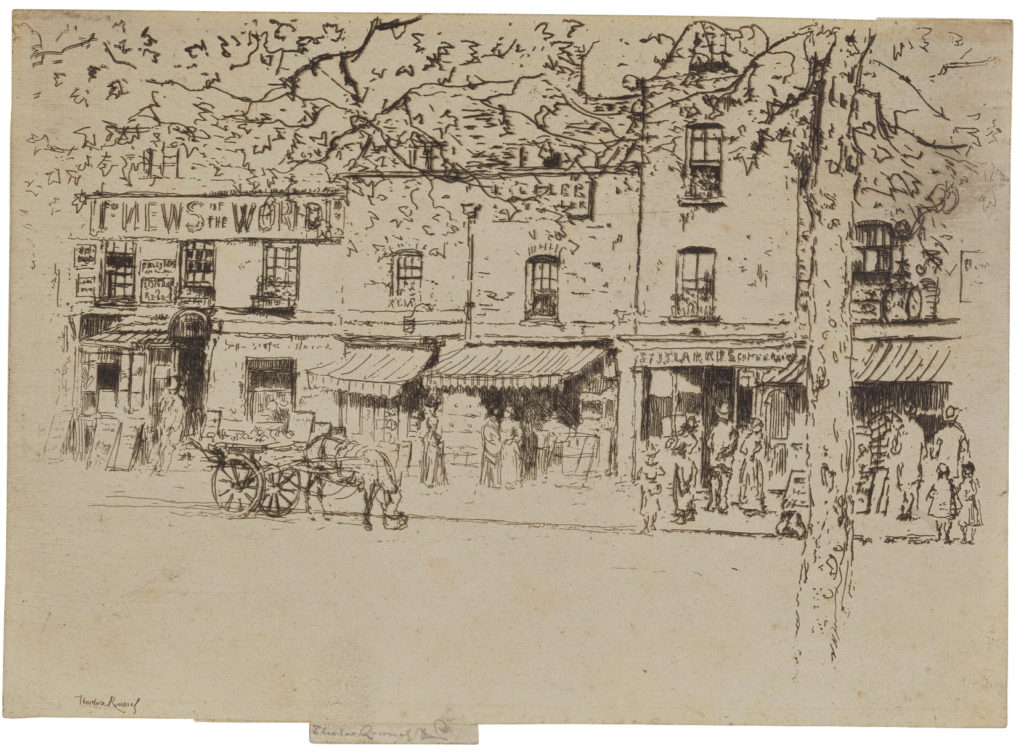
The Street, Chelsea Embankment (1888) Theodore Roussel
Sylvan Cole Gallery
Working Outdoors, Finding a Voice on the Embankment
Roussel adopted some elements of Whistler’s process wholesale, including the habit of working out in nature, studying the street directly rather than reconstructing it in the studio. But he quickly established a distinct signature style, arguably first seen in his series of Chelsea Embankment views. Prints like The Street, Chelsea Embankment, Chelsea Children, Chelsea Embankment, and The Little Fish Shop, Chelsea Embankment (Maunder’s Fish Shop) turn a working riverside neighbourhood into a stage for ordinary life: shopfronts, children, passing figures, the small businesses of a London village.
The same attention extends to the corners of Chelsea that most artists would walk past. The Gate, Chelsea takes a humble threshold as its subject, while Laburnums and Battersea pairs a flowering tree with the neighbouring district across the river. And the black-and-white Chelsea Palaces returns to a subject Roussel first etched in 1888, one he would revisit more than once. He was building, in effect, a local portrait of the place where he lived.
Beyond the Street: Figures and Sitters
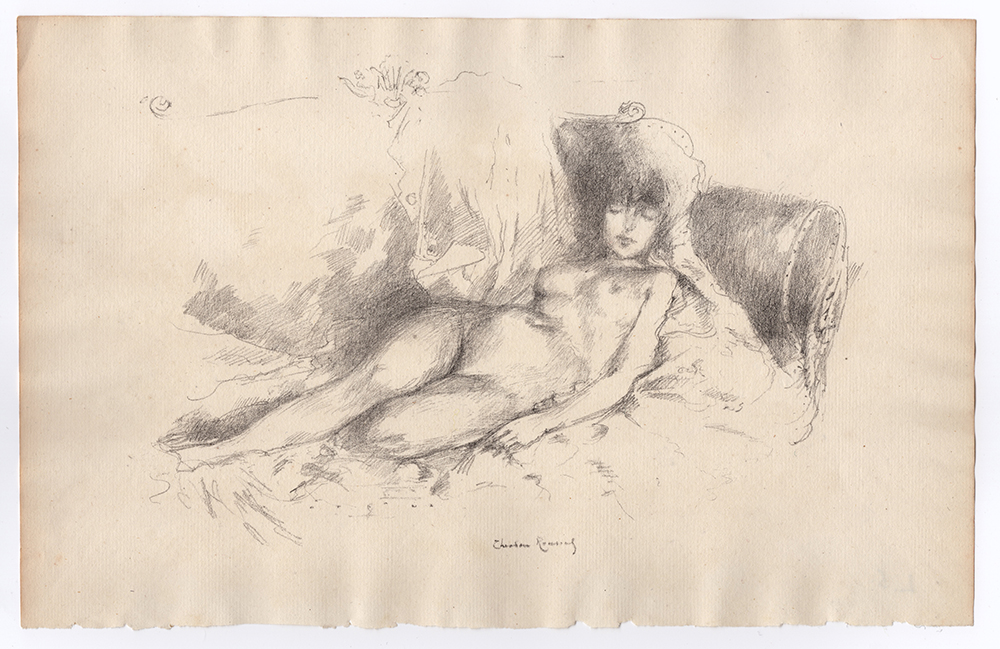
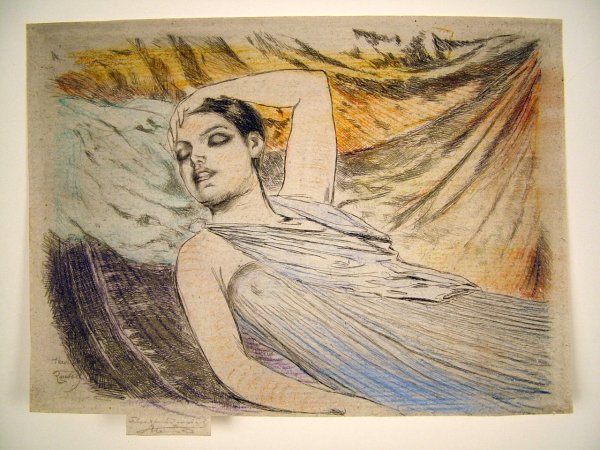
Roussel’s interests ran well beyond landscape and street scenes. Alongside the Chelsea views sit studies of the figure and portraits of sitters, among them Study from the Nude, Woman Asleep, Study From the Nude of a Girl Lying Down, and Sleeping Model, quiet studies of a model at rest. Others, such as Portrait of a Little Spanish Girl, A French Girl, and The Chinese Gown, show a taste for costume and character, and Portrait of Mrs. Cyprian Williams in Fancy Dress carries that theatrical streak into a formal portrait.
Taken together, these prints argue that Roussel was never simply a topographical etcher. He moved easily between the intimate and the observed, between the street and the studio, treating the plate as a medium for whatever caught his attention rather than a specialist’s single subject.
Study from the Nude, Woman Asleep (1890) Theodore Roussel
Emanuel von Baeyer – Cabinet
The Quiet Economics of a Private Printmaker
One of the most revealing facts about Roussel’s practice is how little he sold. Unlike Whistler, Roussel had no gallery or dealer publishing his etchings or lithographs, so he printed only small numbers of impressions. That scarcity shaped everything. Without a publisher demanding uniform editions, each impression could be a considered object in its own right, and Roussel treated it that way.
He marked his impressions in pencil on the tab with “imp.,” short for printed by the artist, a small but pointed claim of authorship over the entire process, from drawing the plate to inking and pulling the sheet. For a printmaker who spent years working largely outside the commercial machinery of the print market, the pencilled signature and the “imp.” were a way of asserting that every stage of the work was his own.
Soft Ground and the Painter’s Touch
Roussel’s technical vocabulary leaned on processes that soften the hard edge of etched line. Soft-ground etching allows a more painterly, textured mark, and he was among the first artists in Britain to focus on it in the late nineteenth century. He combined it with drypoint, aquatint, and straight linear etching, depending on what a given scene demanded.
That painterly bias separates him from the cooler, more linear tradition of the etching revival. Roussel wasn’t simply tracing a drawing onto copper. He was building a picture, and the choice between a crisp drypoint line and a smudged soft-ground texture was as much a matter of mood as of method. Whistler’s own printmaking leaned toward tonal subtlety, and Roussel absorbed that, then made the surface more visibly worked.
Colour as the Long Experiment
If one thread runs through the second half of Roussel’s career, it is his fascination with colour. He had a particular interest in colour science, and from the 1890s he began mixing inks and combining aquatint and soft-ground etching to produce coloured prints, becoming one of the first artists in Britain to do so. The work was exacting, since colour printing of this kind demanded that the image be built up from separate plates for each colour. The Chelsea Palaces composition, which he later reworked in colour, needed six separate printings to complete a single impression.
That experimentation never stopped. In the 1920s, near the end of his life, Roussel developed a new technique in an opaque medium similar to gouache, which he called the “Roussel Medium,” aiming for a purity and intensity of colour that traditional oil-based inks couldn’t deliver. Without a precise description from Roussel himself, the exact technique remains enigmatic. Colour was important to him, but it was one strand in a career devoted to testing what a plate could do.
Sleeping Model (1890) Theodore Roussel
Harris Schrank Fine Prints
The Whole Object: Frames and Mounts
Roussel’s perfectionism extended beyond the plate. Like Whistler, he designed his own special frames, and he occasionally etched his own frames and mounts as part of the finished object. That detail says a great deal about how he thought of a print. It wasn’t finished when the ink dried. It was finished when it was presented the way he intended it to be seen, in a setting chosen and sometimes made by his own hand.
His Influence: Building a Community Around the Plate
Roussel’s influence runs through institutions as much as individual impressions. He played a role in the formation of the International Society of Sculptors, Painters and Gravers, which gave artists interested in printmaking a platform. In 1909 he became the founding President of the Society of Graver-Printers in Colour, a post he held until his death in 1926. That society gave British printmakers a professional community devoted to ambitious, technically adventurous work.
His example also carried an argument. A printmaker didn’t need a publisher, a dealer, or a large edition to take the medium seriously. He could work in small numbers, print his own impressions, design his own frames, and still produce work that collectors now seek out. That model of the artist-printer in complete control of the process anticipates a great deal of later practice.
The Takeaway
Roussel never stopped being grateful to Whistler, and never stopped trying to go further. He took the Master’s lessons in etching and drypoint and made them his own: working outdoors on the Chelsea Embankment, softening line with soft ground, printing his own impressions in small numbers, signing and framing each one as a finished whole. The bareheaded disciple turned out to be one of the most self-reliant and inventive printmakers of the British etching revival.