Piranesi Etching Rome Into Eternity
Somewhere in a cramped workshop near the Spanish Steps, a Venetian architect who never got to build much of anything decided he would construct Rome anyway – not out of stone, but out of acid-bitten copper and printer’s ink. Giovanni Battista Piranesi spent nearly four decades on his Vedute di Roma (“Views of Rome”), and by the time he died in 1778, he still wasn’t done. The series outlived him, expanded by his son, and today stands as one of the great obsessive achievements in the history of printmaking – a project so vast it essentially was Piranesi’s life.
A Frustrated Architect Finds His Weapon
Piranesi arrived in Rome in 1740 wanting to build. He’d trained in Venice under architects and stage designers, soaking up a taste for dramatic perspective and theatrical scale – the kind of exaggerated depth you’d find in an opera set, not a cathedral. But eighteenth-century Rome, mired in economic stagnation and papal bureaucracy, offered almost no commissions worthy of his ambition. He built exactly one structure in his lifetime, a restoration of the church of Santa Maria del Priorato. Everything else – the soaring, impossible structures he dreamed up – he built on paper instead, using an etching needle the way another architect might use a chisel.
This is the secret engine behind the Vedute: they aren’t neutral documentary views. They’re the work of a man channeling architectural frustration into image-making, exaggerating scale, deepening shadows, and staging ancient Rome as a theatre of ruin and grandeur that real Rome could never quite live up to. Denied the chance to build, Piranesi built anyway – just in a medium nobody had thought to take quite so seriously before.
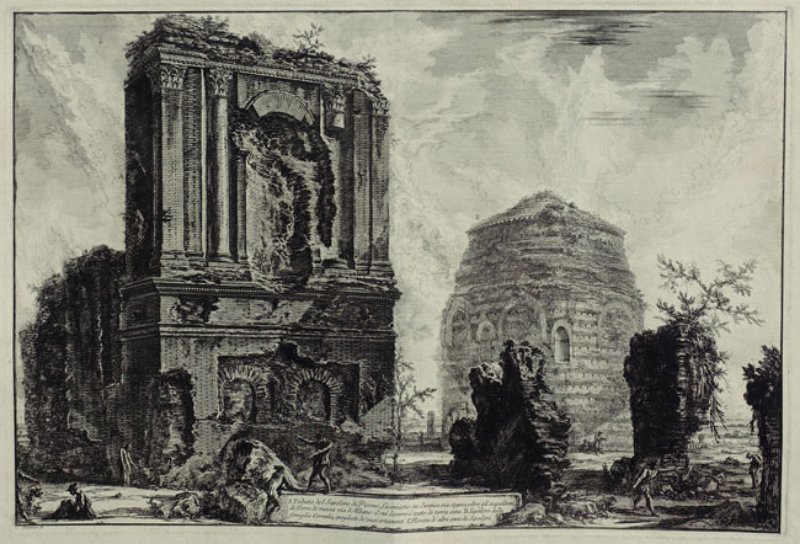
The Tombs attributed to Piso Licinianus and the Cornelii on the Appian Way (1770)
Giovanni Battista Piranesi
Jan Johnson Old Master Modern Prints
Starting Small, Thinking Enormous
The earliest plates appeared in the 1740s, modest in size and ambition compared to what came later – more akin to souvenir views for Grand Tourists passing through, roughly postcard in spirit if not in scale. But Piranesi wasn’t interested in modest. Over the following decades the series swelled to 135 large plates (with more added posthumously), each depicting a monument, ruin, piazza, or bridge, rendered with a theatrical intensity that made tourists feel Rome’s ruins were somehow larger, older, and more haunted than they actually were.
He exaggerated the height of columns. He dwarfed human figures beneath crumbling arches until they looked like ants beneath cathedrals, tiny shepherds and washerwomen going about their business at the feet of monuments built for gods and emperors. He deepened every shadow into near-blackness, carving cavernous voids into vaults and archways until the architecture itself seemed to breathe. Critics have long noted that if you visit the actual monuments Piranesi etched, they’re almost always smaller and less dramatic than his prints promised – which was rather the point. He wasn’t recording Rome. He was mythologizing it, and doing so with a technical command of etching that few printmakers of his century could match.
A Craftsman’s Obsession with the Plate Itself
Part of what makes the Vedute remarkable is simply how hard Piranesi worked the copper. Most eighteenth-century printmakers treated etching as a relatively quick, linear medium – bite the lines, pull the prints, move on. Piranesi treated each plate more like a painter treats a canvas that’s never quite finished, building up tone through dense cross-hatching, layering multiple acid bites for varying depths of line, and using drypoint and burnishing to carve out highlights. The result was a tonal richness – near-photographic gradations from blinding sunlight to pitch shadow – that etching hadn’t really achieved before at this scale, and copper is forgiving enough that lines could always be deepened, figures added, skies darkened. Piranesi exploited that forgiveness relentlessly, treating finished, published, commercially successful plates as if they were still rough drafts.

Pronaos Du Temple De Neptune – Working Proof (1778)
Giovanni Battista Piranesi
Sarah Sauvin
The Plates He Couldn’t Leave Alone
Here’s where the story becomes genuinely strange: Piranesi didn’t simply finish a plate and move to the next. He returned to the same copper plates again and again across years, sometimes decades, reworking them – deepening the etched lines, adding new figures, darkening skies, adjusting architectural details as his eye and technique matured. Print historians studying surviving impressions can trace a single view of the Colosseum or the Pantheon through multiple “states,” each one a snapshot of Piranesi revisiting his own past work with a more ferocious, more theatrical vision than before.
This obsessive revision means the Vedute isn’t really a fixed body of work – it’s a moving one. An early impression of a plate might look almost gentle by comparison to a later pull of the same image, reworked with heavier, more dramatic contrasts. Take his view of the Pantheon: early states show a relatively even, descriptive light; later states pile on cross-hatching until the portico’s coffered ceiling reads as almost violently three-dimensional. For collectors and museums today, this creates a genuine puzzle of connoisseurship – a “first state” impression and a “final state” impression of the identical view can look like two different artists’ work, even though they came off the very same plate. Piranesi was, in a sense, never finished with Rome, because Rome kept changing in his imagination even when the stones themselves stayed put.
Selling Ruin to the Grand Tourists
Practically speaking, the Vedute was also a business – and a shrewd one. Wealthy young Europeans doing the Grand Tour wanted souvenirs of Rome’s grandeur to bring home, and Piranesi’s shop became a essential stop, selling prints that were far more impressive than anything a tourist could actually see with their own eyes. He was, in effect, curating the emotional experience of Rome before the term “curating” existed – supplying visitors with an idealised, sublime version of the ruins to carry back to London, Paris, and Berlin, where the prints shaped an entire generation’s fantasy of antiquity.
This commercial engine is part of why the project could stretch on for decades: it kept selling, so Piranesi kept adding to it, kept reworking it, kept treating it as a living, breathing catalog rather than a closed book. His workshop became something close to a pilgrimage site for visiting Englishmen, Germans, and Scandinavians doing the Grand Tour circuit – a place where you could watch the artist himself working the plates and leave with a rolled bundle of Rome to hang in a library back home. Crucially, he kept the physical copper plates rather than selling off the rights, which meant he could reprint from them for decades and fold new plates into the ongoing series whenever he pleased – essentially running the Vedute as an open-ended subscription rather than a single finite publication.
Dying Mid-Sentence
By the 1770s, Piranesi’s health was failing, but the plates kept coming. He was still etching new views and revising old ones up until his death in Rome in 1778. His son Francesco Piranesi inherited the workshop, the roughly 1,000 copper plates across all his father’s series, and the unfinished ambition, continuing to print and even add to the Vedute after his father’s death – meaning the series doesn’t have a clean endpoint so much as a long fade-out, a project too large and too personal for any single lifetime to fully close.
A Rivalry With His Own Dark Imagination
The Vedute wasn’t Piranesi’s only long-running obsession. Alongside it he produced the Carceri d’Invenzione (“Imaginary Prisons”), a smaller set of fantastical, nightmarish etchings depicting vast, impossible vaulted interiors – staircases leading nowhere, chains and pulleys suspended over bottomless drops. He returned to rework these plates too, years after first publishing them, darkening them into something even more disorienting. The two series share a visual DNA: the same steep perspectives, the same theatrical darkness, the same sense of architecture as monumental and faintly threatening. Where the Vedute mythologized real Rome, the Carceri mythologized an imagined one – together they show an artist who simply couldn’t stop reaching for a more extreme version of whatever he’d already made.
Why It Still Matters
The Vedute di Roma did something no guidebook could: it convinced generations of Europeans that Rome’s ruins were sublime rather than simply old and crumbling. Piranesi’s darkened, theatrical, slightly impossible Rome became the Rome of the Romantic imagination – you can trace its DNA in everything from Gothic novel settings to Hollywood’s idea of what ancient ruins ought to look like. Architects studied the plates as much as tourists did, and the prints fed directly into the Neoclassical revival sweeping across Europe, giving builders in London and Paris a visual vocabulary for grandeur borrowed wholesale from Piranesi’s exaggerated Rome rather than the more modest reality on the ground.
Many of the original copper plates still exist today, housed in Rome’s Istituto Nazionale per la Grafica – meaning it remains technically possible, more than two centuries on, to hold a print struck from the very plate Piranesi himself worked and reworked. Few artistic projects can claim a production run that long.
An architect who couldn’t get commissions ended up designing the way the Western world sees antiquity, one obsessively reworked copper plate at a time. It’s a fitting irony for a project this stubborn: Piranesi spent his career building almost nothing in stone, and in doing so, built something in ink and acid that outlasted nearly everything else from his century.