How a British chemist turned printmaker’s Paris workshop became the beating heart of 20th-century modern art.
A Scientist Walks Into an Art Studio
Stanley William Hayter wasn’t supposed to end up here. Born in London in 1901, he trained not in art school but in chemistry and geology at King’s College London, and for a stretch of his early career he worked as a geologist in the oil fields of Iran. It’s an unlikely origin story for a man who would go on to be called, by institutions from the Met to Britannica, the founder of the most influential print workshop of the 20th century.
But that scientific training never left him. When Hayter moved to Paris in 1926 to study art in earnest, he brought a chemist’s instincts with him – a habit of treating the printmaking plate not as a fixed craft with fixed rules, but as a laboratory. Acids, inks, metals, pressure, viscosity: to Hayter, these weren’t just tools of reproduction. They were variables to be tested, pushed, and broken open.
It’s worth pausing on how unusual this was. Printmaking in the early 20th century was still largely bound to its centuries-old reputation as a reproductive medium – a way of copying paintings or illustrating books, governed by tightly guarded technical traditions handed down through formal apprenticeship. Hayter arrived with none of that inherited reverence for the rules. He looked at the etching plate the way he’d once looked at a rock sample or a chemical reaction: as something to be interrogated, not obeyed.
One year later, in 1927, that instinct became a place. He opened a small experimental workshop, and modern printmaking would never be quite the same.
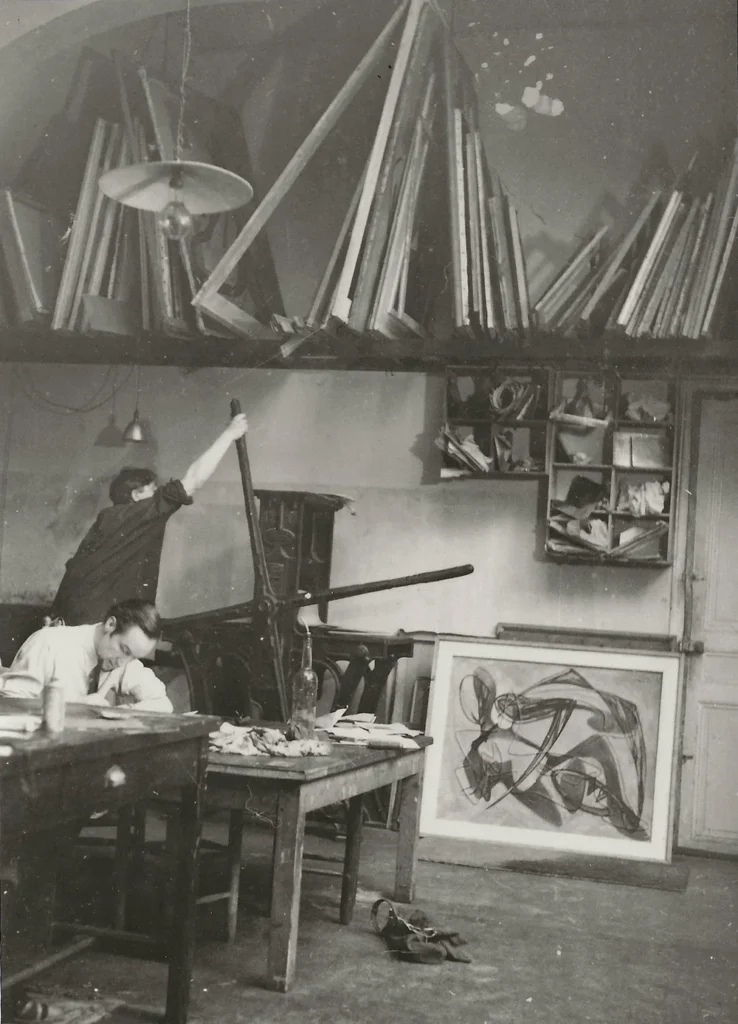
Atelier 17 at 17, rue Campagne-Première (Paris, France)
ca. 1935-39.
Courtesy Joan Peterdi.
Room 17: Where a Studio Became a Movement
The workshop moved a few times in its early years, but in 1931 it settled at 17 rue Campagne-Première in Montparnasse – and the address stuck as its name. Atelier 17, sometimes called Atelier Dix-Sept, wasn’t a school in any conventional sense. There were no professors, no students, no hierarchy of master and apprentice. Hayter himself put it plainly: there was no “professor and student deal going on here.”
Instead, it was something closer to a collective laboratory. Artists of wildly different backgrounds and skill levels worked side by side at the same tables, sharing plates, sharing discoveries, and – crucially – sharing failures. If one artist stumbled onto a new way to bite a line into copper or drag color across a plate, it belonged to the room, not to them alone.
This was radical. Printmaking workshops for centuries had operated on rigid, closed traditions passed down through formal apprenticeship. Atelier 17 threw that model out entirely, and in doing so, it didn’t just produce prints – it produced a new way of working that would ripple through art education for decades.
Part of what made this possible was scale – deliberately, Atelier 17 stayed small. A handful of presses, a cramped room, artists working elbow to elbow. There was no separation between the famous and the unknown, no separate track for the professional versus the curious amateur. A visiting Surrealist luminary might be working the same acid bath as a student encountering intaglio for the first time. That physical closeness bred a kind of intellectual closeness too – techniques passed hand to hand almost as fast as they were invented, with no one artist owning a discovery for long.
Decades later, artists who passed through would describe the effect in strikingly personal terms. The Indian printmaker Zarina Hashmi, who worked at Atelier 17, said the experience “freed” her – not just by teaching new techniques, but by giving her the confidence to trust her own vision rather than someone else’s rulebook. That was, in miniature, exactly what Hayter had designed the space to do.
The Chemist’s Tricks: Reinventing Intaglio
Hayter’s background in chemistry wasn’t incidental to what happened next – it was the engine of it. At Atelier 17, he pioneered techniques that expanded what an engraved or etched plate could actually do:
– Viscosity printing, Hayter’s own invention, allowed multiple colors to be pulled from a single plate in one pass through the press, using inks of different thicknesses that repelled and layered against each other in controlled, painterly ways.
– Soft-ground etching was pushed into new territory, with artists impressing fabrics, textiles, and unconventional materials directly into the ground to create rich, unexpected textures.
– Experimentation itself became the method – not a means to a finished product, but the point of the work.
For Hayter, art wasn’t decoration or entertainment. He described it as a form of research, a “pursuit of knowledge” standing alongside physics, mathematics, music, and poetry. Atelier 17 was where that philosophy took physical form, one hand-cranked press at a time.
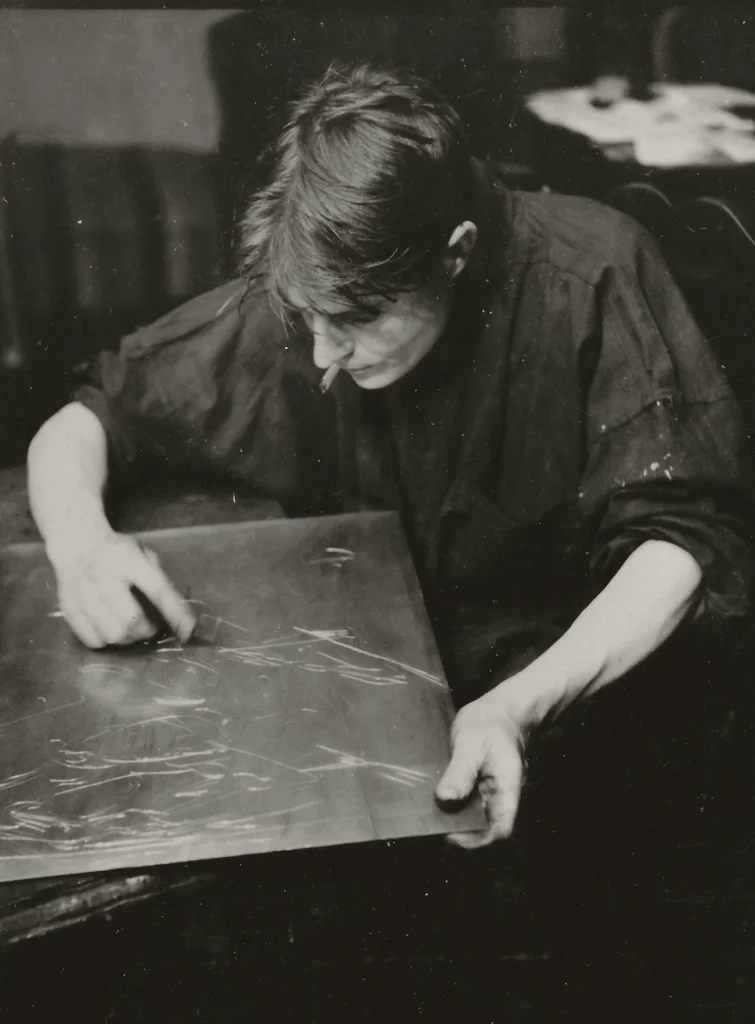
Stanley William Hayter, Atelier 17
The Guest List That Changed Art History
Word travels fast when something genuinely new is happening, and Atelier 17 became a magnet for the most significant artists of the era. Pablo Picasso, Joan Miró, Marc Chagall, Max Ernst, Alberto Giacometti, and Wassily Kandinsky all spent time at the workshop, drawn by its collaborative, boundary-free atmosphere. In 1937, several of these artists – including Miró and Picasso – worked alongside Hayter on print editions created to raise funds for the Republican cause during the Spanish Civil War.
Hayter also moved in Surrealist circles more broadly, invited into the group by André Breton himself. The principle of automatism – drawing and mark-making driven by the unconscious rather than deliberate planning – took deep root in his own work and in the atmosphere of the studio. It’s a thread that becomes essential to understanding what happened next.
War, Exile, and a New York Second Act
When World War II broke out, Hayter fled Europe, and in 1940 he re-established Atelier 17 in New York City. What could have been a disruption instead became a hinge point in modern art history.
In New York, the workshop drew an extraordinary mix: exiled European Surrealists rubbing shoulders with a young generation of American artists still finding their voice – among them Jackson Pollock, Mark Rothko, Willem de Kooning, Louise Bourgeois, Louise Nevelson, and Robert Motherwell. By 1945, the studio had grown large enough to occupy a bigger space on East 8th Street, buzzing with artists testing soft-ground textures, chasing simultaneous color printing, and absorbing the Surrealist idea of automatism that Hayter had carried across the Atlantic.
Motherwell would later credit his own transition into Abstract Expressionism to his time at Atelier 17. The New Yorker’s art critic Robert Coates went further, crediting Hayter with playing a leading role in the very emergence of Abstract Expressionism as a movement. Whether or not Hayter set out to shape American art, the collision of European automatism and American ambition inside his workshop helped light the fuse.
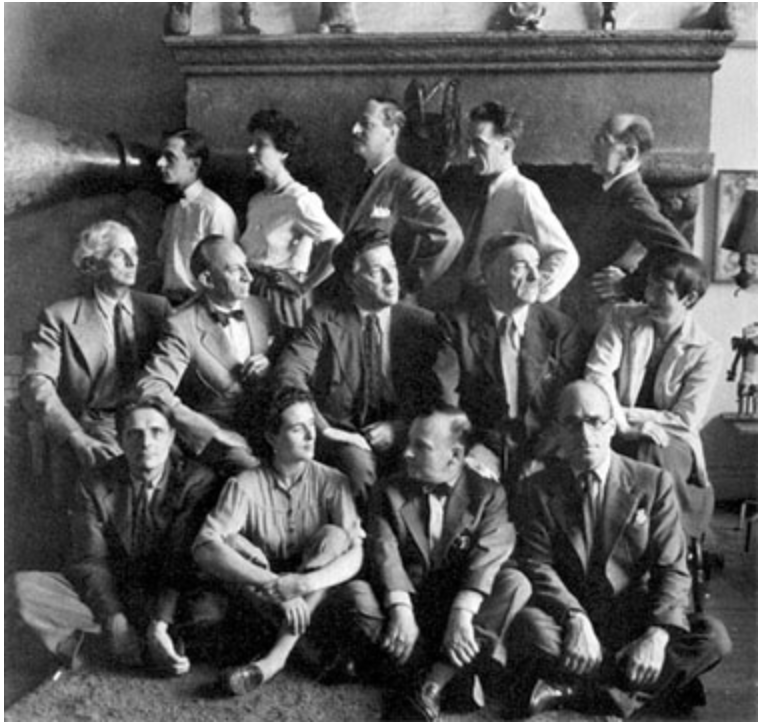
New York, 1942 (left to right):
First row: Stanley William Hayter, Leonora Carrington, Frederick Kiesler, Kurt Seligmann. Second row: Max Ernst, Amedee Ozenfant, Andre Breton, Fernand Leger, Berenice Abbott. Third row: Jimmy Ernst, Peggy Guggenheim, John Ferren, Marcel Duchamp, Piet Mondrian.
Coming Home – And Never Really Stopping
In 1950, Hayter and his family moved back to Paris, and Atelier 17 was re-established there once more, first in Montparnasse and later at other locations. The city he returned to wasn’t quite the one he’d left – the hardships of the postwar years and the reckoning with Vichy collaboration left an uneasy atmosphere – but the workshop endured, continuing to draw artists from around the world for decades.
Hayter kept working, teaching, and experimenting until his death in Paris in 1988, at the age of 86. After his death, the studio carried on under a new name, Atelier Contrepoint, a living continuation of the model he’d built more than sixty years earlier.
Why It Still Matters
No single workshop did more to shape the trajectory of modern printmaking than Atelier 17. It reimagined the print studio as a space of collective research rather than solitary craft. It gave Picasso, Miró, and Chagall room to experiment outside their usual mediums. And it quietly helped incubate the ideas that would become Abstract Expressionism, carried in the hands of artists like Pollock and Motherwell as they moved between the etching needle and the canvas.
Nearly every major current in printmaking since – from the technical innovations in colour intaglio to the collaborative studio models used in art schools today – carries Hayter’s fingerprints. The open, non-hierarchical workshop structure he insisted on, where beginners and masters shared the same tables and the same risks, became a template that university print departments and independent studios would borrow from for the rest of the century.
He set out treating art as a science of discovery. What he ended up building was a movement – one that outlived him, and one whose techniques, whether a collector realises it or not, likely underpin more prints hanging on gallery walls today than any other single workshop in modern history.