
The Painter Who Never Stopped Carving Light: Zao Wou-ki and the Secret Life of His Prints
A Chinese Brush, a French Press: Why a Painter Turned to Ink and Metal
Zao Wou-ki is remembered, rightly, as one of the twentieth century’s great abstract painters – a man who took the calligraphic breath of Chinese ink painting and married it to the chromatic storms of postwar Parisian abstraction. His canvases sell for tens of millions of dollars today, hang in the Musée National d’Art Moderne, and anchor entire wings of Asian and European modernist collections. But sitting quietly beside those canvases is a body of work that art history has only recently learned to take seriously: nearly five decades of lithographs, etchings, and aquatints, numbering in the hundreds, produced almost continuously from the early 1950s until close to his death in 2013. They were not a sideline, not a way to make extra money between exhibitions, not a concession to a dealer’s request for something more affordable. They were where some of his most daring ideas were tested first – a private laboratory that the public only got to see once the paint was already dry on the “real” work.
Zao arrived in Paris in 1948, a young painter from Hangzhou with a classical training in Chinese brush technique, a deep admiration for Cézanne and Matisse absorbed secondhand through reproductions, and almost no French. He was, by his own account, lonely and adrift in a city whose language he could barely speak. Printmaking gave him something painting alone could not: a community, and a way into it that didn’t require fluent conversation. In Paris he became acquainted with Sam Francis, Pierre Soulages, and Alberto Giacometti, artists who moved through the same ateliers and shared the same print workshops that dotted the Left Bank. It was through the print studio – not the gallery wall – that he found his way into the beating heart of French literary and artistic life, at a moment when print ateliers like Lacourière-Frélaut functioned as informal salons where painters, poets, and publishers all crossed paths over the same acid baths and inking slabs.
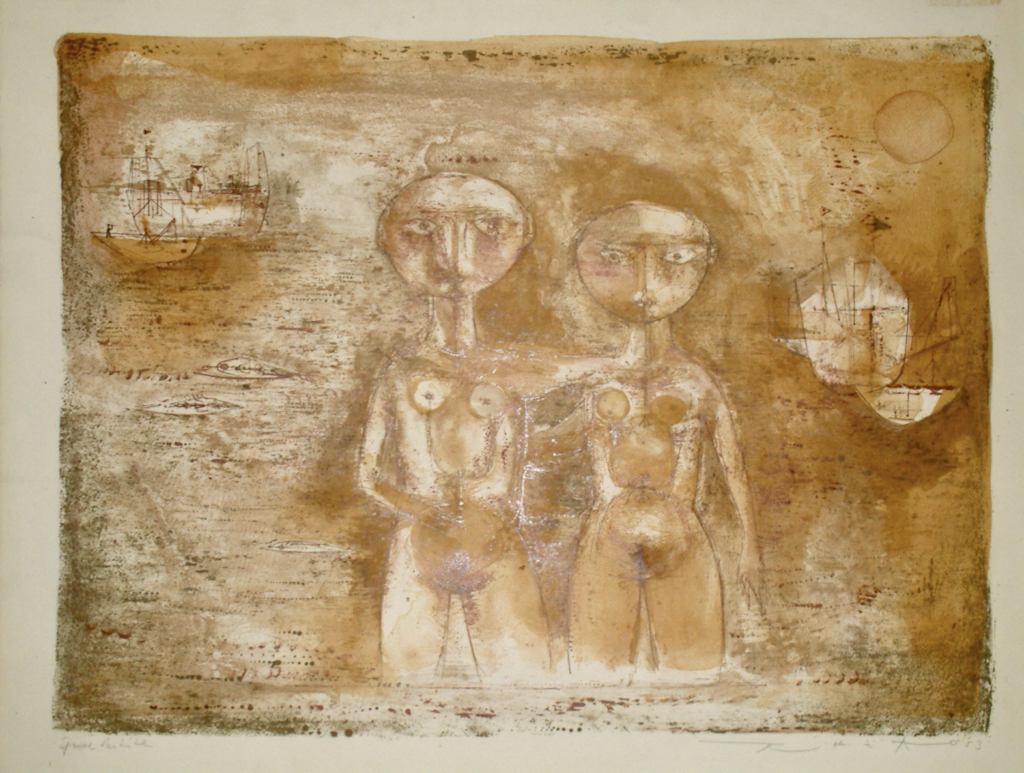
Les Baigneuse, 1953
Zao Wou-ki
Editions Graphiques
The Poem That Started It All
The real origin story of Zao’s printmaking is almost absurdly romantic, and it explains why his prints feel so unlike anyone else’s. In 1950, the poet Henri Michaux wrote a volume of verse in direct response to eight of Zao’s early lithographs, publishing it as “Lecture de huit lithographies de Zao Wou-ki.” It’s a small detail with a large consequence: this ran the usual collaboration in reverse. Normally an artist illustrates a poet’s already-finished words, adding pictures to a text that exists independently of them. Here, a major poet was moved to write specifically because the prints already existed – the image came first, and language followed, chasing after it.
That project set the template for the rest of Zao’s printmaking life. He did not treat prints merely as multiples to sell to a wider audience than his one-off paintings could reach. He made them as instruments of dialogue with the writers he admired, treating each portfolio as a genuine artistic conversation rather than a commercial afterthought. His collaborations with poets and writers, which resulted in a long run of illustrated books and boxed portfolios, are particularly prized by collectors today precisely because of this added cultural weight – a complete set of eight lithographs made for a later Michaux project, “Lecture,” published in 1975, sold for over £30,000 at auction in 2011, a striking price for works on paper produced in an edition rather than as unique objects.
This is the first reason his prints matter as more than a footnote to the paintings: they are a rare visual record of a whole generation of French poetry, seen through the eyes of an outsider who loved language precisely because he had to fight for it, word by word, for years.
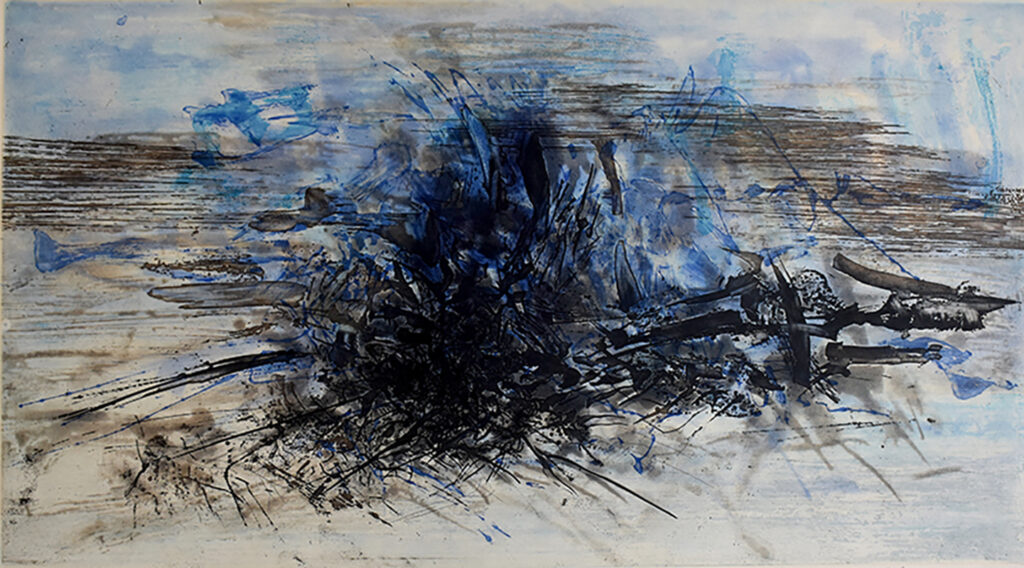
Etching No.149, 1963
Zao Wou-ki
Gilden’s Art Gallery
Why Print at All, When You Can Paint?
For an artist already commanding serious prices on canvas by the 1960s, the sheer physical labor of etching plates, biting acid, and pulling proof after proof might seem like a strange use of time better spent at the easel. But for Zao, the print studio functioned as a laboratory in the truest sense – a place to run experiments whose results would only later show up, transformed, in the paintings that made his reputation. Oil paint dries slowly and forgives revision; a painter can scrape back a passage, glaze over a mistake, let a canvas sit for months before returning to it. A copper plate or a litho stone offers no such patience. It punishes hesitation and rewards a completely different kind of hand control, one where a mark, once bitten into metal or drawn onto stone, is far harder to undo.
Working in etching and aquatint forced Zao to think in terms of resistance and bite – acid eating unevenly into metal, ink caught and held in a thousand microscopic grooves, tone built up in layers of exposure rather than laid down in a single gesture. This pushed him toward atmospheric effects of mist, void, and diffused light that he could not easily achieve with a brush alone, and those effects would later resurface, enlarged and reinterpreted, in his large paintings of the 1970s and 1980s.
The M+ Museum in Hong Kong, which staged a major retrospective dedicated entirely to this side of his career, frames it in exactly these terms: the exhibition traces Zao’s aesthetic and technical progression across etching and lithography, and shows how these mediums resonated directly with the themes and visual language found in his oil paintings. Printmaking, in other words, wasn’t a lesser cousin to painting, produced with a lighter hand and less seriousness. It was a parallel research project, run in a completely different material language, whose discoveries fed straight back into the main body of his work.
Where His Prints Pull Ahead of the Pack
Postwar Paris was thick with painter-printmakers. Miró, Chagall, Braque, and Soulages all worked the same ateliers, published with the same specialist printers, and contributed to the same tradition of luxury illustrated books that French publishing houses had cultivated since the turn of the century. So what actually separates Zao’s prints from that crowded, prestigious field?
He treated the print like a Chinese ink painting, not a Western drawing. Where many of his European peers used etching and lithography primarily to reproduce line and gesture – essentially translating a drawn mark into a printed one – Zao used aquatint’s soft tonal veils to recreate something closer to ink wash on silk or paper. There’s the same sense of breathing space around a form, the same feeling of a mark dissolving into surrounding atmosphere rather than sitting flatly on top of it. A lithograph by Zao rarely reads as “a drawing turned into a print.” It reads instead as its own self-contained weather system, with light and void doing as much work as line.
He kept expanding technically into his final years, rather than settling into a formula. His graphic output ranges from a modest two-color etching made in 1951, printed on Rives paper in a small edition, to lithographs printed in as many as fourteen colours at the Art Estampe workshop in Paris, on sheets over a meter wide, produced for institutions like the Fondation Mémoire de la Liberté. Most printmakers, once they find a process that works, repeat it with variations for the rest of their career. Zao kept complicating his own technique for fifty years, moving between two-color etchings, multi-plate aquatints, and large-scale color lithography without ever fully settling.
His literary collaborations reached genuinely rarefied company. Beyond Michaux, Zao illustrated the poetry of Roger Caillois and other major figures of French letters, producing portfolios such as “À la gloire de l’image et art poétique” in 1976, a suite of fifteen lithographs printed in Barcelona in an edition of 300 plus artist’s proofs. Taken together, this body of illustrated books reads today almost like a map of mid-century French poetry, filtered through a Chinese-born eye that brought an entirely different visual vocabulary to bear on it.
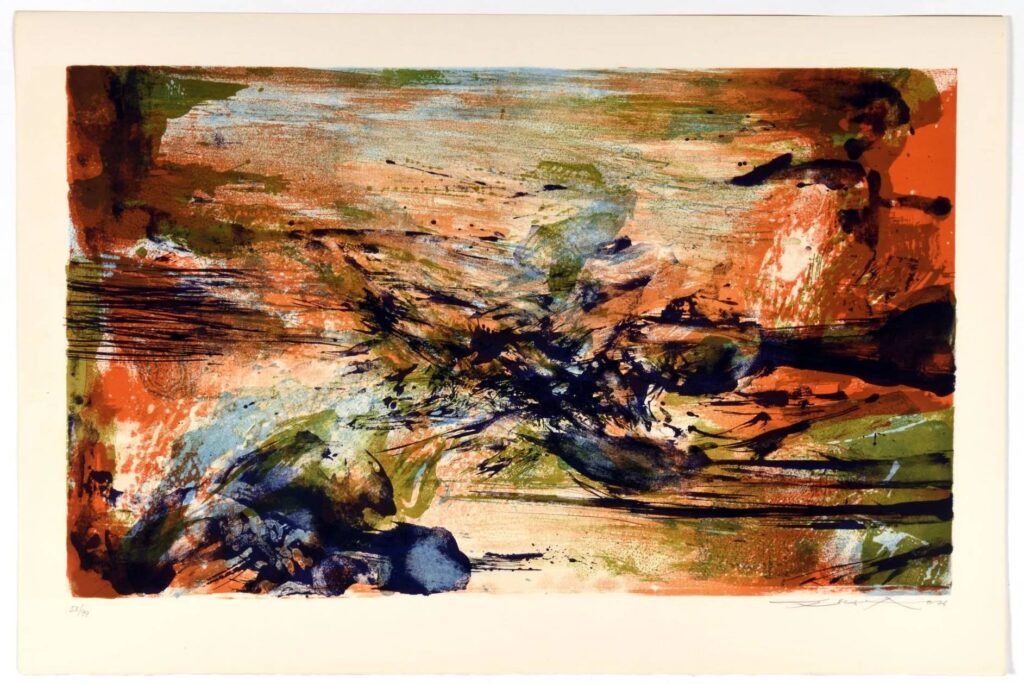
To the Glory of the Image and Poetic Art, 1976
Zao Wou-ki
Epicentrum Art Gallery
The Verdict of Time
Zao Wou-ki once described painting as a form of breathing, something as necessary and unthinking to him as respiration itself. His prints are the exhale you can actually hold in your hands – smaller than the canvases, quieter in scale, often made in direct dialogue with someone else’s words, but no less rigorous in their ambition. They reveal an artist who refused to let a medium’s traditional hierarchy dictate how seriously he’d take it, who treated a litho stone with the same intensity he brought to a six-foot canvas. That refusal is exactly why, decades later, major institutions like M+ are finally giving his printmaking the retrospective attention his paintings received long ago – and why collectors, quietly but consistently, keep paying premium prices to own a piece of it.