
The Painter Who Refused to Multiply: Mark Rothko and His War on the Print
Walk into any museum shop in the world and you can buy a Rothko. Rolled canvas, giclée print, tote bag, coffee mug – his floating rectangles of color have become one of the most reproduced images in modern art. There’s a bitter irony buried in that ubiquity: Rothko himself almost never allowed his work to exist in multiple, “official” form. He did not make prints. Not etchings, not lithographs, not silkscreens — none of the print media that nearly every major artist of his generation used, at least occasionally, to extend their work into a more democratic, collectible form.
This wasn’t an oversight. It wasn’t a failure of opportunity – Rothko had every technical and commercial avenue open to him that Robert Motherwell, Willem de Kooning, Barnett Newman, and later Warhol, Lichtenstein, and Rauschenberg walked through eagerly. It was a refusal, and it tells you almost everything about what Rothko believed a painting actually was.
A Painting Was an Encounter, Not an Image
Rothko’s entire late career was organized around a single, near-obsessive idea: that a painting is not a picture of something, and not even really an “image” to be looked at from across a room – it is an event that happens between the canvas and a single standing body. He wanted viewers close, enveloped, alone with the picture, ideally in dim, controlled light. He described the relationship as a consummated experience between picture and onlooker, insisting that nothing should stand between his painting and the viewer.
That phrase – nothing should stand between – is the key to the whole problem of printmaking for Rothko. A print, by definition, interposes a second surface, a second object, a translation, between the original gesture and the eye. For an artist trying to engineer an almost devotional, unmediated confrontation, that mediation wasn’t a minor loss of quality. It was a violation of the entire premise of the work.
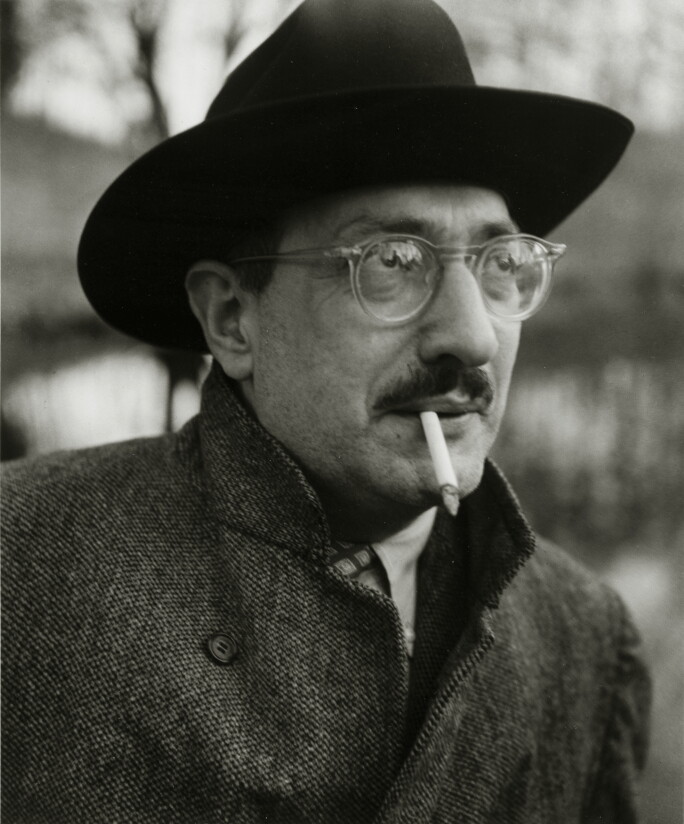
Mark Rothko
The Surface Was the Argument
This wasn’t only philosophical – it was material. Rothko’s “classic” paintings, the soft-edged rectangles hovering in fields of colour that he arrived at around 1949, depend on an extraordinarily specific physical construction: thin, translucent veils of pigment and glaze, layered wet-on-wet or in successive washes, so that light seems to originate from inside the canvas rather than bouncing off its surface. Broad, thin washes of color combine with an increasingly simplified use of form to produce an unprecedented luminosity, giving his large floating rectangles a quality of engulfing the spectator.
That luminosity is not a color you can spec out for an ink run. It’s built from optical depth – the way one translucent layer sits a fraction of a millimeter above another and lets light pass through both. A lithographic stone or a silkscreen mesh flattens that structure by nature. It reproduces the shape of a Rothko instantly and reproduces the experience of a Rothko never. Conservators who have spent decades studying his technique still find him engineering effects that resist even careful photographic documentation, let alone a print edition. Rothko was experimental and innovative with his materials, making unconventional choices – sometimes at odds with long-term durability – specifically because they produced the aesthetic effect he was after. A man that fussy about how paint sat on canvas was never going to hand that effect over to a printer’s press.
The Anti-Benjamin Artist
Walter Benjamin, the theorist and critic, had already diagnosed the problem in 1936, decades before Rothko’s classic paintings existed: mechanical reproduction strips a work of art of its “aura,” its unrepeatable presence in time and space. Critics who study Rothko’s resistance to reproduction have explicitly framed him this way – as an artist who built paintings almost as a countermeasure to the coming flood of images. Rothko’s paintings function as reproduction-resistant works precisely because, once reproduced, an image begins to refer only to itself as an image rather than to the physical, situated original – and something essential is lost in that transfer: the materiality of the work and its presence in a specific physical place.
If you have ever stood in the Rothko Room at Tate Modern or the Rothko Chapel in Houston and then later glanced at a phone photo of the same paintings, you know exactly what that critic means. Any image of a Rothko found online will look flat and unremarkable next to the experience of seeing the actual canvas – though Rothko is an extreme case, most paintings lose something significant in the transfer to reproduction. A print, unlike a photograph, would have made that loss official – a sanctioned, saleable, editioned version of a diminished experience. Rothko seems to have understood, earlier and more completely than almost anyone else in his generation, exactly what was at stake in letting an image proliferate.
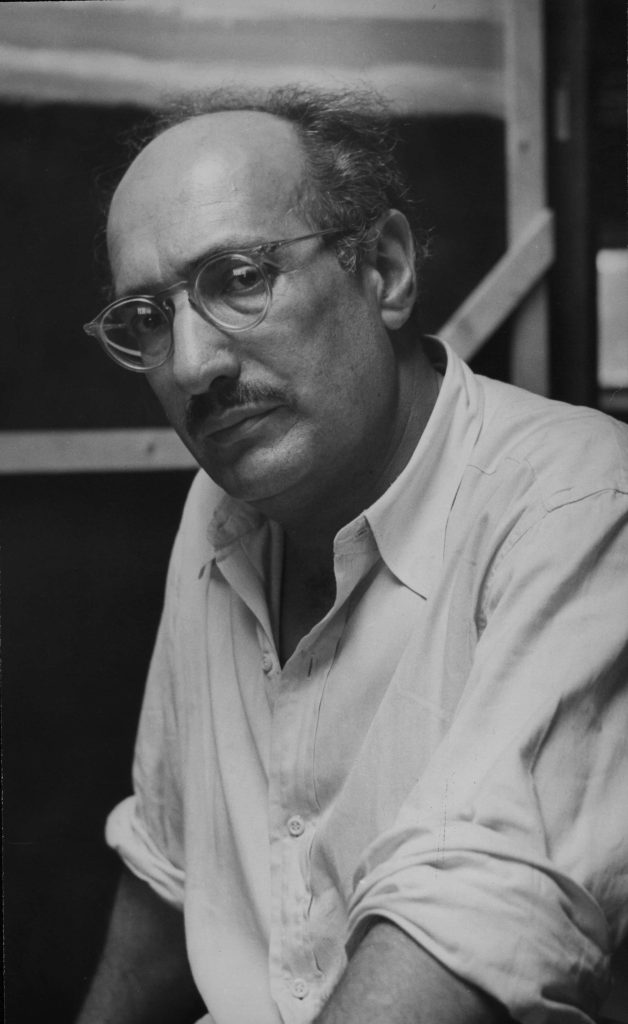
Mark Rothko
Guarding the “Uniqueness of the Image”
Rothko was cagey in public about interpreting his own work, but in the rare moments he did explain himself, he kept circling back to two words: uniqueness and clarity. He told friends that a painting’s power depended on how little you told, not how much, and that two things mattered above all in painting – the uniqueness and clarity of the image and how much one chooses to reveal. He stripped his paintings of titles, of narrative, of anything that could be “explained,” precisely so a viewer would approach the canvas unprepared, as a singular event rather than a decoded message.
A print edition is the structural opposite of a unique image. It exists specifically to multiply an image into interchangeable copies. For most artists this tension is manageable — a lithograph is understood as its own object, related to but distinct from a painting. For Rothko, whose entire aesthetic theology rested on singularity – one canvas, one encounter, one body standing in front of it – an edition of forty identical sheets would have been close to a contradiction in terms.
The Company He Kept – and Refused to Join
What makes Rothko’s abstention so striking is how thoroughly out of step it was with his peers. The print boom of the 1950s–60s swept up nearly everyone around him. Motherwell became one of the most prolific printmakers of the New York School. Barnett Newman, Rothko’s close friend and fellow traveler in the reduction of form to color and scale, eventually produced etchings. A generation later, Warhol, Lichtenstein, Jasper Johns, and Rauschenberg would treat the print not as a lesser cousin of painting but as its own vital arena – sometimes the primary site of their most radical ideas. Johns and Rauschenberg used printmaking to interrogate authorship and repetition; Warhol used it to dissolve the very idea of the unique original that Rothko was so protective of.
Rothko watched all of this happen and simply didn’t participate. He guarded his paintings so intensely that he also fought over how they were hung, lit, and installed – famously withdrawing from the Seagram murals commission when he decided the Four Seasons restaurant was the wrong setting for work he intended as something closer to a sacred space, and later channeling that same controlling instinct into designing the Rothko Chapel as a permanent, unrepeatable architecture for his paintings. An artist who wouldn’t trust a restaurant to house his work correctly was never going to trust a print run to represent it at all.
The Legacy of the Refusal
There’s a strange afterlife to this decision. Because Rothko made no official prints, the market for “Rothko prints” today consists almost entirely of posters, giclée reproductions, and licensed images made after his death, sold by museum shops and print dealers rather than pulled by the artist’s own hand. Rothko has become one of the most popular artists working today in the poster and reproduction market, even though hand-painted reproductions have become less common due to the legal protections around his estate. The very ubiquity he tried to forestall arrived anyway – just without his authorship attached to it, exactly as he might have predicted and precisely as he refused to sanction while he lived.
In the end, Rothko’s silence in the print room wasn’t a gap in his career. It was one of his most consistent artistic statements — arguably as deliberate as leaving his paintings untitled. He built a body of work around the conviction that a painting had to remain singular, physically present, and encountered rather than viewed, and he simply never found a version of that experience that a press, a stone, or a screen could deliver. In an era when nearly every major artist was learning to multiply, Rothko spent his career making sure there could only ever be one.