The Restless Plate: How Richard Hamilton Made Printmaking His Real Laboratory
Everyone remembers Richard Hamilton for one collage: Just What Is It That Makes Today’s Homes So Different, So Appealing?, the 1956 cut-and-paste manifesto that basically invented the visual vocabulary of Pop art before Pop art had a name. But treat that collage as the whole story and you miss the engine underneath it. Hamilton was, first and foremost, a printmaker – and not in the polite, secondary sense the word usually implies. Across more than sixty years he produced roughly two hundred prints, and in doing so he didn’t just use printmaking, he interrogated it, rebuilt it, and repeatedly forced it to do things no one had asked a print to do before.
A Draughtsman Before He Was an Artist
Hamilton’s path into printmaking started earlier and stranger than most people assume. Before he was ever admitted properly into the Royal Academy Schools, he trained as an engineering draughtsman at a government training centre and worked as a “jig and tool” designer – a background in precision drawing and technical specification that never really left his hand. He made his first etching in 1939, a full seventeen years before the collage that would make him famous, which means the printmaker in Hamilton predates the Pop artist by a wide margin. That early grounding in exact, mechanical line is exactly what let him later treat photomechanical processes, offset lithography, and eventually computer graphics not as gimmicks but as natural extensions of drawing itself.
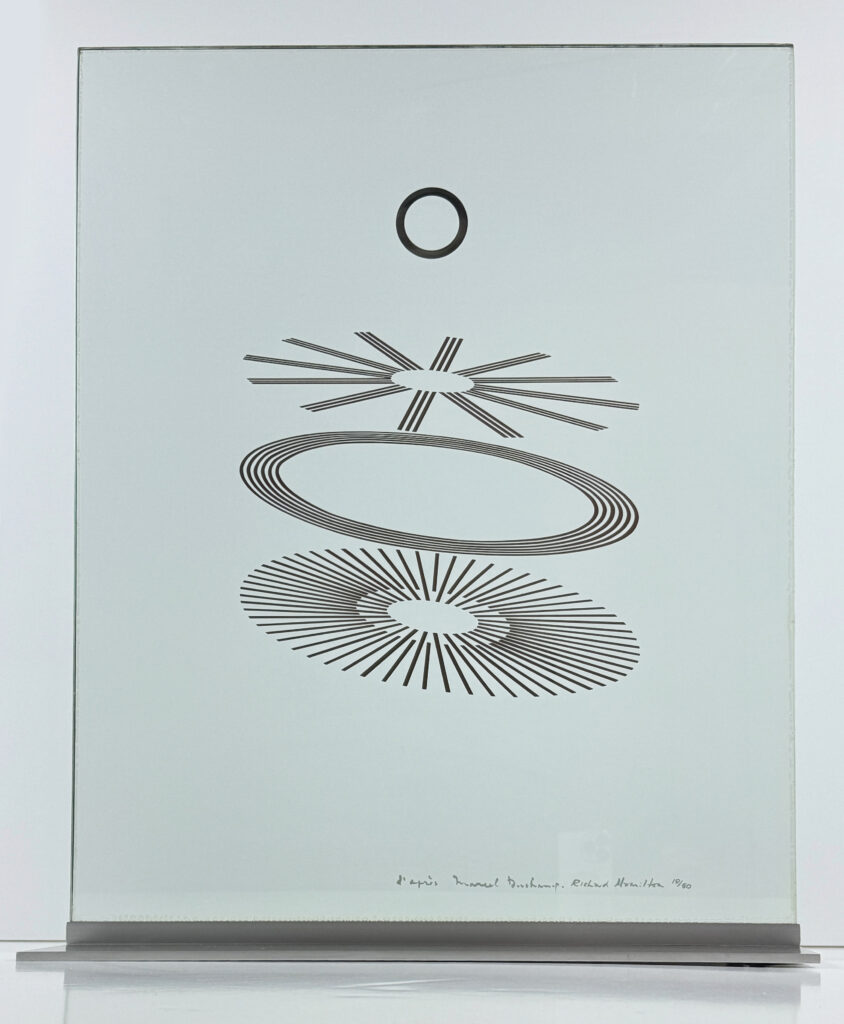
Oculist witnesses (après Marcel Duchamp) (1968)
Richard Hamilton
Petersburg Press
The Independent Group Years: Thinking in Mass Media
By the early 1950s Hamilton was deep inside London’s Independent Group, the loose circle of artists, architects, and critics obsessed with advertising, science fiction, and American consumer glamour as legitimate subjects for serious art. This is where the intellectual scaffolding for his printmaking got built. Hamilton wasn’t interested in mass media as a target for satire so much as a system to be studied and reproduced on its own terms – which made reproductive processes like screenprint, offset litho, and collotype feel less like tools borrowed from commercial printing and more like the correct native medium for the subject matter itself. A painting about advertising still felt like fine art commenting on commerce from a distance. A print about advertising, made using some of the same industrial processes advertising itself used, collapsed that distance entirely.
Chasing Celebrity Through the Silkscreen
By the mid-to-late 1960s, Hamilton had zeroed in on a recurring cast of subjects – Marilyn Monroe, the Rolling Stones, Bing Crosby – filtered through his ongoing fascination with how photography and mass reproduction actually construct our sense of a famous face. His 1965 print My Marilyn reworked contact-sheet outtakes of the actress, complete with her own red grease-pencil rejection marks, into a meditation on image selection itself – on all the discarded, “wrong” photographs that never make it to print. Two years later came I’m Dreaming of a White Christmas, a screenprint pulled from a hazy film still of Bing Crosby in the 1942 movie Holiday Inn, its Ben-Day-dot blur turning a Hollywood crooner into something closer to a half-remembered dream. These weren’t illustrations of celebrity. They were forensic examinations of how the printed, mass-circulated image actually behaves – where it degrades, where it seduces, and where it lies.
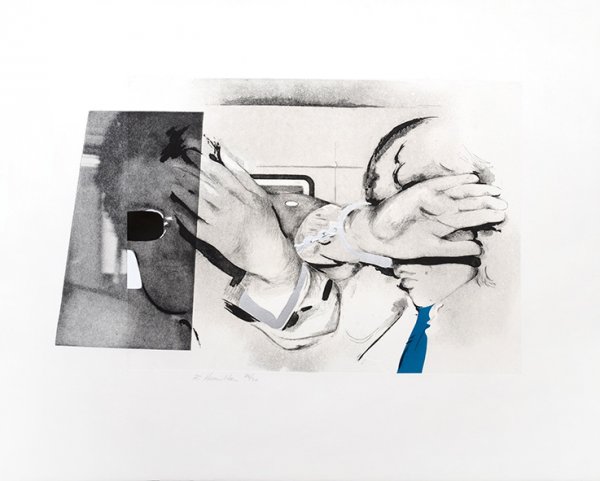
Swingeing London 67
Richard Hamilton
Peter Harrington Gallery
The Technologist Who Never Stopped Upgrading
What separates Hamilton from nearly every other printmaker of his generation is how aggressively he chased new technology rather than settling into a signature technique. He is on record as having explored nearly every printmaking process that exists except relief printing – screenprint, collotype, intaglio, offset lithography, and eventually digital output all appear across his catalogue, often combined within a single sheet. In 1971, working on the portfolio Five Tyres Remoulded, he became one of the first artists anywhere to use a computer to solve the tangled perspective problems posed by an earlier image, Five Tyres Abandoned, from 1963 – using the machine not to generate imagery outright but to calculate geometry no hand could reliably plot. By the 1980s he was producing fully computer-generated works, and by the 1990s and 2000s he’d moved into inkjet output, treating the digital print with the same rigor he’d once brought to drypoint. One late edition, Bathroom, made for documenta X, grew directly out of paintings he was showing at the exhibition – Hamilton described it as among his first real attempts to pull a finished edition straight out of a graphics computer, still framed, tellingly, as a problem of space and habitation rather than a novelty.
Working With the Masters
For all his technological restlessness, Hamilton was equally serious about craft in its oldest sense, and he understood that the two weren’t in tension. In 1973 he was invited to contribute to a portfolio celebrating Picasso’s ninetieth birthday, and rather than treat the commission casually, he insisted on being introduced to Aldo Crommelynck – the legendary Parisian master printer who had worked at Picasso’s side for two decades and handled every one of his etchings after 1961. The resulting print, Picasso’s meninas, launched a working relationship between Hamilton and Crommelynck that continued for years afterward. Hamilton was candid about what that kind of collaboration meant to him: he came to see the advantage of pairing an artist’s ideas with a master printer’s total command of presses, acids, and pigments, insisting that the artist’s real job was to stay locked onto the plate or stone until the final proof came out right. It’s a philosophy that runs through his whole career – endless technical curiosity paired with genuine deference to the people who actually knew how to make a press behave.
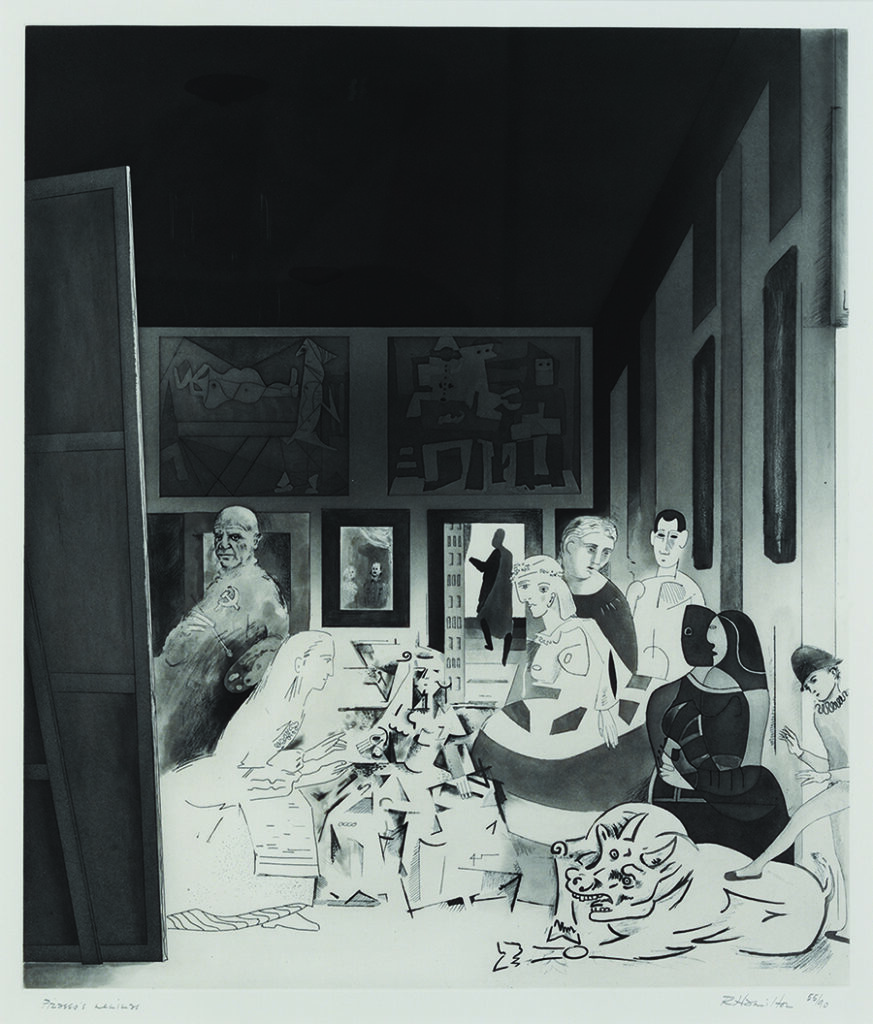
Picasso’s Meninas (1973)
Richard Hamilton
Sims Reed Gallery
A Career the Institutions Keep Returning To
No publisher shaped that late-career output more than Petersburg Press, the London house founded by Paul Cornwall-Jones that became Hamilton’s principal printmaking home from the late 1960s onward. It was Petersburg that issued Oculist Witnesses, his 1968 collaboration with Marcel Duchamp, and it kept publishing him steadily for the next two decades – Kent State in 1970, a searing response to the shooting of student protesters at Kent State University; Portrait of the Artist by Francis Bacon, made the same year; Release in 1972, produced with the National Council for Civil Liberties; and later works like Interior with Monochromes, the Motel diptych, and Bronze by Gold, spanning into the mid-1980s. The relationship put Hamilton in close company with the rest of Petersburg’s roster, which at various points included Dieter Roth and other artists for whom the press served as a genuine creative partner rather than a simple production house. Some of the Petersburg editions, including the 1972 screenprint built from seventeen hand-cut stencils, were produced jointly with Kelpra Studio, the print workshop that had already become legendary in London for its technical precision with screenprinting – another example of Hamilton pairing his own restlessness with the steadiest hands he could find. Petersburg Press eventually published the definitive catalogue of his graphic work, Richard Hamilton Prints 1939–1983, cementing just how central that partnership had become to the historical record of his printmaking.
Hamilton’s standing as a printmaker only solidified with time. He won the World Print Council Award in 1983, by which point his reputation as one of the medium’s most inventive practitioners was already well established among curators and collectors. The Alan Cristea Gallery – later Cristea Roberts – mounted dedicated survey after dedicated survey of his editions, including New Technology and Printmaking, built specifically around the idea that nearly every piece in the show employed some combination of media never previously used together in the history of the medium, and later Word and Image, Prints 1963–2007, tracing his repeated return to the same handful of themes across four decades of technical reinvention. The Art Gallery of Ontario’s Cut, Paste, Print made the same case from a different angle, framing Hamilton as an artist who habitually folded collage, offset litho, screenprint, and photography together into single images. Tate gave him full retrospectives in 1970, 1992, and again in 2014, three years after his death, cementing what his print dealers and biographers had been arguing all along – that the prints weren’t a sideline to the paintings and the famous early collage. They were the connective tissue holding his entire sixty-year investigation of images together.
Why the Prints Are the Real Hamilton
Strip away the reputation of “the man who made the first Pop art collage” and what’s left is someone who treated every new printing technology as an open question rather than a shortcut. Hamilton moved from drypoint to screenprint to computer-assisted perspective to full digital output not because each new tool was trendy, but because each one let him ask his real, lifelong question in a slightly different way: how does a mechanically reproduced image actually shape what we believe we’re seeing? That question started in an etching studio in 1939 and was still being asked, on a graphics computer, more than sixty years later. The plate changed. The obsession never did.