The Woodcut Rebel: How Erich Heckel Carved a New Language for German Expressionism
A Chemistry Student Who Chose Chisels Over Test Tubes
In 1904, a young architecture student in Dresden was quietly falling out of love with blueprints. Erich Heckel had enrolled to study a respectable trade, but something else was pulling at him – the raw, unpolished power of images that didn’t ask permission to be beautiful. Within a year, he’d co-founded Die Brücke (The Bridge) alongside Ernst Ludwig Kirchner, Fritz Bleyl, and Karl Schmidt-Rottluff, a group of self-taught artists who believed art had grown soft, decorative, and dishonest. They wanted a bridge – hence the name – between the exhausted academic traditions of the nineteenth century and something fiercer, more immediate, more human.
The group had no formal art school training, which turned out to be an advantage rather than a handicap. Untethered from academic convention, they taught themselves by looking sideways: at African and Oceanic tribal carvings displayed in Dresden’s ethnographic museum, at medieval German woodcuts by Dürer and Cranach, at the raw folk art traditions that polite Impressionist-influenced painting had long since abandoned. Heckel, among all of them, would become the group’s quiet technician – the one who understood most instinctively that the humble woodblock, a medium associated with devotional prints and cheap illustration, could be weaponised into something startlingly modern.
Why the Woodcut? Because Splinters Don’t Lie
Painting can seduce. It can smooth over hesitation with a confident glaze or a clever blend of color. The woodcut cannot lie so easily. Every gouge of the knife is permanent, every jagged edge a decision made in wood and never taken back. This is precisely what drew Heckel and his Brücke colleagues to the medium: its brutal honesty matched their appetite for emotional directness, and its physical demands – the resistance of the wood, the risk of a slipped chisel – made the artist’s hand and body part of the finished image in a way brushwork rarely could.
Heckel didn’t treat the woodcut as a lesser cousin to painting, a reproducible afterthought fit only for illustrating books or making cheap multiples. He treated it as a primary language, equal in ambition to anything done in oil. His blocks often show visible tool marks left deliberately raw, wood grain allowed to bleed through the composition like a second set of veins running beneath the skin of the image. Look at a print like Fränzi Standing or the stark, angular figures scattered throughout his 1910s work, and you’ll notice the bodies feel constructed as much as depicted – hacked from wood rather than painted onto it, their elbows and collarbones reduced to sharp planes that seem to fight the material even as they emerge from it.
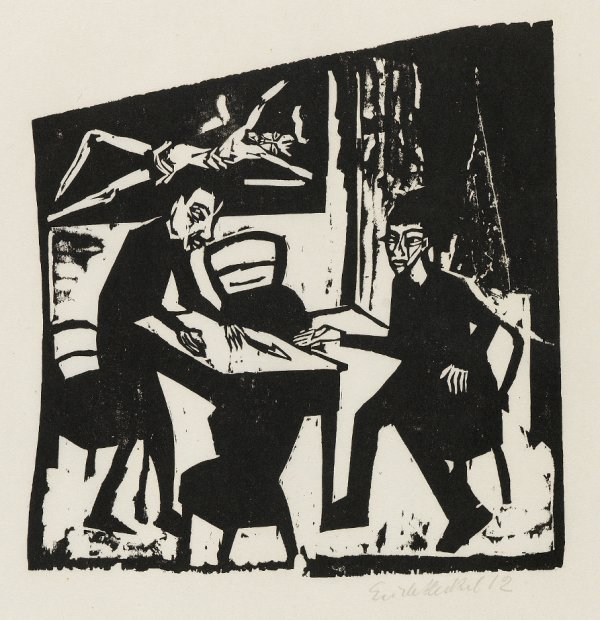
Gegner (Adversaries) (1912)
Erich Heckel
Simon Theobald
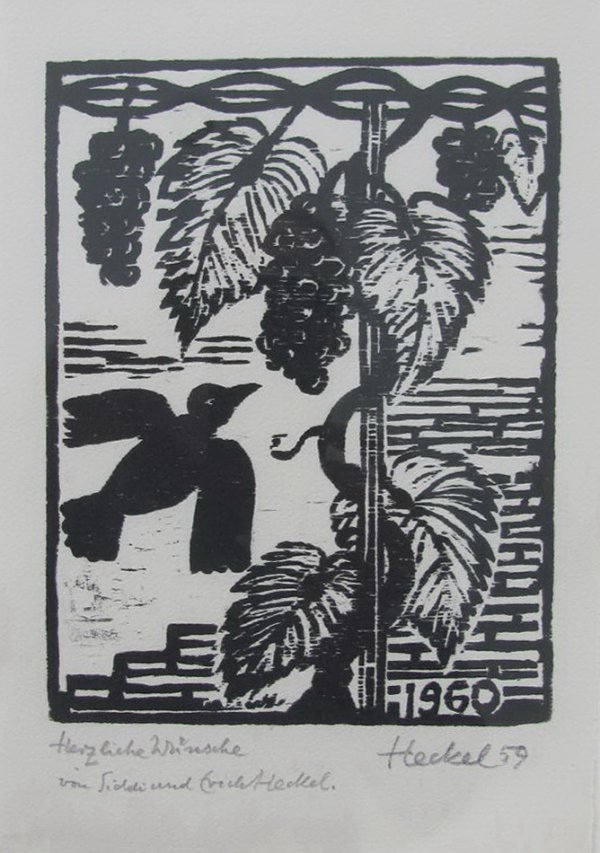
Jahresblatt: Vogel Und Trauben (1959)
Erich Heckel
William Chambers Art
The Brücke Studio: Communal Life as Artistic Manifesto
To understand Heckel’s prints, you have to understand how the Brücke artists actually lived. They shared a converted butcher’s shop as a studio in Dresden, filling it with fabrics, carved furniture, and models who were often friends, lovers, or neighborhood girls rather than professional sitters. Nudity wasn’t scandal here – it was research. The group believed that industrial, corseted, bourgeois society had alienated people from their own bodies, and that art’s job was to reclaim that lost intimacy.
This communal, almost tribal way of working shows up directly in Heckel’s printmaking. Many of his early woodcuts depict friends bathing at the Moritzburg lakes outside Dresden, bodies rendered in flat, angular black shapes against white paper, stripped of individualizing detail so that the figures feel less like portraits and more like symbols of unguarded human presence. The technique and the philosophy were inseparable: a soft, blended painting technique would have contradicted the very message of rawness the group wanted to send.
The Printmaker as Restless Experimenter
Heckel refused to stay loyal to a single technique, and this restlessness is part of what separates him from artists who mastered one printmaking method and repeated it for a career. He moved fluidly between woodcut, lithography, and etching, treating each medium as a different instrument in an orchestra rather than interchangeable tools serving the same end.
His lithographs often possess a soft, smoky quality entirely absent from his woodcuts – useful for the misty lakes and bathers of his Dresden and Baltic seaside scenes, works that pulse with the Brücke fascination for unguarded nudity and communion with nature. The lithographic crayon let him build up tone gradually, in a way that suited dreamier, more atmospheric subjects.
His etchings, meanwhile, allowed for finer linework, a nervous, scratchy energy that could capture urban anxiety and crowded city streets in a way the blunt woodcut couldn’t manage. Where the woodcut speaks in blunt declarative sentences, Heckel’s etched line speaks almost in a whisper, tracing hesitation and unease into figures caught mid-gesture.
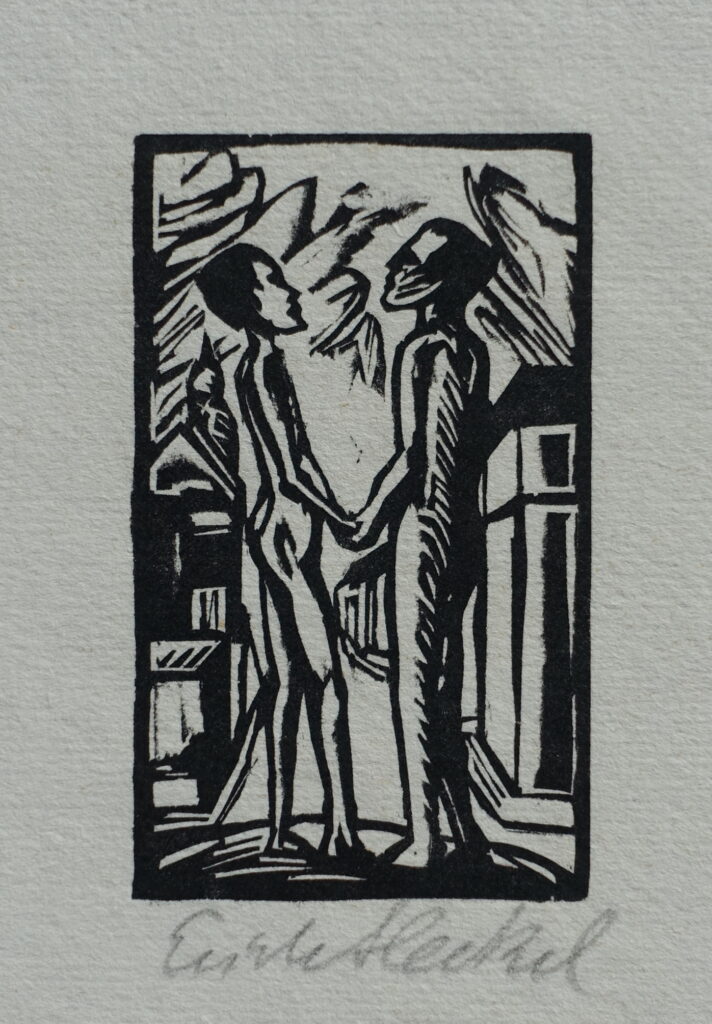
Begegnung (Encounter) (1922)
Erich Heckel
Jan Johnson Old Master Modern Prints
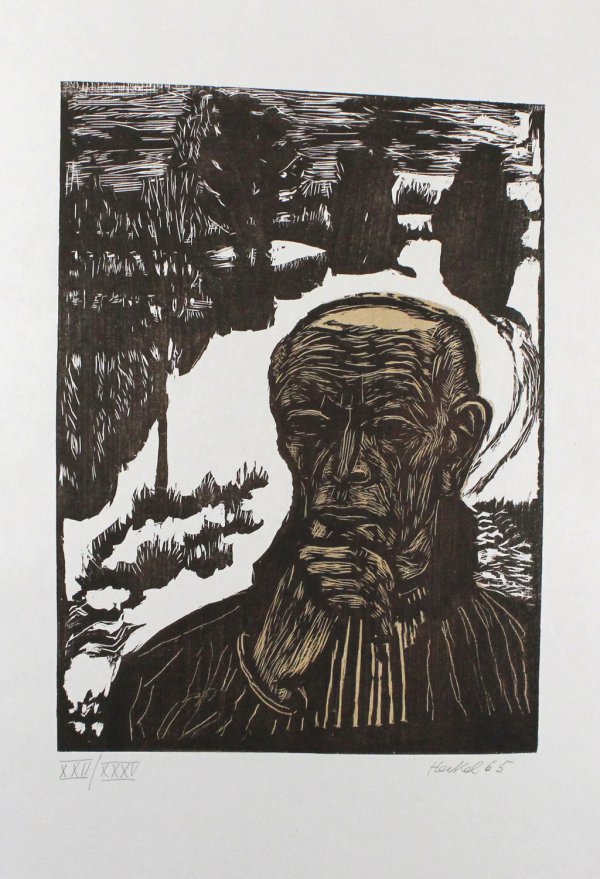
Bildnis (1965)
Erich Heckel
Sylvan Cole Gallery
Colour as Confrontation, Not Comfort
When Heckel did use colour in his prints, it wasn’t to please the eye – it was to unsettle it. Flat planes of acid yellow, bruised purple, or blood orange were laid down not to represent observed reality but to convey feeling directly, unmediated by naturalism. This was a Fauvist-adjacent instinct shared across the Brücke circle: colour liberated from its descriptive duty, free to express anxiety, ecstasy, or alienation instead of simply reporting what a lake or a body actually looked like.
Heckel frequently printed multiple woodblocks in sequence – one block per colour – requiring exact registration between each pass. Any misalignment would leave ghostly halos around figures, an effect some later printmakers embraced as an aesthetic choice but which, in Heckel’s hands, was usually a technical problem to be solved with painstaking precision, block by block, colour by colour.
Branded “Degenerate” – and Nearly Erased
The tragic irony of Heckel’s career is that the very qualities that made his prints so vital – their emotional rawness, their rejection of idealised beauty – made him a target under the Nazi regime a generation later. In 1937, his work was included in the infamous “Degenerate Art” exhibition organized by the Nazi government, a traveling show designed to humiliate modernist artists by displaying their work alongside insulting wall text and photographs of disabled people, implying a shared moral and biological corruption.
Over 700 of Heckel’s pieces were confiscated from German museums during this campaign. Many were destroyed outright; others were sold off internationally to raise foreign currency for the regime. He was forbidden from exhibiting, and like many of his surviving Brücke colleagues, he retreated into a kind of internal exile, working quietly and privately while the public art world he’d helped build was dismantled around him.
That a government felt threatened by woodcuts tells you everything about how much power Heckel had actually put into them. These weren’t polite decorative objects destined for a parlor wall. They were arguments – about bodies, about honesty, about what art was allowed to say without asking permission first.
The Postwar Years: A Quieter, Persistent Voice
Heckel’s Dresden studio and much of his early work were destroyed in Allied bombing raids in 1944, an almost unbearable second loss layered atop the earlier Nazi confiscations. Yet he continued working into the postwar decades, teaching at the Karlsruhe Academy of Fine Arts and continuing to produce prints, watercolors, and paintings until his death in 1970. The late work is calmer, more muted than the explosive energy of his Brücke years – but the underlying commitment to the print as a serious, expressive medium never wavered.
Why He Still Matters
eckel’s prints ask a question that feels newly relevant in our age of digital smoothness and infinite undo: what do we lose when art becomes too easy to correct? The woodcut demanded commitment. Every mark was consequential, every gouge irreversible, every choice made permanent the instant the knife touched wood. In choosing this unforgiving medium, and in refusing to abandon it even as his world collapsed twice – first to war, then to fascism, then to bombs – Heckel made a case for imperfection as a form of truth-telling. One gouge, one splinter, one irreversible cut at a time.