When You Change Something, You Change Everything: Wayne Thiebaud in the Print Shop
Wayne Thiebaud is famous for paint – for pie cases and gumball machines rendered in thick, sundae-bright impasto that seems to cast its own shadow off the canvas. But run the numbers on his career and a different picture emerges: Thiebaud was an active printmaker for seven decades, with his earliest print dating all the way back to 1948. Painting made him famous. Printmaking is where he quietly did some of his most rigorous thinking, stripped of the very impasto that made his paintings instantly recognizable.
That’s the paradox worth sitting with first. Take away the thick paint, the buttery colour, the celebrated surface – and what’s left? Line. Edge. The bare architecture of a composition. Printmaking forced Thiebaud to answer that question again and again, decade after decade, and the answers he found there fed straight back into everything else he made.
The Accidental Studio Visit That Started It All
The origin story reads almost too neatly, but it’s true. Kathan Brown, founder of Crown Point Press, saw an exhibition of Thiebaud’s paintings in San Francisco – without knowing the artist – and invited him to her printshop to make an artist’s book. There was no long courtship, no calculated career move on Thiebaud’s part. It was one printer recognizing a compositional intelligence in someone else’s canvases and wanting to see what that intelligence would do with a copper plate instead of a brush.
That visit produced Delights, a 1964 portfolio that would become one of the great debuts in postwar American printmaking. In it, Thiebaud returned to the still-life motifs that had made his name – ice cream cones, rows of cakes, gumball machines – but rendered them small-scale and in black and white, so the subjects looked strikingly different from their painted counterparts. Imagine the jolt of that: an artist known for lush, saturated color choosing to work his most iconic imagery down to bare line on white paper, as if testing whether the compositions could survive without their most famous ingredient.
They did. That single project cracked something open. Delights marked the beginning of what would become a printmaking partnership lasting more than fifty years at Crown Point Press, where Thiebaud eventually created over one hundred different images – one of the longest sustained artist-printer relationships in American art history.
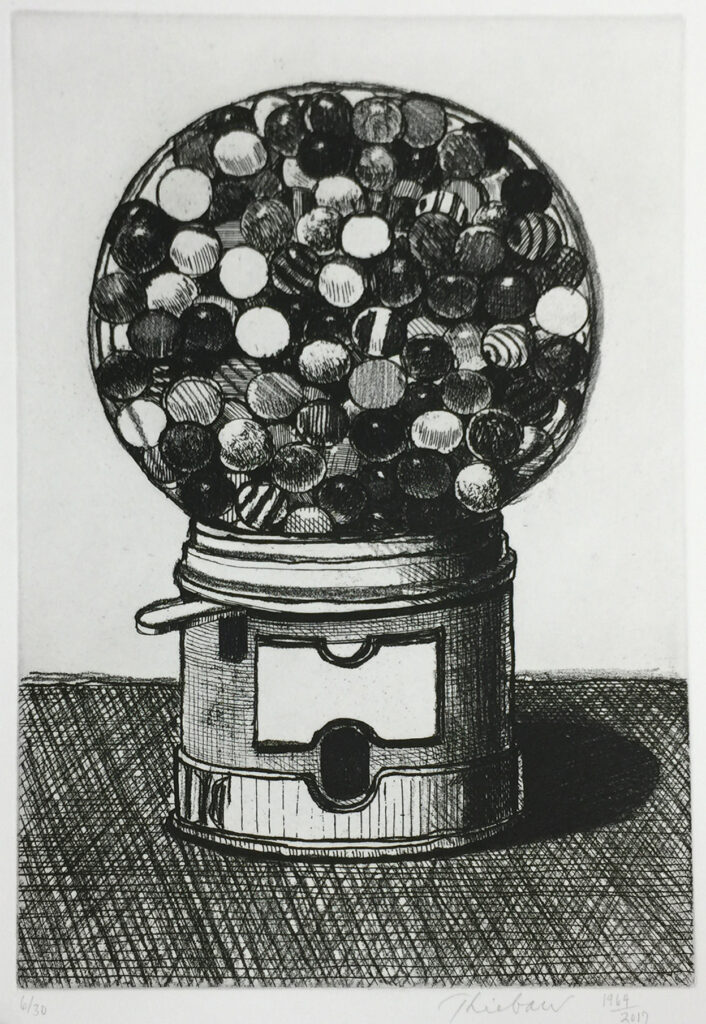
Dark Gumball Machine (1964)
Wayne Thiebaud
Jonathan Novak Contemporary Art
His Own Words: “When You Change Something, You Change Everything”
If you want the whole philosophy of Thiebaud’s print practice in a single sentence, he gave it to you himself. As he told his publisher at the time, “When you change something, you change everything.” That’s not a throwaway line – it’s the operating principle behind decades of work. Move a dessert from oil paint to etched line, and you’re not just translating an image into a new material. You’re forcing every formal decision – contour, weight, spacing, the way light falls off an edge — to be made again from scratch.
Read that quote as a manifesto and Thiebaud’s print career starts to look less like a side hobby and more like an ongoing experiment in controlled variables. Keep the subject constant – a cone, a slice of pie, a row of pastries – and change only the medium. What survives tells you what was structurally essential about the image. What disappears tells you what was merely decorative. Few artists have been so explicit, or so disciplined, about turning their own studio practice into that kind of test.
Building a World Out of Spheres, Triangles, and Ellipses
Underneath the nostalgic, candy-coloured subject matter, Thiebaud was doing something closer to geometry than illustration. His images are, in fact, composed of only a few elemental forms – spheres, ellipses, triangles, and squares – so that something like Billiard Balls reduces essentially to spheres within a triangle, and Banana Splits reduces to four ellipses.
Printmaking became the place where he tested how far those elemental forms could travel. By moving the same subject through mediums – from painting to drawing to print – Thiebaud continued what he described as a “critical interrogation” of his subjects and their formal qualities, putting a simple sphere-and-triangle like an ice cream cone through its paces in each material and finding it yield something different every time. An etched line carries a different weight than a brushstroke; a woodcut’s carved edge behaves differently again than either. Each medium became a new lens angled at the same handful of shapes.
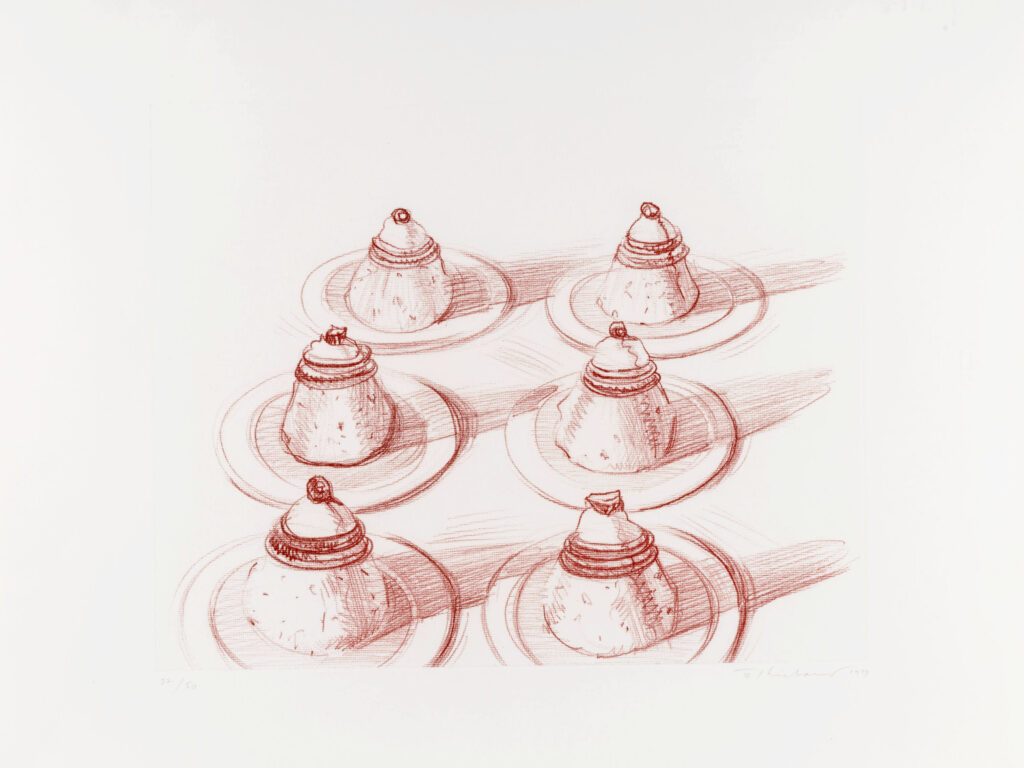
Six Italian Desserts, from Recent Etchings II (1979)
Wayne Thiebaud
Leslie Sacks Gallery
A Toolkit Wider Than You’d Expect
Thiebaud didn’t settle into one printmaking process the way some painters treat a print studio as a one-technique detour. Since his first print in 1948, he went on to work in limited-edition aquatints, woodcuts, etchings, lithographs, screenprints, and monotypes, and his printing practice runs from the early, small-scale black-and-white etchings of the 1960s to the complex, colorful woodcuts of the 1980s and beyond.
Crucially, switching technique wasn’t cosmetic – it changed the actual argument a piece was making. Experimenting with diverse processes such as etching, serigraph, and woodcut produced vastly different effects even when the subjects and compositions were similar, in service of what Thiebaud called his “constant search” – his continuing inquiry into the process of making images. He even revisited his own past images decades later in new processes: a piece like Gumball Machine exists as a linocut with watercolor hand additions, made in 1971 and reworked in 2003, and Pie Case pushed intaglio further still as a color direct gravure and aquatint etching finished with graphite and colored pencil in 2005 – evidence that he kept reopening the same formal questions with sharper tools, decades after he’d first asked them. Most artists move on once a subject feels resolved. Thiebaud treated resolution as temporary, always open to revisiting once a new technical possibility gave him a fresh angle on an old problem.
Structure First, Charm Second
It’s easy for viewers to stop at the surface pleasure of Thiebaud’s imagery and miss the discipline underneath. As one gallery study of his prints and works on paper puts it, the sumptuous, delightful appeal of the images makes it easy to overlook his incredibly skilled draughtsmanship and his relentless investigation of form, volume, and perspective.
His graphic work bears that out directly. With an emphasis on edges and negative space, his prints appeal to the eye through rudimentary forms, the stark contrast of black ink on white paper following the traditional arc of his graphic output – fine lines that are spare in certain areas and dense with cross-hatching in others, at first reading as direct and simple before revealing immense depth and solid form. That’s a printmaker’s vocabulary – line weight, hatching density, negative space – doing work a painter’s brush can’t quite replicate. Where his paintings seduce with texture and color temperature, his prints seduce with restraint, asking the eye to fill in volume from sparse marks.
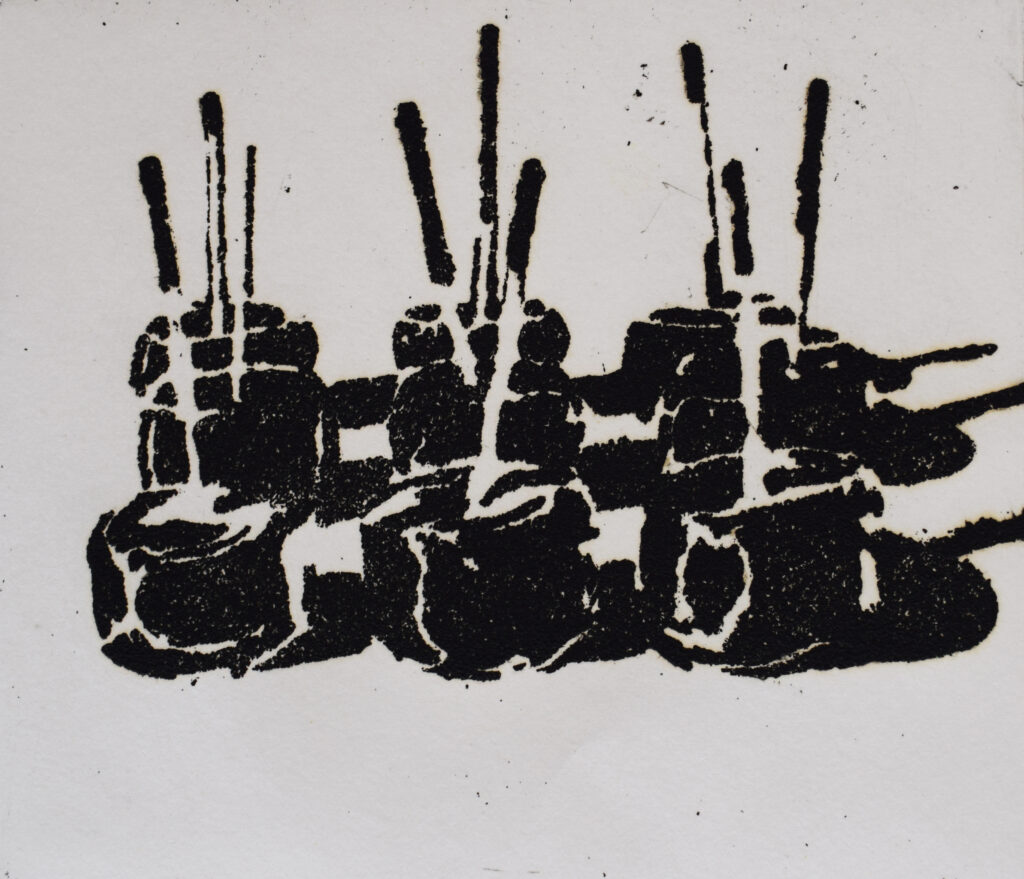
Candy Apples (1964)
Wayne Thiebaud
Gilden’s Art Gallery
The Teacher Who Never Stopped Being a Student
Thiebaud’s relationship to printmaking is inseparable from his identity as an educator. His teaching career at UC Davis spanned more than four decades and helped shape thousands of students, and prints functioned almost as classroom demonstrations of his own thinking. Although better known as a painter, Thiebaud was a prolific printmaker throughout his career, and printmaking was integral to his process as he investigated the effects of line, color, pattern, and composition. Gifts of his prints to the university stand today as a continued commitment to the UC Davis community and a virtual classroom revealing the artist’s process – proof that the print wasn’t just a finished object, it was a teaching tool, including for himself.
There’s something fitting about that. A print, unlike a finished oil painting, often carries visible evidence of its own construction – proof states, trial pulls, layered colour separations that show a composition arriving in stages. For a lifelong teacher, that transparency wasn’t incidental. It was arguably the whole point: a way of showing students, and himself, exactly how a resolved image gets built one decision at a time.
His Influence: Making the Print Studio Safe for Formal Risk
Thiebaud’s real legacy in printmaking isn’t a single technique – it’s a working method. By treating every medium shift as a total reset of a problem (“change something, change everything”), and by staying loyal to one workshop relationship for half a century, he helped model a version of the artist-printmaker partnership built on sustained trust rather than one-off novelty projects. His decades at Crown Point Press, alongside contemporaries reshaping what a “painter’s print” could be, helped establish California fine-art print workshops as places where major artists went not to reproduce their paintings, but to interrogate them.
That model has outlasted him. The long-term, trust-based relationship Thiebaud practiced with Kathan Brown became something of a template for how serious painters approach printmaking workshops – not as a quick commercial detour, but as an ongoing studio relationship worth investing decades into, with a printer whose technical knowledge becomes as essential to the final image as the artist’s own hand.
The thread that runs from a 1964 black-and-white etching of an ice cream cone to a 2005 hand-worked aquatint of a pie case is the same thread that ran through his classroom for forty years: subject matter as an excuse, and the real content, always, is line, edge, and form.