
Ink, Stone, and Genius: The Secret Life of Atelier Mourlot
A Print Shop That Rewired Art History
Walk into an unassuming building on the Rue de Chabrol in Paris in the 1950s, and you might not guess that inside, some of the twentieth century’s most important art was being born — not on canvas, but on slabs of limestone. This was Atelier Mourlot, a family lithography workshop that started out printing wallpaper and department store posters and ended up becoming the beating heart of modern printmaking. Picasso, Matisse, Chagall, Miró, Braque, Léger — nearly every titan of the era passed through its doors, often more than once, often for years at a stretch. Understanding Mourlot means understanding how a craftsman’s workshop quietly became a laboratory for genius, and how the humble printed multiple came to sit, unashamed, beside the unique painted masterpiece.
From Wallpaper to the Avant-Garde
The Mourlot story begins humbly, almost anonymously. Founded in 1852, the family firm spent decades producing commercial lithographs — posters, packaging, decorative wallpaper, the workaday visual output of a busy Parisian print house. For most of its early history, nobody would have mistaken it for an art institution. It was a business, run on deadlines and ink costs, competing for print contracts like any other shop in the city.
The turning point came in the 1920s and 30s under Fernand Mourlot, who inherited the business from his father and had a hunch that would eventually upend the entire trajectory of the workshop: the same technical mastery used for advertising posters could serve fine art, if only artists could be persuaded to get their hands dirty with stone and grease pencil. Fernand began cautiously, printing exhibition posters for galleries and dealers, building relationships with the Parisian art world one commission at a time. It was a gamble, taken slowly, that transformed a commercial print shop into one of art history’s great creative crucibles — though almost nobody involved could have predicted just how far it would go.
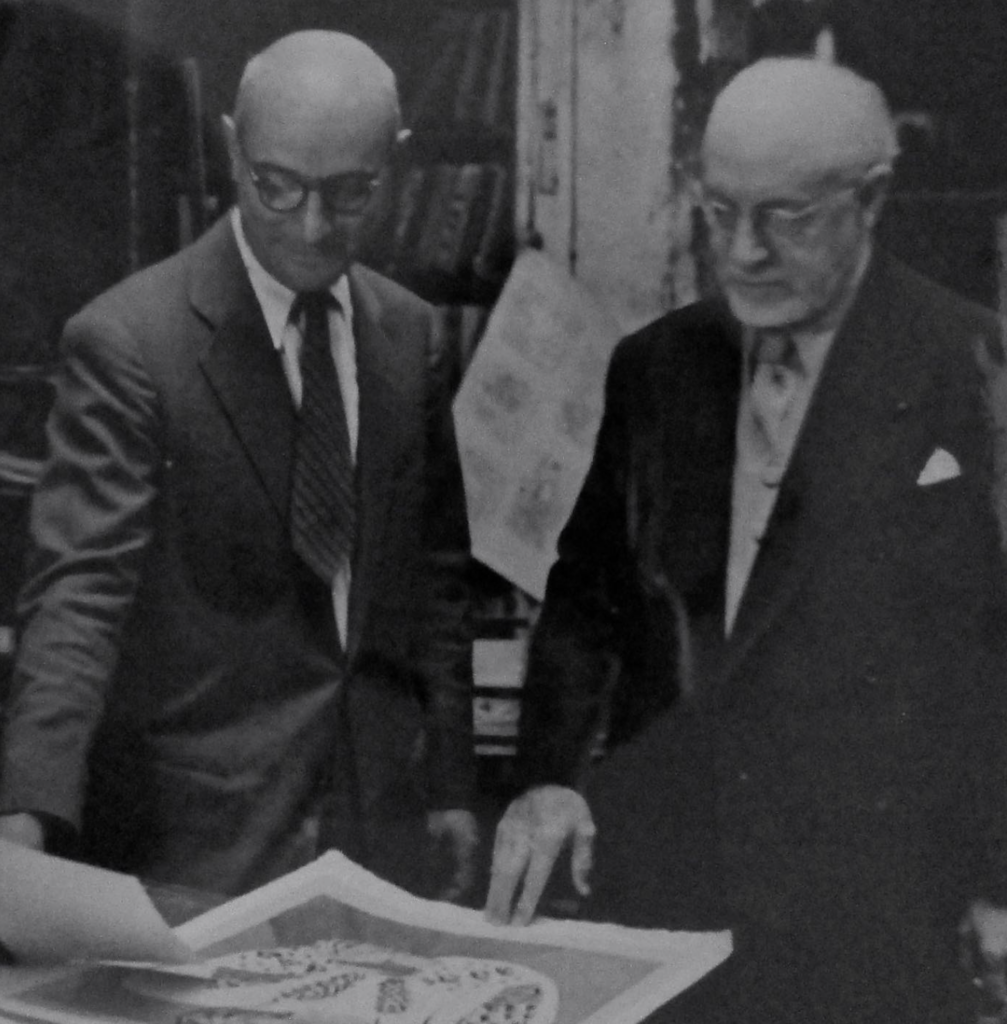
Fernand Mourlot with Henri Matisse at Atelier Mourlot, Paris 1948
Why Lithography? The Chemistry of Seduction
To understand why so many great painters fell for this particular medium, it helps to understand what lithography actually asks of an artist. Unlike engraving or etching, where the artist must cut, bite, or otherwise fight the surface, lithography is disarmingly direct: the artist draws straight onto a flat slab of limestone with a greasy crayon, ink, or wash, almost exactly as they would draw on paper. The stone is then chemically treated so that the greasy marks attract printing ink while the untouched areas repel it and hold water instead. Run it through the press, and the drawing transfers, again and again, with a richness of tone that etching can rarely match.
For painters accustomed to total control on canvas, this was liberating and maddening in equal measure. Liberating, because the gesture felt immediate — a loose, expressive line looked exactly as loose and expressive on the final print as it had on the stone. Maddening, because color lithographs required separate stones for each hue, meticulous registration so the colors would align, and an intimate understanding of how the stone’s surface would behave under pressure and humidity. None of this could be faked. It demanded a whole new discipline, layered on top of an artist’s existing instincts, and that tension — between spontaneity and precision — is exactly where Mourlot’s printers made themselves indispensable. They became translators, turning an artist’s raw vision into technically flawless multiples, often solving problems the artist didn’t even know existed.
Picasso Walks In, and Everything Changes
The pivotal moment in Mourlot’s history came in 1945, when Pablo Picasso arrived at the atelier and began an obsessive, years-long love affair with the medium. He treated the lithographic stone like a living collaborator, reworking single images through dozens of successive states, pushing the printers to their technical limits, occasionally showing up at odd hours simply to see what the stone might do next. Fernand Mourlot later recalled that Picasso’s appetite for experimentation was insatiable — he wanted the medium pushed past what anyone thought possible, treating each printing session less like a commercial job and more like an open-ended investigation.
- His famous The Bull series is the clearest record of this restlessness. Over the course of a single month in late 1945, Picasso reworked one image of a bull through eleven successive states, tracking it as it’s reduced from a full, fleshy, anatomically rendered animal down to a handful of spare, essential lines — pure gesture, almost calligraphy. Seen together, the eleven states aren’t just eleven pictures of a bull; they’re a visible record of an artist thinking, deciding, subtracting. It’s still one of the most taught images in art foundation courses precisely because it shows genius as process, not just product — and it’s Mourlot’s stones and Mourlot’s printers that made that process visible and preservable at all.
Picasso wasn’t a polite guest, either. He would scratch into stones that had already been prepared, demand reprints, argue with the master printers over tonal values, and treat the workshop’s equipment with a kind of gleeful disregard for convention. That friction, rather than derailing the collaboration, seems to have been exactly what made it productive.
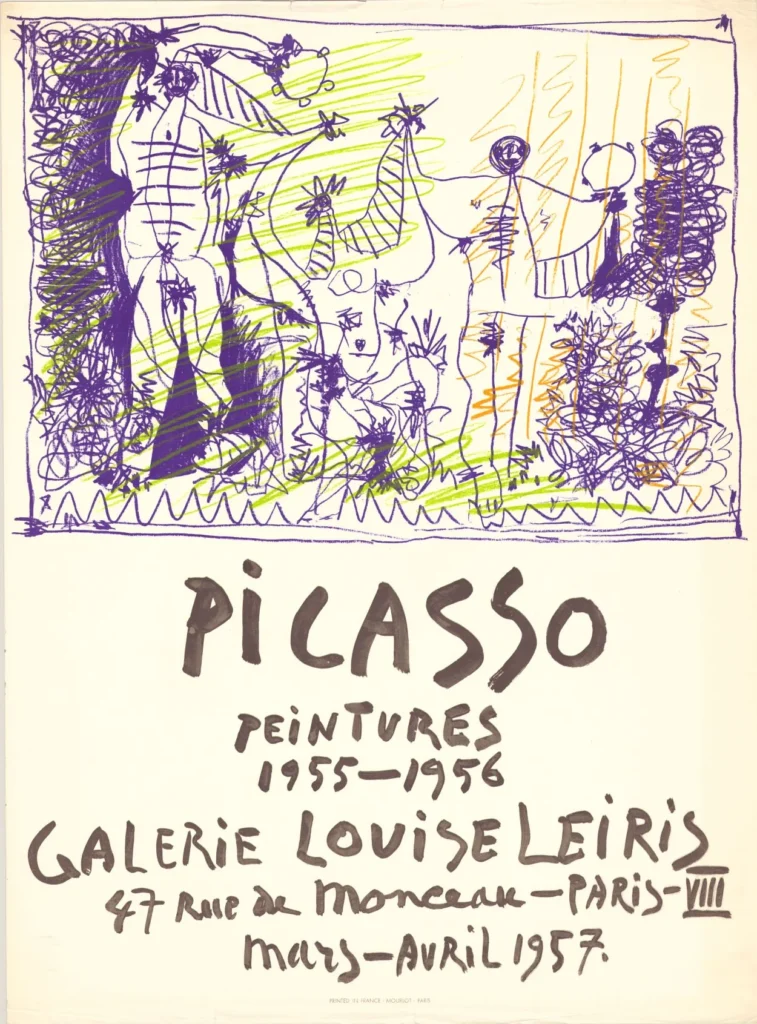
Picasso – Peintures 1955-1956
Pablo Picasso
Hommage Art
The Poster as High Art
Mourlot didn’t just print limited-edition fine art lithographs intended for collectors’ portfolios — it also produced exhibition posters, and here lies one of the atelier’s sneakiest, most underappreciated contributions to art history. Major artists personally designed the posters announcing their own gallery shows, drawing the lettering and imagery directly onto stone rather than handing the job to a commercial illustrator. Because of that, the “lowly” promotional poster became, almost by accident, a legitimate art form in its own right.
A Mourlot poster advertising a Chagall exhibition wasn’t ephemera meant to be torn down after the show closed; it was a genuine work by Chagall’s hand, conceived specifically for the lithographic surface and printed with the same care as his paintings. Matisse, in his final years, turned to poster and print design when his declining health made large-scale painting difficult, finding in Mourlot’s workshop a way to keep working at full creative intensity through a different physical means. This blurring of commercial and fine art anticipated ideas that Pop Art would later make explicit and famous. Decades before Andy Warhol made the poster-as-art concept fashionable in New York, Mourlot’s workshop had already normalized it in the galleries of Paris — quietly, without manifestos, simply by treating the poster as worthy of an artist’s full attention.
The Invisible Hands Behind the Masters
Here’s the part often left out of the glossy museum wall text: Mourlot’s lithographs weren’t solo performances, however much the signed edition might suggest otherwise. Master printers — craftsmen with decades of training in mixing inks, judging the grain and moisture of a stone, and coaxing exact colors from repeated pulls — worked alongside the artists as true collaborators, not mere technicians executing someone else’s instructions.
When Matisse wanted a specific saturated blue, or Chagall needed a wash of dreamlike color to bleed just right across a stone, it was the printer’s technical judgment, built from years at the press, that made the vision physically possible. Fernand Mourlot himself became close personal friends with many of these artists, dining with them, visiting their studios, and in doing so his workshop functioned less like a factory floor and more like a salon where painting, printmaking, craftsmanship, and friendship all blurred together into something genuinely collaborative. Art history, with its habit of fixating on the signature at the bottom corner of a print, tends to credit the single named genius; the truer story unfolding inside that workshop was one of a real partnership between hand and hand, between artistic vision and technical mastery, neither of which could have produced the final print alone.
Why Mourlot Still Matters
Today, original Mourlot lithographs and posters are treasured by collectors and museums alike, not as reproductions but as authentic multiples — original works of art that happen to exist in more than one copy, each pull as legitimate as the last. They also did something quietly radical for their era: by making great art available in editions, at prices well below what an original painting could command, Mourlot helped democratize access to modern masters at a moment when their paintings were becoming reachable only by the wealthiest collectors and institutions.
The atelier closed its doors in the 1980s, its role in the art world having shifted as the great generation of artists it had nurtured passed away one by one. But its legacy endures every time a Picasso poster hangs in a student’s dorm room, or a Chagall exhibition print sells at auction for a price that would have astonished Fernand Mourlot himself. It stands as proof that some of the twentieth century’s boldest artistic breakthroughs happened not in a painter’s private studio, sealed off from the world, but on a shared workshop floor — ink-stained hands, disputed color proofs, and all.
Explore Mourlot posters at Hommage Art