Rome, around 1524. Clement VII sits on the papal throne, Raphael has been dead four years, and the city is the most glamorous art market in Europe. The studios Raphael left behind are still humming, full of ambitious, brilliant, slightly unemployed artists.
One of the most gifted of them is Giulio Romano, Raphael’s favorite pupil and heir to his workshop. Giulio has talent to burn and, as it turns out, a taste for provocation. He produces a series of drawings showing couples in a variety of explicit sexual positions. In another century, they might have stayed in a private portfolio, shown to a few amused friends.
But this is the age of print, and someone has realized that a private joke can be turned into a product.
Il modi (1524 – 1527)
The Engraver Who Never Learned His Lesson
Enter Marcantonio Raimondi, the finest engraver in Italy. Marcantonio had built his career on reproducing other artists’ work, and he had already tangled with the law once. Years earlier he had copied Dürer’s prints so faithfully that he reproduced the German master’s monogram too, which prompted Dürer’s complaint to the Venetian authorities. Marcantonio kept copying, minus the monogram.
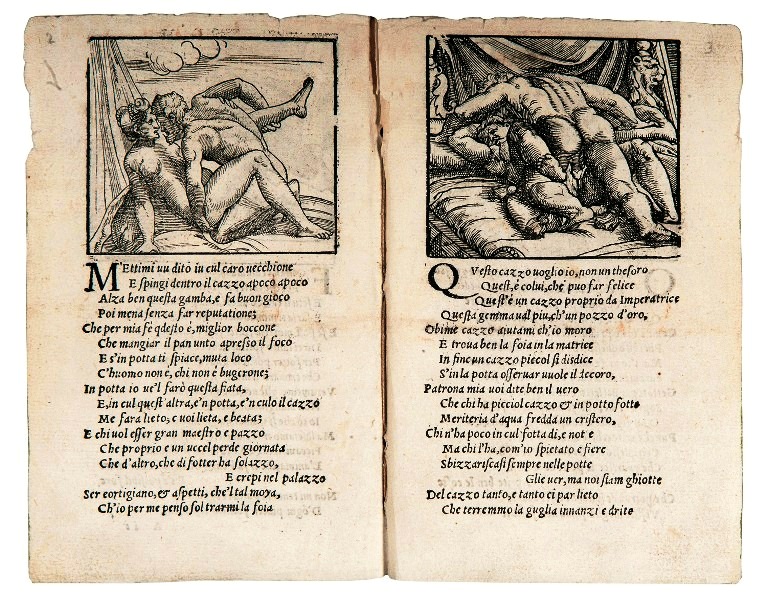
By the 1520s he had become something like the official printmaker of the Raphael circle, spreading the master’s compositions across Europe. He turned Giulio’s drawings into a set of engravings known as I Modi, “The Ways,” sometimes called “The Positions.”
Engraving was a perfect technology for the job. A copper plate could produce many impressions, each crisp and detailed. The sheets were small, portable, and easy to hide. A painting of this kind would have stayed in a patron’s private chamber. A print could be slipped into a coat, passed across a table, or tucked into a book.
I Modi spread through Rome.
The Crackdown
The papal authorities were not amused. The Church had tolerated a great deal of earthy humor in Renaissance Rome, but explicit images of this kind, produced commercially and circulated freely, crossed a line. Part of the problem was the content. The larger problem was reach.
According to Giorgio Vasari, whose Lives of the Artists is our main early source for the story, Marcantonio was arrested and thrown in prison. Officials hunted down the prints and destroyed as many as they could find. The plates and the impressions were targeted, and the campaign was so thorough that almost none of the original engravings survive. What remains are scraps: a few fragments of the first edition, plus later copies made by other artists once the dust had settled.
Giulio, meanwhile, had conveniently left town. He had accepted an invitation to work for the Gonzaga court in Mantua, where he would build the astonishing Palazzo Te. The man who drew the images escaped. The man who multiplied them paid the price. It is a pattern that would repeat for centuries: the printer takes the fall, because the printer is the one who made the idea travel.
Enter the Poet with Nothing to Lose
If Rome had a patron saint of scandal, it was Pietro Aretino, a sharp-tongued poet and satirist who made a career out of insulting the powerful and getting away with it, usually.
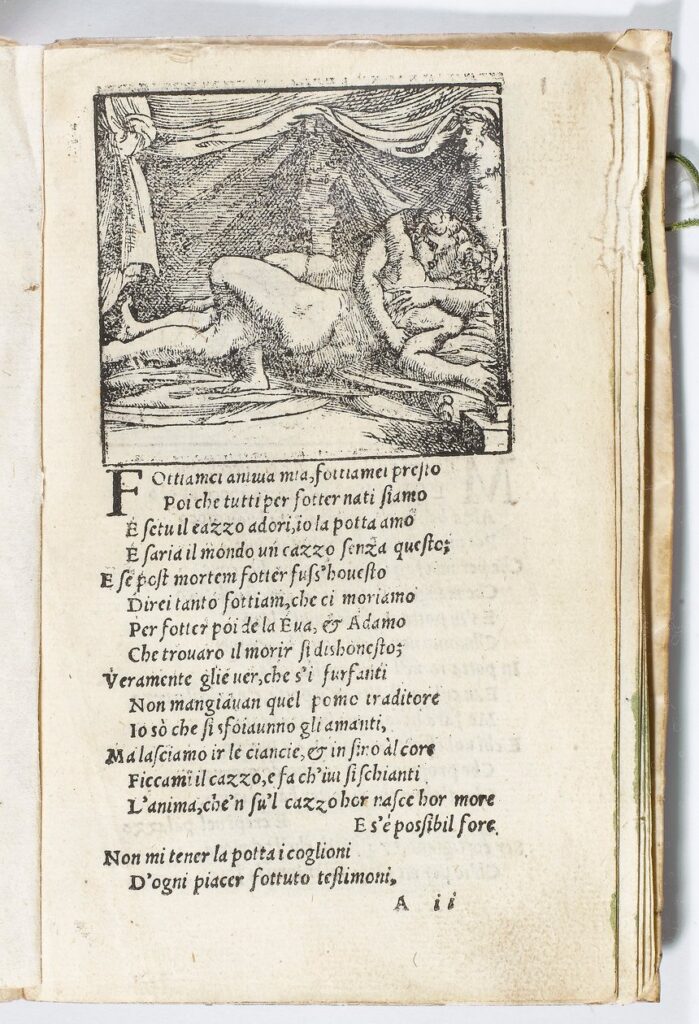
Aretino got hold of a set of the prints and, with characteristic audacity, wrote a sonnet to accompany each one. These became his notorious Sonetti lussuriosi (“Lust Sonnets”), written in the voice of the people in the images. They were bawdy, witty, and entirely unapologetic. Aretino later defended them by arguing that nothing about the human body was shameful, a position the Church found as annoying as it was influential.
Aretino also stood up for Marcantonio. Accounts of exactly who secured the engraver’s release differ. Vasari credits the intervention of powerful friends, including Cardinal Ippolito de’ Medici and the sculptor Baccio Bandinelli, while Aretino himself was happy to claim a share of the credit. Either way, Marcantonio got out. His luck did not hold, however: the catastrophic Sack of Rome in 1527 destroyed much of the artistic community he had worked in, and his career never recovered.
Il modi (1524 – 1527)
You Can’t Un-Print a Picture
Here is the twist the authorities didn’t see coming. The suppression helped make I Modi legendary. The original prints may have been destroyed, but the idea of them kept spreading. Copies were made, new versions appeared, and Aretino’s sonnets, which were far easier to reproduce and conceal than images, kept circulating. For centuries, collectors and scholars chased rumors and scraps of this lost masterpiece of notoriety.
The story reveals something essential about the new medium. Before print, authorities controlled images by controlling the objects. A painting is a single thing, and a single thing can be locked in a palace, covered with a curtain, or burned. A print is something else entirely: a rumor made physical. Destroy a hundred copies, and the hundred-and-first is already in someone’s pocket.
The Birth of Censorship as We Know It
Renaissance authorities understood quickly that this was a new kind of problem. Over the following decades, the Church and the state built machinery to match the technology: licensing requirements, official approval for printed works, and eventually the Catholic Church’s Index of Prohibited Books, first issued in the mid-16th century. Governments across Europe developed their own versions.
In a sense, the story of I Modi is a preview of every battle over free expression that followed. A new technology makes distribution cheap. Someone produces something the powerful consider dangerous. The authorities punish the person closest at hand, often the printer rather than the author. And the forbidden thing becomes more famous because it was forbidden.
Why It Matters Now
It would be easy to treat this as a quirky footnote, a naughty episode from the Renaissance. But look at it again. An artist makes provocative work, a skilled technician mass-produces it, a poet amplifies it, authorities panic, and the whole thing becomes impossible to contain.
Swap copper plates for smartphones and the plot barely changes. Every new medium repeats the same lesson that Marcantonio learned in a Roman jail cell. The moment an image can be copied, it no longer belongs to the people who want to control it.
Printmaking didn’t only spread ideas. It spread the knowledge that ideas could no longer be stopped.