There’s a moment every printmaker remembers: the first time they pulled a print off the press and saw not lines, but clouds. Soft washes of gray drifting into deep, velvety black, with none of the scratchy crosshatching that etching usually demands to suggest shadow. That moment belongs to the aquatint – one of the most quietly revolutionary techniques in the history of printmaking, and one every serious etcher eventually falls in love with.
What Aquatint Actually Is
At its core, aquatint is an etching technique for creating areas of tone rather than line. Where a standard etched line is made by scratching through a hard, acid-resistant ground so the acid bites a single continuous groove, aquatint works by a completely different logic: it creates texture rather than contour.
The printmaker dusts a copper or zinc plate with an extremely fine powder – traditionally powdered rosin, though asphaltum and even spray enamel are used today – and then gently heats the plate until the powder melts into thousands of tiny, discrete droplets fused to the metal. Each of those droplets acts as its own microscopic acid-resist. When the plate goes into the acid bath, the acid can only reach the metal in the infinitesimal gaps between the rosin grains. The result is a surface stippled with a fine tooth of bitten dots too small for the eye to resolve individually – which means that when ink is worked into those pits and wiped across the surface, the eye perceives not dots, but a continuous, even field of tone.
It’s a bit like the printmaking answer to the halftone screen used later in commercial reproduction, except the ‘screen’ here is organic, irregular, and entirely under the artist’s hand – grain size, bite time, and coverage can all be manipulated to produce anything from a whisper of gray to a bottomless, atmospheric black.
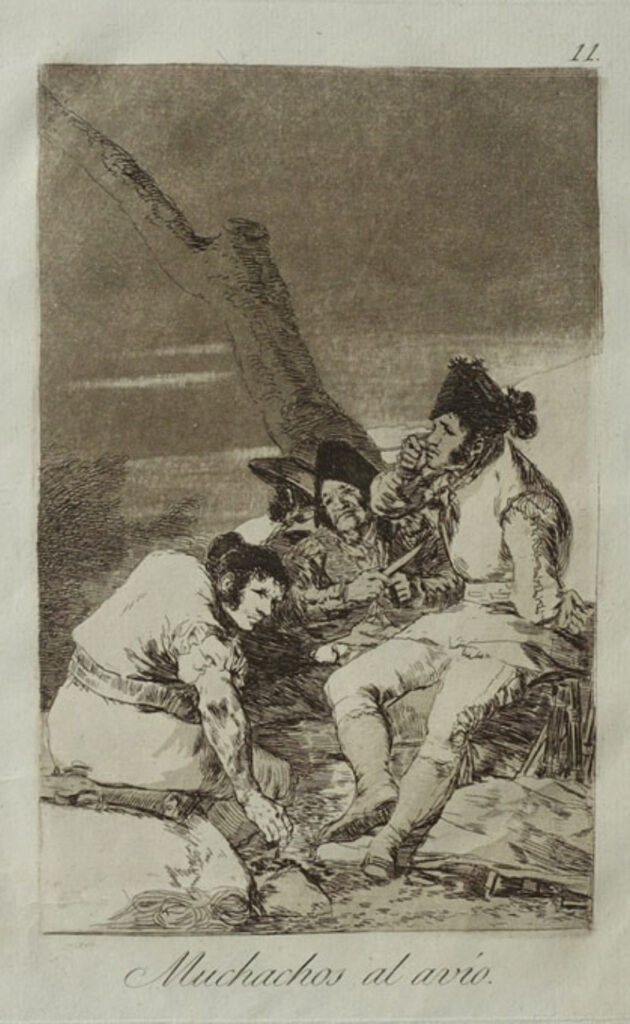
Muchachos al avio (1799)
Francisco Goya Jan Johnson Old Master Modern Prints
Where It Came From
The technique emerged in the mid-18th century, most credibly associated with the French printmaker Jean-Baptiste Le Prince, who is often cited as its inventor around the 1760s, though the underlying rosin-dust principle had been experimented with earlier by several hands across Europe. What Le Prince and his contemporaries were chasing was something watercolourists already had and etchers didn’t: the ability to render a wash. Etching, for all its expressive line-work, was fundamentally a technique of drawing – and drawing struggles to describe a cloudy sky, a shadowed interior, or the soft gradation of a body turning away from light.
The technique found its true genius, however, in the hands of Francisco Goya. His Los Caprichos (1799) and later Los Desastres de la Guerra used aquatint not as decoration but as psychological weather – plunging figures into ambiguous, suffocating darkness that line alone could never have achieved. Goya proved aquatint wasn’t a technical novelty; it was an emotional register.
What Aquatint Offers the Artist
Tone as a primary language. This is the headline gift of aquatint: it lets an artist think in values rather than only in outline. A landscape can have genuine atmosphere. A portrait can have real chiaroscuro. Where line etching describes edges, aquatint describes light – and light, of course, is where mood lives.
Control over the exact darkness of a passage. Because tone is built through controlled acid bites, an aquatint plate can be worked in stages. The printmaker stops the acid on lighter areas early by ‘stopping out’ – painting them with an acid-resistant varnish – and lets darker areas continue biting longer. This produces a genuine tonal scale on a single plate, from pale gray through to rich black, all achieved before a single line of ink is ever pulled.
A textural voice all its own. Depending on the coarseness of the rosin grain, aquatint can look like anything from a fine mezzotint-like velvet to a grainy, almost photographic granulation, to a loose, spontaneous ‘sugar-lift’ bloom (a related technique where a sugar-and-ink solution painted directly onto the plate lifts away under hot water to expose the metal beneath in the shape of a brushstroke – essentially painting in aquatint).
Pairing with line etching. Few artists use aquatint alone. Its real power shows when it’s combined with traditional line etching or drypoint on the same plate – the lines carry the drawing, the aquatint carries the mood, and the two together do something neither could alone. This is the combination you see across the great tradition, from Goya through to modern printmakers like Sean Scully or Jim Dine, who lean on aquatint’s atmospheric depth to give scale and gravity to otherwise linear compositions.
A democratising intimacy. Because it’s a printmaking technique, an aquatint image isn’t singular – it exists across an edition, letting an artist’s tonal vision reach many hands rather than one collector’s wall. But because every plate is individually inked, wiped, and pulled, no two impressions are ever quite identical. There’s a handmade variability inside the multiple, something closer to a live performance repeated many times than a mechanical copy.
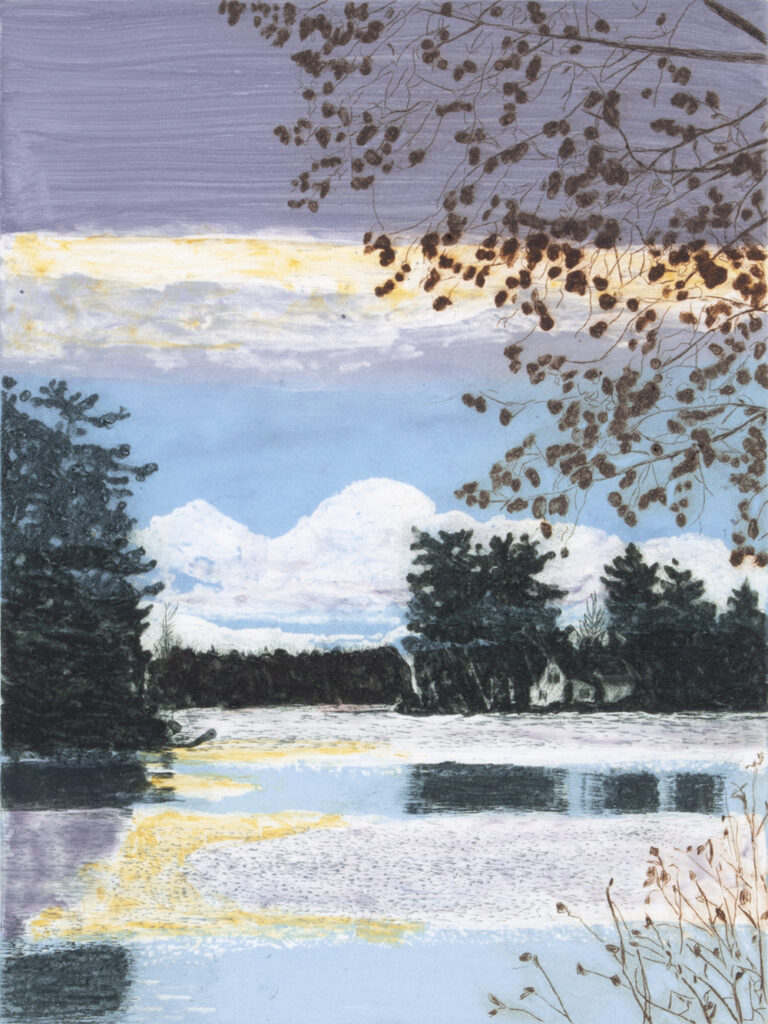
Bass Lake Camp (2025)
Sarah Klahn Oehme Graphics
The Craft Behind the Poetry
None of this happens by accident, and this is where the ‘master printer’ part of the story matters. Aquatint punishes impatience. Rosin dust that’s too coarse leaves the ground unevenly, causing ‘foul biting’ where acid eats through unprotected metal in ragged, uncontrollable patches. Heat the plate wrong and the resin melts into fused sheets instead of discrete grains, killing the tooth entirely. Leave the plate in the acid a beat too long and a delicate grey becomes an opaque black with no way back.
This is why aquatint has always been as much a discipline of patience and testing as one of vision. Printmakers pull test proofs, measure bite times in minutes rather than guesses, and build tonal charts for each plate before committing to a final pull. The unpredictability is part of the appeal – but taming that unpredictability, stage by stage, acid bath by acid bath, is the whole craft.
Why It Still Matters
In an age of infinite digital gradients, it would be easy to assume aquatint is a historical curiosity – a workaround for a problem software solved centuries later. But that misses what makes it valuable. Aquatint tone isn’t calculated; it’s grown, chemically, on a physical surface, with all the irregularity and organic breath that implies. Every artist who picks up a rosin box today is joining a conversation that runs from Le Prince’s first experiments through Goya’s shadows to the ateliers still teaching the technique now – a conversation about how to make metal, acid, and ink describe something as intangible as light falling through a room.
That’s the real offer aquatint makes to an artist: not just a technique, but a way of drawing with darkness itself.