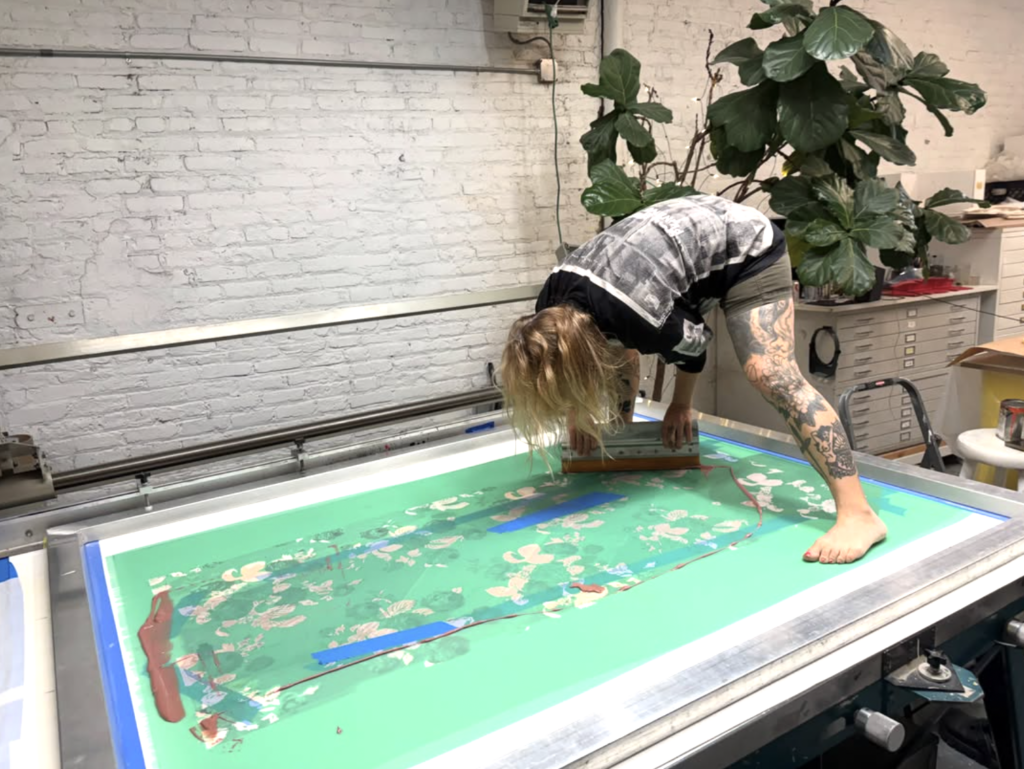
We tend to meet prints behind glass: a hushed Dürer engraving, Hokusai’s wave frozen mid-crash. What the glass hides is the body. Every print is the residue of a physical struggle, and shoulders, wrists, knees, lungs, and fingertips all took part in its making. Printmaking is a contact sport that happens to produce masterpieces.
The Tyranny of the Press
Start with the machine. An etching press is a mangle for art, a steel-and-iron beast that pushes a bed between two rollers under enormous pressure. Cranking the star wheel pulls on your shoulders, back, and core, and a printer pulling an edition of fifty does it hundreds of times. Rembrandt, who ran his own press and reworked plates through many states, knew this rhythm intimately: ink, wipe, lay the damp paper, crank, peel, repeat.
The pressure that forces paper into the incised lines of a plate will happily flatten a finger. Roller pinch injuries are a rite of passage in print studios, and every shop has a story about someone who learned it the hard way. Experienced printers develop a reflex, a kind of muscle memory for where their hands are at every moment, that beginners simply don’t have.
Kingsland Editions
Rocking, Rubbing, and Repeating: The Repetitive Strain Chronicles
Printmaking is repetition disguised as creativity.
The mezzotint rocker is the most punishing example. To create the velvety blacks of mezzotint, the printmaker rocks a toothed steel blade across the entire plate, in every direction, thousands upon thousands of times, until the surface is uniformly roughened. Only then does the artist begin burnishing the lights back out of the darkness. It is meditative and deeply hard on the wrists and shoulders. A large plate could demand days of rocking before a single image appeared.
The Japanese baren, the flat disc used to rub the back of the paper against an inked woodblock, demands sustained circular pressure from the whole arm. Traditional printers worked kneeling or sitting on the floor, which adds knees, hips, and lower back to the casualty list. Ukiyo-e was a collaborative industry in which the artist, the carver, and the printer were separate specialists. When we marvel at the luminous colour fields in a Hiroshige, we are looking at the endurance of printers and carvers whose names history mostly forgot. A single image might need a dozen or more blocks and impressions, each one a fresh round of rubbing.
The brayer (the ink roller) seems innocent, but rolling out ink again and again, in every colour and every pass, is a classic route to tendonitis and sore shoulders. Multiply that by a colour woodcut with a dozen layers and the arithmetic gets painful.
The Gouge Slips: Cuts, Punctures, and the Classic Mistake
Relief printmakers carve with sharp tools, and the number-one rookie error is holding the block with one hand while pushing a gouge toward it with the other. Linoleum is forgiving. Your palm is not.
Hand slips from gouges, scrapers, and burins are the most common acute injuries in the field. Engravers, from Dürer’s era onward, drove a burin through copper with the heel of the hand, so a slip meant a puncture wound to the palm. Engraving rewards a steady, controlled push, and it punishes a moment of distraction. Add craft knives, razor blades, and the sharp burr along the edge of a freshly cut metal plate, and a printmaker’s hands tell a story in small scars.
Wood engravers and woodcut artists face an extra problem: the hard grain. End-grain boxwood, prized for the fine lines of Victorian illustration, resists the tool, so the carver braces and pushes harder, and fatigue invites the slip.
The Stone Age Problem: Lithography’s Heavy Lifting
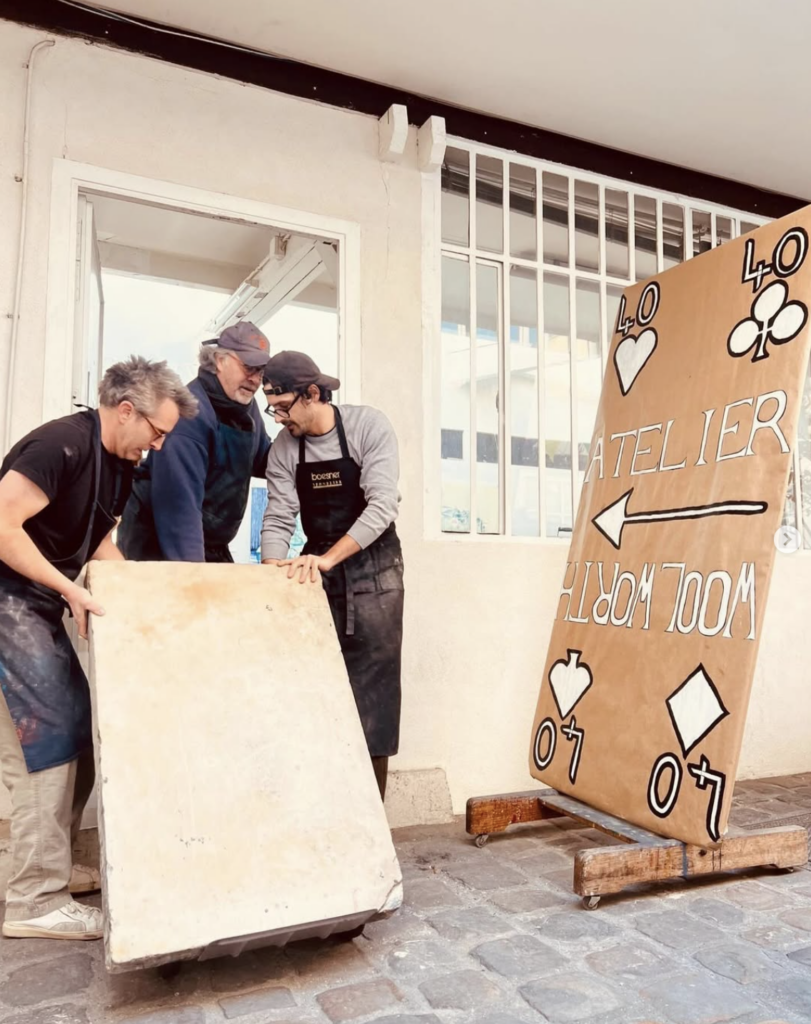
Lithography, born in Bavaria around 1796 with Alois Senefelder, relies on slabs of limestone that can weigh as much as a small person. Lifting, flipping, and grinding them down to be redrawn is one of the quickest ways to wreck a back. Printers have long used trolleys, hoists, and teamwork for exactly this reason, and a good litho shop is a quiet lesson in lifting technique.
Altelier Michael Woolworth
Graining a stone, working carborundum grit in circular sweeps across its surface, is another taxing marathon for the arms. Then come the pinch hazards when stone meets press bed, and the constant bending over a low, heavy bed to ink, dampen, and register. The romance of the Parisian lithographic workshop, with its smocked printers hauling stones for the likes of Toulouse-Lautrec, rests on a great deal of unglamorous muscle.
Breathing In the Past: Fumes, Dust, and Chemistry
Acid etching with nitric acid or ferric chloride can cause chemical burns and skin irritation, and acid fumes are hard on the lungs. Historically it got worse. The so-called Dutch mordant, a mix of hydrochloric acid and potassium chlorate, released chlorine gas as it bit the plate, which is exactly as unpleasant as it sounds. This is why traditional studios invested in ventilated etching rooms and why modern ones push safer mordants.
Aquatint, the technique behind the tonal haze of Goya’s prints, uses powdered rosin dusted onto a plate. Inhaled dust is an irritant, and fine dust clouds in enclosed spaces are a fire and explosion hazard. Heating the plate to fuse the grains adds burn risk to the list.
Solvents and inks used for cleanup can cause dermatitis and respiratory issues over time, and some historic pigments and driers contained heavy metals. Lead, for instance, was once common. The old image of the artist toiling away in a poorly ventilated garret was less romantic than it sounds.
Eyes on the Prize (and the Cost)
Engravers worked at distances of inches for hours. Before electric light, they famously used water-filled glass globes to concentrate lamplight on the plate, a trick shared with lacemakers and watchmakers. The eyestrain was real, and the cost to eyesight is a recurring theme in artists’ biographies. Honoré Daumier, who produced thousands of lithographs for the satirical press, suffered serious vision decline late in life, though the causes were likely multiple.
Fine line work also means a hunched posture. The neck cranes, the shoulders curl forward, and the breath gets shallow, so the eyes and the spine suffer together.
The Greatest Hits: A Field Guide to Printmaker Injuries
– Repetitive strain injuries: tendonitis, tennis/golfer’s elbow, and carpal tunnel from rocking, rubbing, rolling, and carving. – Shoulder and neck pain: from press cranking, brayering, and hunched work at the bench. – Lower back strain: from lifting stones, heavy plates, and bending over low presses. – Cuts and punctures: from gouges, burins, scrapers, and blades, especially hand-slips. – Crush and pinch injuries: fingers caught in press rollers or under stones. – Chemical burns and irritation: from acids and mordants. – Respiratory irritation: from fumes, rosin dust, and solvents. – Eye strain: from long hours of fine detailed work. – Knee and hip pain: from traditional floor-level barren work.
Making It Out Alive: What Modern Printmakers Do
The good news is that most of this is preventable. Keep your hands behind the cutting tool, and use a bench hook or non-slip mat. Take regular breaks to rest your wrists and shoulders, and vary your tasks so no single muscle group does all the work. Lift stones with help or equipment, never alone, and keep your fingers well clear of the roller line when the bed is moving.
Wear nitrile gloves, eye protection, and a proper respirator where fumes or dust are involved. Choose a well-ventilated space, and consider non-toxic alternatives such as saline-based or electrolytic etching, water-based inks, and oil-based cleanup with vegetable oil rather than harsh solvents. Good lighting and a bench at the right height do more for your eyes and spine than any amount of stoicism. If pain or numbness lingers, see a medical professional rather than pushing through. I’m an art historian here, not a doctor.
The Last Impression
The next time you stand before a print, imagine the person behind it: shoulders burning, hands cramping, a faint smell of acid in the air. Imagine the carver braced over a block of cherry wood, the printer kneeling at a baren, the lithographer hauling a stone across a workshop floor. A print is evidence of a body at work, repeated hundreds of times, with every pull of the press a small act of endurance. The beauty isn’t in spite of the labour. It’s made of it.