Mezzotint: The Printmaking Technique That Starts With Total Darkness
What If You Made a Print by Erasing Instead of Drawing?
Every other printmaking technique invented before the seventeenth century worked the same basic way: start with a blank, clean surface, and add marks — lines, dots, gouges — to build up an image. Etching, engraving, woodcut, they all begin at zero and add darkness where you want it.
Mezzotint flips that logic completely. You start with a metal plate roughened into total, uniform blackness, capable of holding so much ink that if printed as-is, it would produce nothing but a solid black rectangle. The entire image is then created by doing the opposite of drawing: scraping, burnishing, and smoothing that roughened surface back down, area by area, until it holds less and less ink. Light doesn’t get added to a mezzotint. It gets rescued from the dark.
It’s an almost backwards way to think about image-making — and it produced some of the richest, most luminous tonal prints ever pulled from a press.
The Tool That Made the Whole Technique Possible
None of this works without a strange, specialized instrument called a rocker: a curved metal blade with a row of fine teeth along its edge, mounted on a handle. The printmaker rocks this tool back and forth across the bare copper plate, over and over, in every direction, walking it methodically across the entire surface dozens or even hundreds of times until the plate is covered in a dense, even field of tiny pits and burrs.
This preparatory stage — called “grounding” or “rocking” the plate — is grueling, repetitive labor that can take many hours before a single image-making mark is scraped. Done correctly, though, it creates a surface so evenly and thoroughly roughened that it holds ink with total, velvety consistency across its entire area. That uniform darkness is the raw material every mezzotint image is carved out of, and getting it right was so important that many eighteenth-century printmaking workshops employed specialist “grounders” whose entire job was preparing plates for someone else to actually draw on.
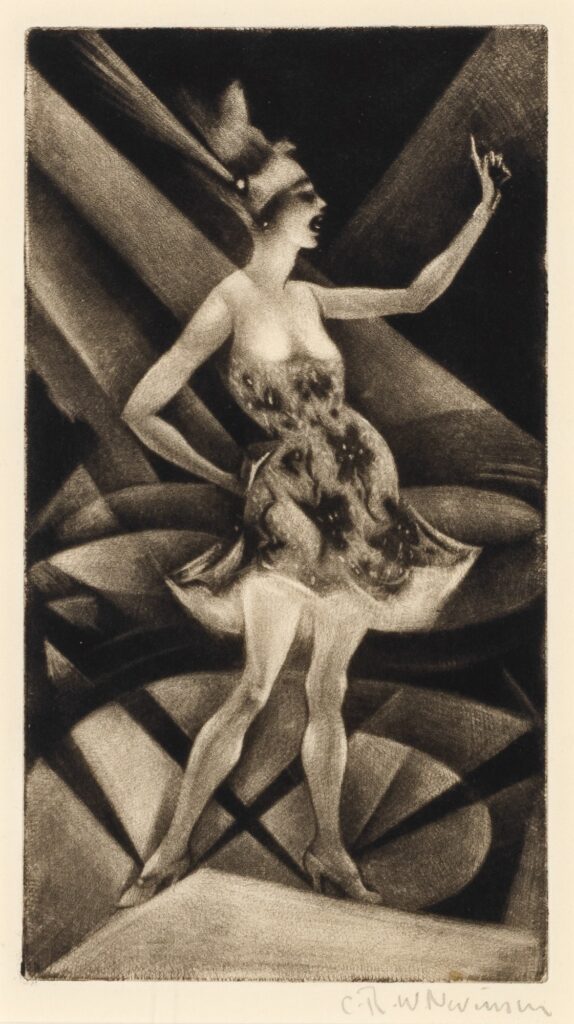
The Roof Garden (1917)
Christopher Nevinson
Harris Schrank Fine Prints
An Invention Born in a Prince’s Workshop
Mezzotint’s origin story has an unusually specific birthplace: it’s generally credited to a German amateur artist and soldier working in the mid-1600s, who is said to have developed the technique while in the service of a German prince, inspired by watching a soldier scrape rust from a musket barrel and noticing how the roughened metal held ink differently depending on how smooth or pitted it was. Whether or not every detail of that story is precisely accurate, the technique spread from small courtly circles into the wider printmaking world remarkably fast, in large part because it solved a problem no other method could touch.
The problem was reproducing paintings. Patrons and collectors wanted affordable, multiple copies of prized oil portraits and history paintings, and engraving — built from painstaking networks of fine lines — struggled to capture the soft transitions of light and shadow that made oil painting so prized in the first place. Mezzotint, with its ability to produce smooth, continuous gradations from deep black to pure white, could mimic the velvety modeling of a painted surface in a way line-based techniques simply couldn’t.
The English Obsession Nobody Saw Coming
Mezzotint found its true home not where it was invented, but across the English Channel. Eighteenth-century Britain developed something close to a national obsession with the technique, so much so that continental Europeans took to calling it la manière anglaise — the English manner — even though the process had been invented elsewhere entirely.
The timing was perfect. Britain’s portrait painters, most famously Sir Joshua Reynolds and Thomas Gainsborough, were producing enormously popular society portraits that patrons wanted reproduced and circulated. Mezzotint engravers built entire careers translating those paintings into prints, and the technique’s gift for rendering the soft fall of light across silk, skin, and shadow made it uniquely suited to capturing the atmosphere of Reynolds’s moody, painterly canvases. Print shops across London did brisk business selling mezzotint reproductions to a public that could never afford the original paintings but could afford a print of one.

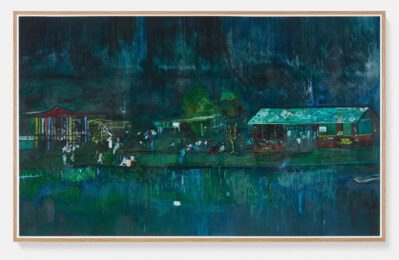
At the edge of the village (2014)
Robert Kipniss
ebo Gallery
The Actual Craft: Carving Light Out of Darkness, Inch by Inch
Once a plate was fully and evenly grounded, the real image-making began, and it worked nothing like drawing with a pencil or scratching with an etching needle. The mezzotint artist worked with two main tools: a scraper, a flat blade used to shave down the roughened texture and reduce how much ink an area could hold, and a burnisher, a smooth, rounded tool used to polish areas down further still, all the way to a mirror-bright, ink-free surface for the very brightest highlights.
The process moved almost always from dark to light — blocking in the broadest masses of shadow first, then working steadily toward the lightest passages with increasing pressure and precision. There was no way to “add back” texture once it had been scraped and burnished smooth; unlike a line that could be re-etched, every decision here was effectively permanent, so the whole image had to be planned before the scraper ever touched the plate.
That dark-to-light workflow gives mezzotints their distinctive look: tonal transitions that feel genuinely continuous, closer to a photograph than to any line-based print. Eighteenth-century viewers, seeing mezzotints for the first time, often described them less as prints and more as paintings — exactly the effect the technique had been built to achieve.
The Night Sky’s Favorite Printmaking Technique
Mezzotint’s gift for deep, saturated black made it the natural choice for one striking niche: images of the night. Candlelit interiors, moonlit landscapes, and shadow-drenched portraits all found their ideal partner in a technique built from darkness rather than added to it.
That affinity found its most literal expression in the work of eighteenth-century artist-astronomer John Russell, who spent decades observing the moon through a telescope and turned to mezzotint specifically because no other technique could convincingly render a cratered lunar surface emerging from the total blackness of space. His large-scale lunar prints stand as a kind of proof of concept for the whole medium: give mezzotint total darkness to work with, and it can carve out something that feels less like an illustration of light than like light itself.
The Technique’s Fatal Flaw — and Why That Made It More Valuable
Here’s the twist that makes mezzotint’s story genuinely poignant: the very quality that gives it such rich, velvety blacks is also what destroys it fastest. Those thousands of tiny pits and burrs raised by the rocker are delicate. Every trip through the press, under enormous pressure, flattens them a little more. A mezzotint plate that produces a handful of glorious, deep-black impressions at the start of a print run will, within perhaps thirty or forty pulls, start losing its darkest tones as the burr wears down — the blacks turning grey, the rich atmosphere thinning out.
This meant mezzotint editions were, by the standards of other printmaking techniques, tiny and fast to exhaust. Printmakers and print sellers responded by treating the earliest, richest impressions as especially prized objects — what collectors today call “early states,” pulled before the burr began to degrade. A weathered, later-state mezzotint and a fresh, early one can look like two entirely different prints, even though they came from the exact same plate. Some publishers later turned to steel-facing plates with a thin electroplated layer to slow the wear, but the technique’s essential fragility never fully went away — and, in a strange way, that fragility became part of its romance.
The Artists Who Pushed Mezzotint Past Reproduction
While mezzotint spent much of its early life as a reproductive technique — a tool for translating someone else’s painting rather than making original art — a handful of artists recognized its expressive potential in its own right. William Blake experimented with related tonal processes in pursuit of the same moody, atmospheric effects. In the nineteenth century, artists working in the American and European traditions returned to mezzotint as a technique capable of extraordinary emotional depth, drawn to its unmatched ability to render darkness not as an absence but as a rich, textured presence.
The technique found a genuine revival in the twentieth century among printmakers who valued exactly what had once made it commercially awkward: its slowness, its unforgiving physical labor, and its unmatched tonal range. Contemporary mezzotint artists still spend the better part of a day just rocking a single plate before they’ve made a single deliberate mark, treating that grueling preparatory labor not as a chore to rush through but as part of the meditative discipline the technique demands.
Why a 350-Year-Old “Reproduction Trick” Still Matters
Mezzotint never became the most efficient printmaking technique, and it was never meant to be. What it offers instead is something no faster method can replicate: a tonal depth built from actual physical texture rather than the optical illusion of hatched or stippled lines, and a working process that forces the artist to think in terms of light being uncovered rather than darkness being applied.
That inversion — subtracting instead of adding, revealing instead of building — is what makes mezzotint feel so different from every other print in a portfolio, and why printmakers willing to put in the hours of rocking a plate keep returning to a process invented for a problem — reproducing paintings cheaply — that digital photography solved centuries ago. The problem mezzotint was built to solve doesn’t exist anymore. The atmosphere it creates still does.